Why new Arctic climate change findings are so significant

Add Axios as your preferred source to
see more of our stories on Google.
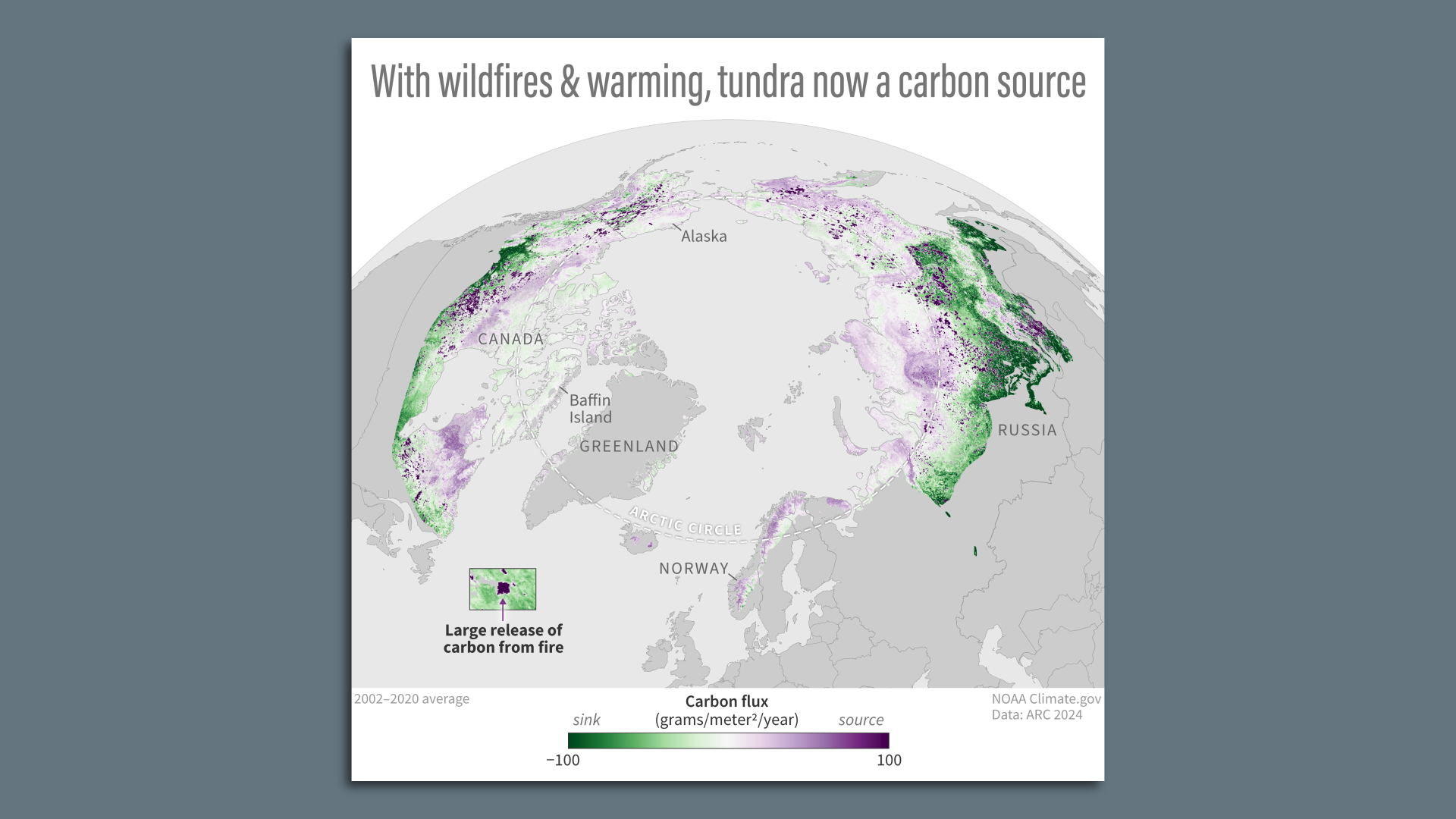
Map of the Arctic showing areas that are emitting more carbon than they are absorbing. Image: NOAA 2024 Arctic Report Card
The news that the frigid Arctic tundra ringing the polar region has switched from being a net absorber, or "sink," of planet-warming greenhouse gases to a net emitter, or "source," indicates the Arctic is on the brink of further, sweeping changes.
Why it matters: This conclusion, contained in an authoritative federal report, indicates far-reaching consequences lie ahead for the world. And it suggests more Arctic climate dominoes are still to fall.
- Any added emissions of greenhouse gases, which in this case are mainly carbon dioxide and methane, only serve to accelerate the rate and increase the magnitude of global warming, scientists warn.
The big picture: The Arctic's carbon balance is of intense interest to researchers. The permafrost in its soil has trapped carbon dioxide and methane for thousands of years.
- Now, as the Arctic climate warms at rates up to four times faster than the planet's average, snow is disappearing sooner in the spring, permafrost is melting, and massive wildfires are burning in areas that had previously not routinely supported them.
- Each of these developments — and more — are allowing the tundra to transition into a net source of greenhouse gases, which scientists discovered from looking at 2024's data as well as two decades of observations.
- The carbon balance shift is driven by a combination of permafrost melting, which is allowing microbes in the soils to free up long-trapped carbon and methane, as well as increasingly common and severe Arctic wildfires.
Circumpolar wildfire emissions have averaged 207 million tons of carbon per year since 2003, with 2024 coming in as the second-highest year during this period.
The intrigue: These are signs of a region undergoing rapid and transformative climate shifts, report authors said at a scientific meeting Tuesday in Washington and in separate interviews with Axios.
- "The Arctic exists now within a new regime," said Brendan Rogers, a scientist with the Woodwell Climate Research Center who served as a co-author on the report's section detailing the movement of carbon between the land, sea and air.
- Twila Moon, a scientist at the National Snow and Ice Data Center and lead author of the overall report, told Axios: "The Arctic today looks vastly different than it did even just in recent past decades, and that rapid change is going to continue into the future."
Yes, but: Moon said the Arctic hasn't slipped into a new normal, stable state — its climate is now far more unstable and extreme, with new records expected to be broken each year.
By the numbers: The past nine years were the warmest nine on record in the Arctic, the report found.
- Each of the 18 lowest minimum sea ice extent readings have occurred during the past 18 years.
- This year had the second-highest wildfire emissions north of the Arctic Circle, coming in second behind 2023.
- The population of migratory tundra caribou populations has declined by a staggering 65% during the last two to three decades, the report found. These animals are an important food source for Arctic communities.
Between the lines: While a milestone, the tundra carbon emissions finding doesn't mean the planet has crossed a so-called "tipping point" that would indicate rapid and irreversible change, Rogers cautioned.
- Long-standing worries about a permafrost "methane bomb" — a rapid, huge burp of planet-warming methane as permafrost thaws — have not borne out, and this report doesn't validate them.
- "It's not a doomsday scenario," Rogers said.
What's next: The tundra carbon finding is a signal of other fundamental shifts yet to come across the Arctic.
- For example, Rogers noted that the boreal forests combined with tundra ecosystems aren't clearly net emitters of more greenhouse gases than they take in, but this transition may be coming.
- However, the boreal biome, which consists of coniferous forests such as pine and spruce trees and lies to the south of the tundra, is a net source of planet-warming methane, the report found.
- Sea ice cover also continues its long decline. The first ice-free summer in the Arctic Ocean likely will occur within the next few decades, if not sooner, according to most studies.
While rapid and far-reaching changes have significant ramifications for the people living in the Arctic, they're having increasing geopolitical implications for NATO, Russia and China.
- Russia is building up its military capabilities in the region as the U.S., Canada and other NATO countries try to keep up. China has also moved to increase its Arctic presence.
- Arctic shipping is already increasing sharply along Russia's Northern Sea Route and across the Arctic.
- This past summer brought the lowest sea ice extent in the famed Northwest Passage of any summer in the satellite era, the report found.
The bottom line: Global warming has transformed the Arctic into a region prone to more weather and climate extremes and unwelcome surprises.
