Canada wildfires dominated 2023's global forest losses

Add Axios as your preferred source to
see more of our stories on Google.
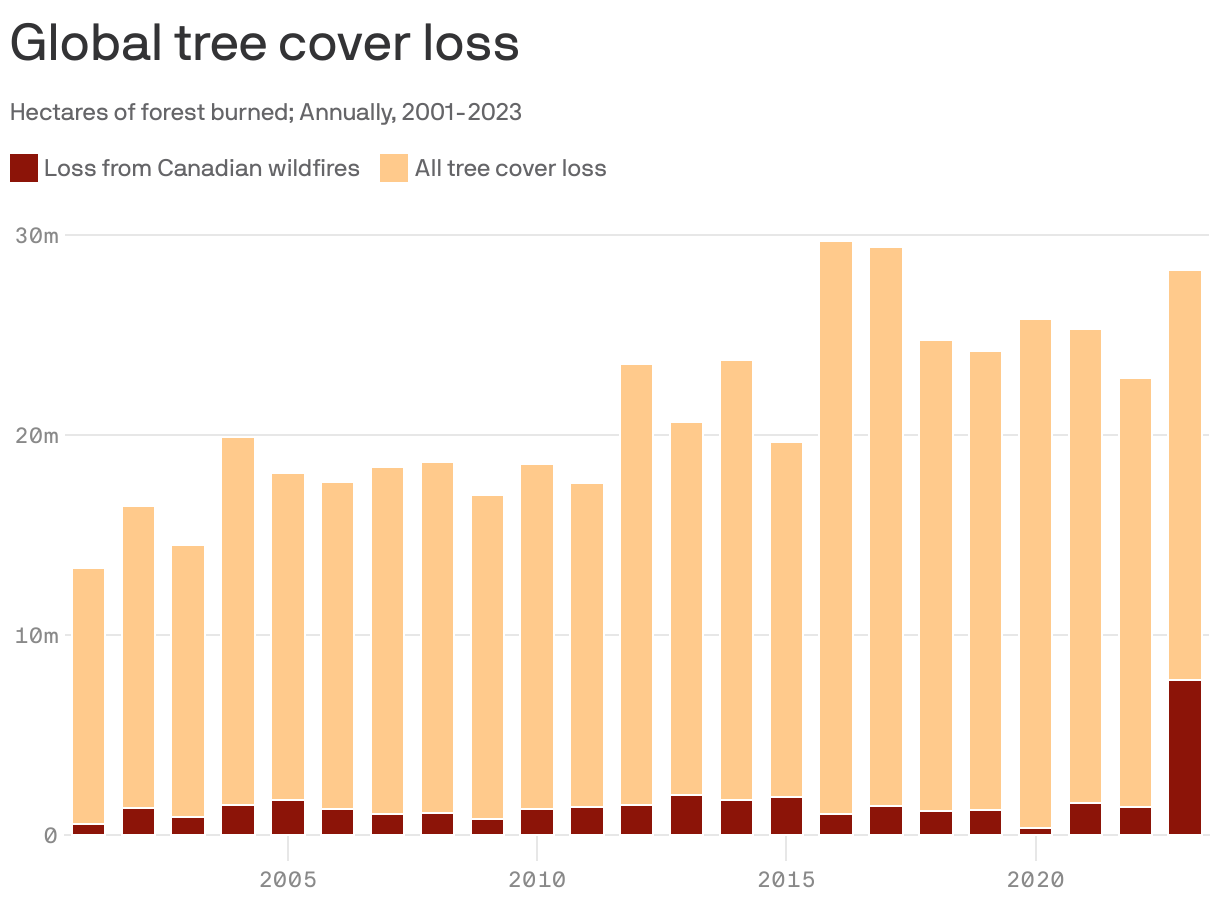
Amid a surge in wildfires in the planet's northern reaches, Canada accounted for nearly one-third of all the forest lost to wildfire last year, a new report finds.
Why it matters: While last year's wildfire season in Canada was an outlier, with some fires smoldering through the winter, it illustrated a trend toward more active seasons in the boreal forests that ring the Arctic.
Zoom in: The new report, from the World Resources Institute's Global Forest Watch and University of Maryland, shows that wildfires burned more than six times the Canadian annual average since 2001.
- The amount of tree cover loss produced about 3 billion tons of carbon dioxide emissions, which weren't counted in the country's reported annual emissions totals.
- This is equivalent to the emissions from driving about 714 million gasoline-powered cars for a single year.
- Or to put it another way, the emissions are equivalent to nearly four times the carbon emissions from the global aviation sector in 2022, the report found, and 25% more than emissions from all tropical primary forest loss combined last year.
The big picture: A separate study published Monday found growing wildfire activity and greenhouse gas emissions in the boreal forests, along with a pronounced spike in the globe's most extreme fires during the past two decades.
- Referring to that study and others, NASA researcher Jessica McCarty told Axios that scientists are working to understand how more intense wildfires will affect boreal ecosystems.
- "Folks on the ground in the North know this happening — the science is supporting those observations," she said in an email.
James MacCarthy, a research analyst at Global Forest Watch, said it will take decades for ecosystems to absorb the CO2 emitted by last year's Canadian wildfires.
- He and report coauthor Alexandra Tyukavina of the University of Maryland told Axios the most important response to the wildfires should be to cut emissions of greenhouse gases.
- Those gases are indirectly driving the spike in severe boreal wildfires via rapidly increasing average temperatures and drier conditions.
Yes, but: Canada reports human-caused emissions to the U.N. for the purposes of tracking its progress as part of global carbon negotiations.
- However, it excludes wildfire-related emissions in its managed forests from its reported emissions.
- This is despite the fact that many of the fires in these areas are ignited by human activities, such as campfires or arson, and worsened by global warming.
- That leaves a blank line in Canada's carbon emissions ledger. "It doesn't match what we see in the atmosphere," MacCarthy told Axios.
