Sustaining Israel-Hezbollah ceasefire poses huge challenge for Biden and Trump

Add Axios as your preferred source to
see more of our stories on Google.
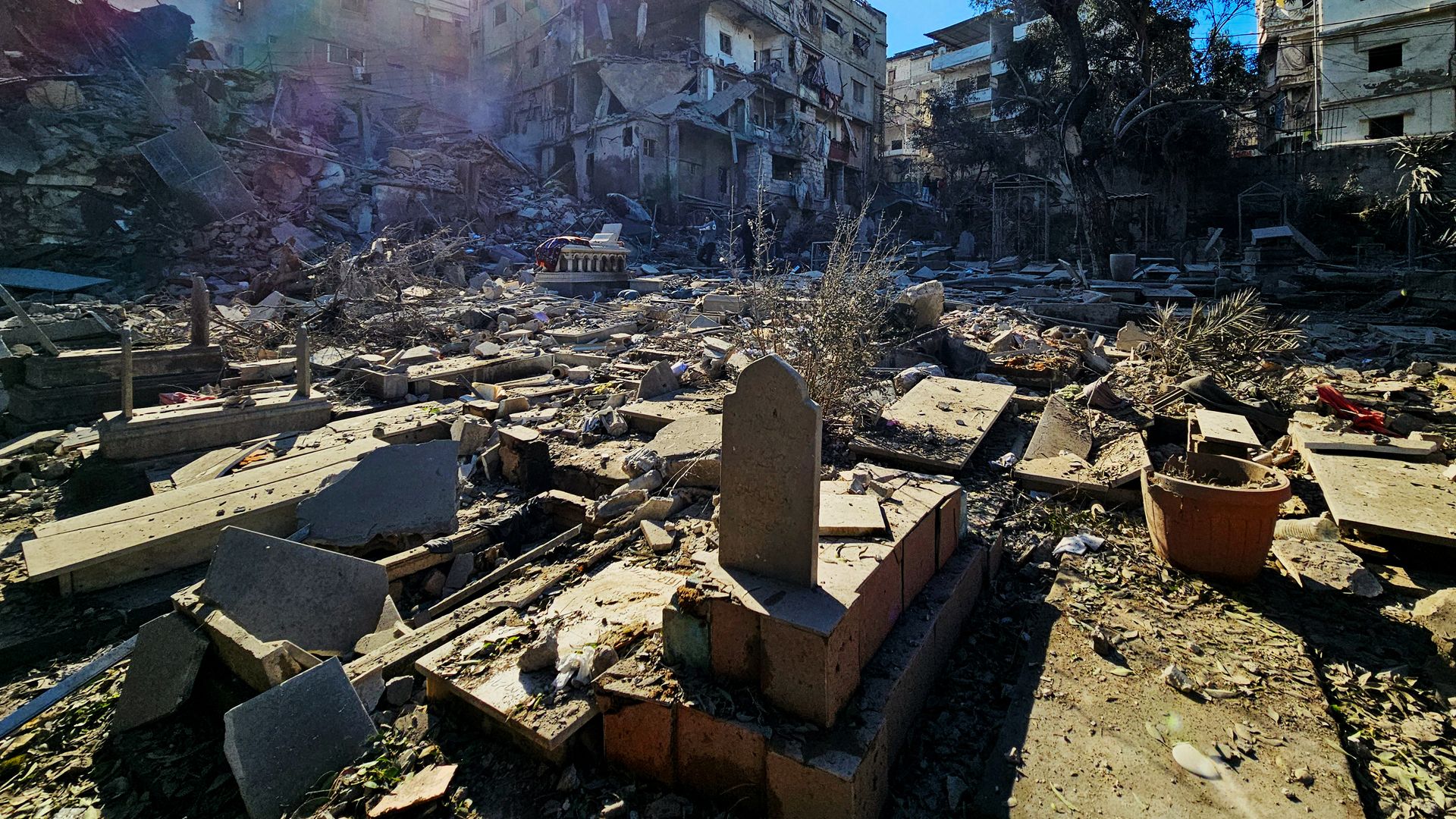
A damaged cemetery following an Israeli airstrike in Beirut. Photo: AFP via Getty
Reaching a ceasefire between Israel and Hezbollah was a hard-won diplomatic achievement, but preventing it from collapsing could ultimately be more difficult.
Why it matters: The U.S. will now be tasked with maintaining calm along one of the most volatile borders in the Middle East, between Israel and Lebanon, during a presidential transition and amid a broader regional crisis that is far from over.
- The deal required months of complex negotiations, which President-elect Trump and his team — who will inherit the agreement — were looped into in the final days.
- If successful, the deal will end a year of bloodshed and allow hundreds of thousands of people on both sides of the border to return home.
- But the deal gives the U.S. the onerous tasks of monitoring violations and, potentially, holding back Israeli Prime Minister Benjamin Netanyahu — who vowed even before finalizing the deal to abandon it if Hezbollah crosses one of several red lines.
Flashback: A day after the U.S.-French ceasefire initiative was announced in September, Israel took the White House and the world by surprise by assassinating Hezbollah leader Hassan Nasrallah.
- While President Biden and his senior advisers were not shedding any tears over Nasrallah's death, Netanyahu's decision to keep Biden in the dark created tensions, U.S. officials told Axios.
- By mid-October, though, Biden's senior adviser Amos Hochstein began working with both Israel and Lebanon to draft the parameters of a ceasefire deal.
Behind the scenes: On Oct. 31, a few days before the U.S. elections, Hochstein travelled to Israel and met Netanyahu.
- "I think there is a window," Netanyahu told him, according to a U.S. official who attended the meeting.
- "We saw at the time a change of attitude and an alignment in both Israel and Lebanon about getting a ceasefire," the U.S. official said.
Five days after the elections, Netanyahu confidant Ron Dermer met Trump in Mar-a-Lago. While they were walking together on Trump's golf course, Dermer told Trump about the Lebanon negotiations, two sources familiar with the conversation said.
- Trump offered no objections, and even signaled support for Netanyahu working with Biden to get a deal before Jan. 20.
- Dermer discussed the Lebanon deal over the following two days with Hochsten, national security adviser Jake Sullivan and Biden's top Middle East adviser, Brett McGurk.
- At that point, Hochstein saw "light at the end of the tunnel" and decided to brief Trump's national security team that a deal was likely within days, a U.S. official said.
Zoom in: One of the the last big sticking points was whether Israel would have the right to respond to violations by Hezbollah.
- France advised Lebanese leaders not to accept that provision because it would be a violation of Lebanon's sovereignty, according to a U.S. official. "It had the potential to scuttle the entire deal," the official told Axios.
- Secretary of State Tony Blinken pulled French President Emmanuel Macron aside at the G20 in Rio de Janeiro on Nov. 19 and told him the French position was jeopardizing the deal, the official said.
- The U.S. official said that in this short encounter, Macron agreed France would stop delivering that message to Lebanon. A French official denied that.
As of last Thursday, the deal was nearly complete. But while Hochstein was meeting Netanyahu, the International Criminal Court issued an arrest warrant against him.
- Netanyahu was livid — particularly after France said it would enforce the arrest warrant — and became completely distracted from the Lebanon ceasefire negotiations.
- It took another three days, mediation by Biden between Netanyahu and Macron, and a threat from Hochstein to walk away before negotiations got back on track.
- A deal was reached on Sunday night. The Israeli cabinet approved it 36 hours later.
Between the lines: On Monday, Hochstein gave a second briefing to the Trump team and told them about the commitments the U.S. made as part of the deal — mainly overseeing the monitoring mechanism and navigating Israel's ability to respond to violations.
- "The Trump team agreed this is good for Israel and Lebanon and for the national security of the U.S. and that doing it now and not later will save lives," a U.S. official said.
- A Trump Transition official claimed Hezbollah agreed to the deal after Trump won because it knew the terms of a deal would only get tougher under Trump.
What to watch: U.S. officials say the next step is for the Lebanese military to move into southern Lebanon, a region in which it has historically been outgunned by Hezbollah, and ensure that the militia is moving north and any remaining heavy weaponry is removed.
- The Lebanese military failed to carry out a similar agreement after the 2006 war between Israel and Hezbollah.
- A U.S. official contended that this time around, the Lebanese army is in a stronger position, Hezbollah has been weakened militarily and politically, and the U.S. will be more actively involved.
While there will be no U.S. troops on the ground in southern Lebanon, U.S. military officers will work out of the embassy in Beirut in coordination with French, Israeli, Lebanese and UN officials. They will receive complaints and address violations.
- The deal does give Israel license to respond to direct security threats from Lebanese territory, but U.S. officials hope the monitoring system will mitigate the need to do so.
- "We want to have live messaging to make sure that whenever there is a serious violation it is addressed immediately. If it's not addressed and develops into a direct threat, Israel would have to address it. If we don't take the eyes off the ball that won't be necessary," a U.S. official said.
What's next: In eight weeks, this fragile ceasefire will be Trump's to manage.
