Majority of Hearst profits now B2B, CEO says

Add Axios as your preferred source to
see more of our stories on Google.

Illustration: Eniola Odetunde/Axios
Hearst projects it will earn $12.8 billion in top-line revenue this year, up from $11.95 billion in 2023, CEO Steve Swartz told Axios in an interview.
Why it matters: For the first time in the company's 137-year-history, more than 50% of Hearst's profits will come from professional products, not consumer-facing newspapers, magazines and TV stations.
- That's up from 13% in 2013.
Swartz credits the company's B2B (business-to-business) investments for helping the company grow amid a volatile consumer advertising and subscription landscape.
- "I do believe we are a stronger publisher of newspapers and magazines — two very difficult businesses — because we have other sources of growth," Swartz said.
- "We can be more patient than perhaps some others."
Zoom in: Hearst has homed in on three focus areas for its B2B investments: financial services, health care and transportation. Many of those investments stemmed from Hearst's early forays into trade publishing.
- While the company is open to adding another B2B vertical eventually, Swartz believes doubling down on its existing businesses is more pragmatic.
- "I would say we have a better chance of growing and making bolt-ons and finding big new acquisitions in those three areas than in adding something totally new," Swartz said, noting that those three categories "represent a big swath of the global economy."
Catch up quick: Hearst invested in Fitch Group, an overseas bond rating business, in 2006 and acquired the entire company by 2018. The 5,000-person business is Hearst's single biggest contributor to profits, Swartz said.
- Hearst's transportation business grew from the company's 1903 launch of Motor Magazine. The unit now includes data and software services for aviation, trucking and automotive businesses.
- Hearst acquired its first health care services company, Databank (FDB), in 1980 for $80,000. Today, FDB is one of six B2B health care companies in Hearst's portfolio.
State of play: Investments in trade publications and professional data and services have helped Hearst offset a challenging environment for consumer media, particularly within its magazine portfolio.
- Last week, the company announced layoffs within its magazine publishing group, which houses more than two dozen brands, including Cosmopolitan, Esquire, Good Housekeeping and Harper's Bazaar.
- The general-interest magazine market is tougher than the local newspaper market right now "because you cannot rely on high subscription prices," Swartz said.
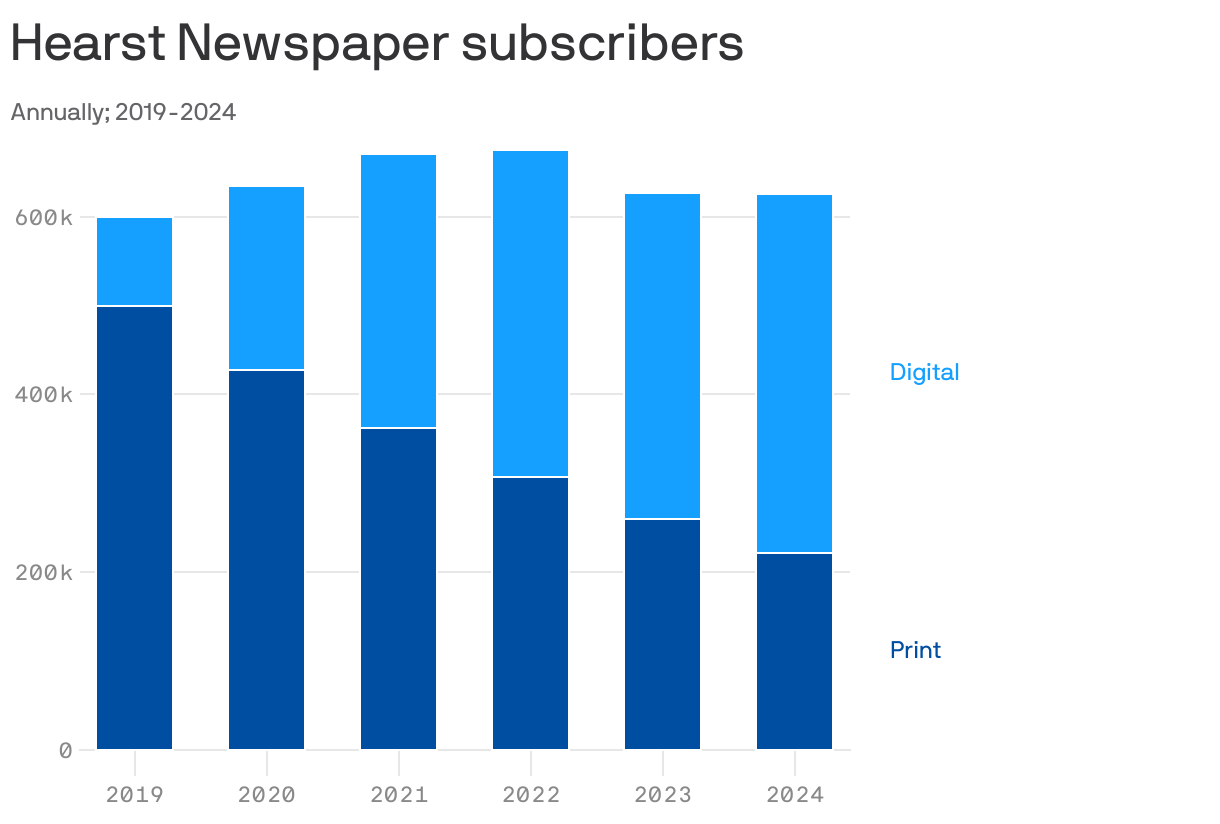
- Hearst's newspaper business, driven by major papers like the Houston Chronicle and San Francisco Chronicle, has been able to nearly offset print declines through digital subscription growth.
- The company recently struck a multiyear deal with OpenAI to integrate content from more than 40 of its local newspapers and more than 20 of its magazine brands into OpenAI's products, such as ChatGPT.
Yes, but: While print continues to face challenges, Hearst's local television business continues to be very profitable.
- Swartz noted the firm's local broadcast business "had a very strong year," in part due to an uptick in political advertising around the election.
- Hearst also owns 20% of ESPN and 50% of A&E, both through joint ventures with Disney.
The big picture: Hearst has relied on a strong balance sheet, originally stemming from consumer media, to buy its way into the B2B world.
- It has spent a whopping $14 billion on mostly B2B acquisitions over the past decade, including $3 billion in the last two years.
- In August, it acquired QGenda, an Atlanta-based health care workforce management company for over $2 billion. It March, it purchased Avinode, an air charter sales and sourcing platform, for $200 million in cash. It also bought a puzzle games platform called Puzzmo to support its newspaper portfolio last year.
What to watch: The 22,000 company is owned by a family trust. Only five of the 13 seats on Hearst's board of trustees are reserved for descendants of the Hearst family. The rest are made up of current and former Hearst executives.
- The trust doesn't expire until the last of William Randolph Hearst's grandchildren who were alive at the time of his death have died.
