Iowa officials can challenge voter registrations, federal judge rules

Add Axios as your preferred source to
see more of our stories on Google.
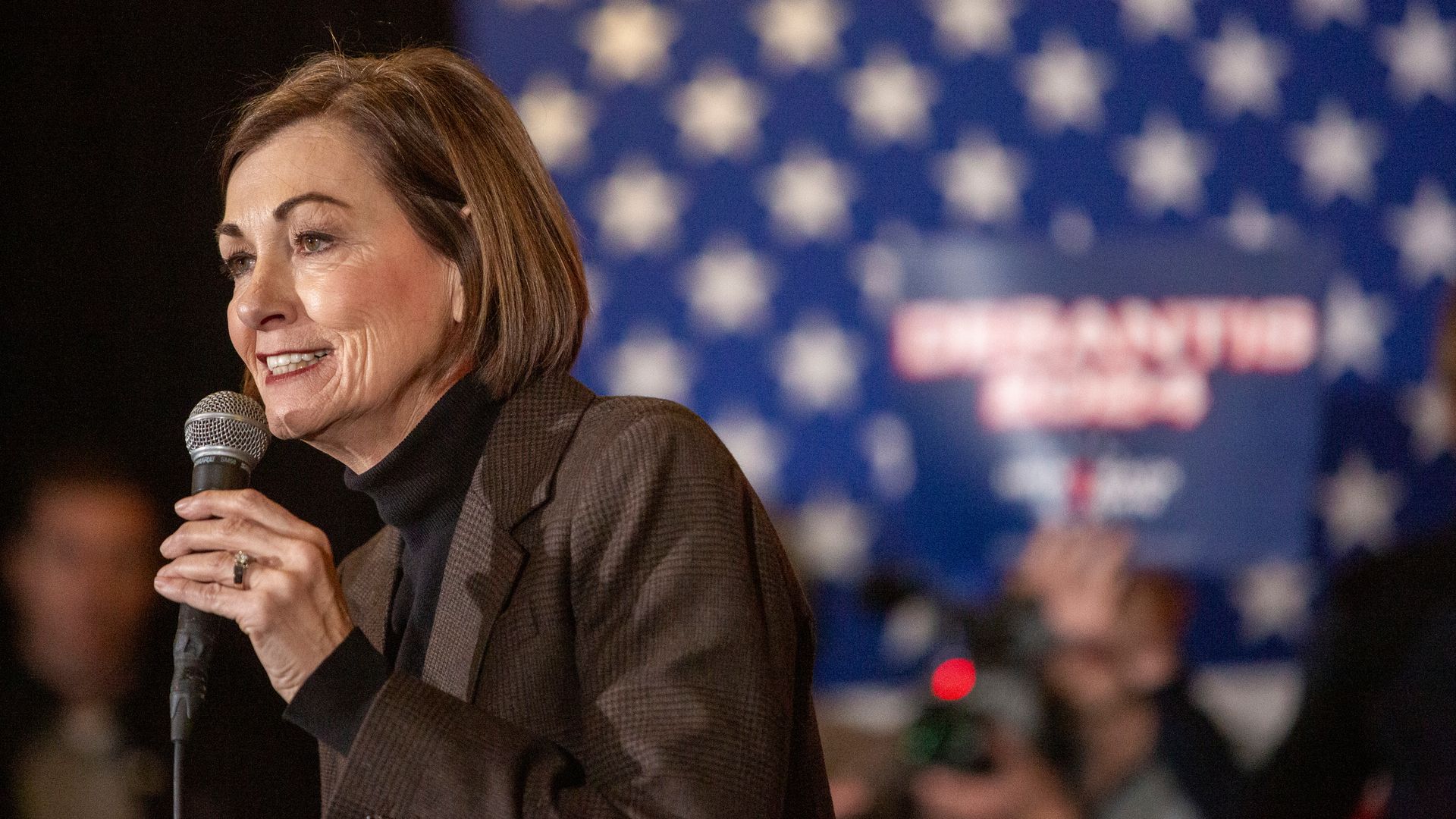
Iowa Gov. Kim Reynolds. Photo: Rachel Mummey/Bloomberg via Getty Images
Iowa officials can challenge the ballots of 2,176 registered voters they believe may not be U.S. citizens, a federal judge ruled days before Election Day on Sunday.
Why it matters: Iowa Secretary of State Paul Pate said he's working to ensure the election's integrity, but the ACLU joined a group of naturalized citizens in suing the Republican official because they said his decision wrongly kept "numerous naturalized U.S. citizens" from voting with a regular ballot.
Driving the news: ACLU argued that the 12-year-old Iowa Department of Transportation list that Pate instructed county auditors to follow on Oct. 22 after early voting had started in the state was based on outdated information, which it said could burden naturalized citizens and deter people from voting.
- However, U.S. District Judge Stephen Locher noted in his decision Sunday that the Supreme Court had allowed Virginia to continue its automatic purging of voters while state officials appeal a lower court's decision temporarily blocking the program.
- The Biden-appointed judge said the Supreme Court's guidance for courts is to "act with great caution before awarding last-minute injunctive relief into how Iowa officials handle election issues."
Zoom out: Republicans including former President Trump have claimed significant numbers of immigrants who aren't citizens are voting in U.S. elections, but Axios' Stef Kight notes there's no evidence such voting has ever happened on any significant scale.
Zoom in: "This portion appears to be relatively small — no more than 12% — but, still, the injunctive relief requested by plaintiffs effectively would force local election officials to permit those individuals to vote," Locher wrote.
- "Whatever concerns plaintiffs might have about the nature and timing of Secretary Pate's letter, it would not be appropriate for the court to respond by granting injunctive relief that effectively forces local election officials to allow ineligible voters to vote."
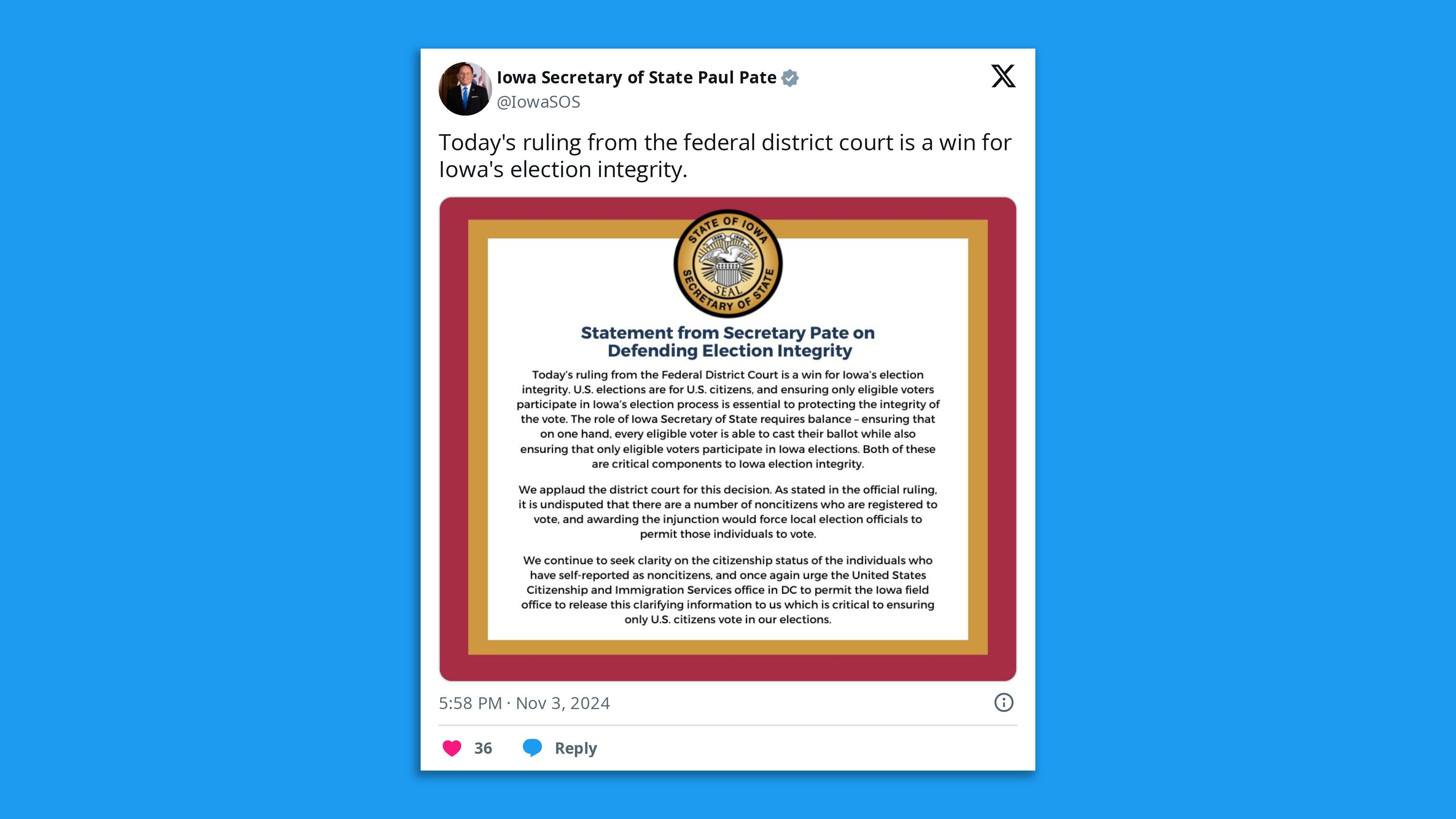
What they're saying: Both Iowa Gov. Kim Reynolds (R) and Pate on X called the ruling a "win" for election integrity.
The other side: Rita Bettis Austen, ACLU of Iowa legal director, in an emailed statement Sunday expressed disappointment with the decision not to outright block Pate's directive, which she said could "disenfranchise eligible voters simply because they are people who became citizens in the past several years."
- But she said she's glad their litigation has produced some positive developments — in particular that their clients will be able to cast regular ballots.
- "We are also glad that the court forced Secretary Pate to 'back away' from his position in the directive and no longer require that everyone on the list be forced to vote provisionally only," she added.
- "Now, county auditors 'may exercise their own independent judgment based on information available to the official' to permit a voter on the list to cast a regular ballot. And, anyone who is challenged who can prove they are a citizen with documentation will be able to vote a regular ballot."
Go deeper... Shock poll: Harris grabs last-minute Iowa lead over Trump
Editor's note: This article has been updated with comment from ACLU's Rita Bettis Austen, further comment from Iowa Secretary of State Paul Pate and a link to the ruling.
