Senate Democrats' sneaky advantage in 2024

Add Axios as your preferred source to
see more of our stories on Google.
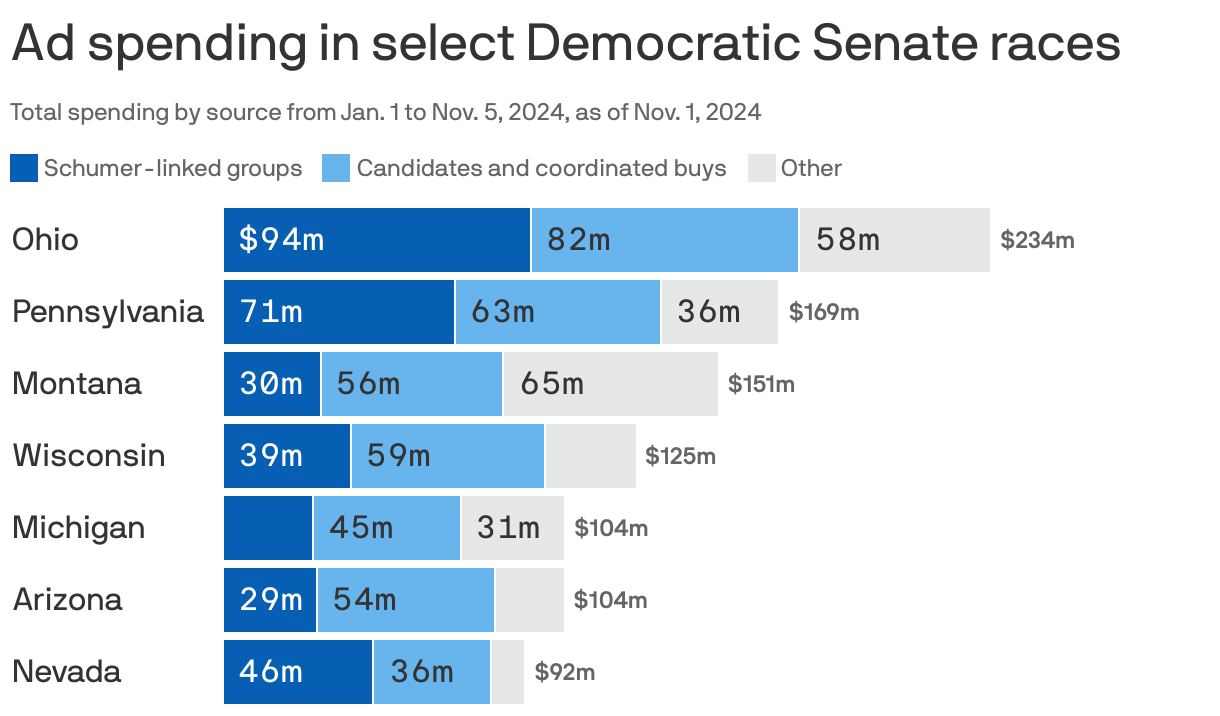
Senate Democratic campaigns have outspent Republicans with the one currency that both parties value the most: hard dollars.
Why it matters: The Senate map favors Republicans. But the Senate money favors Democrats.
- Those competing dynamics will collide on Election Day, with no obvious winner in sight in most races— other than local TV stations.
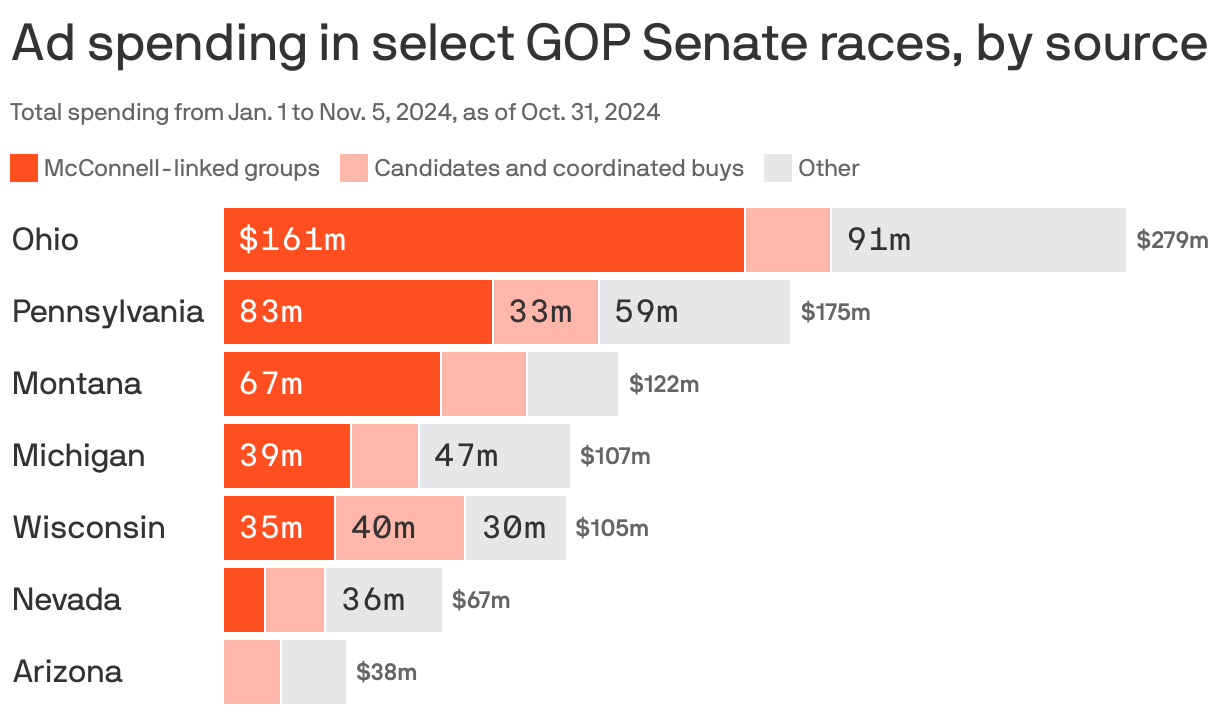
Zoom out: The Democrats' advantage with hard dollars — raised in smaller increments and controlled by campaigns — has forced Republicans to rely on their leader's outside super PACs to level the playing field.
- It's a dynamic that's also in play in the House, where Democrats trounced their opponents in hoovering up hard dollars in the third quarter, and the DCCC has consistently outraised the NRCC.
- Republicans say they face a structural disadvantage on the fundraising front. Democrats are simply better, the GOP says, at convincing grassroots donors to part with small dollar amounts.
- That's also true at the presidential level, where Vice President Harris's campaign has embarrassed former President Trump on the fundraising front since she became the nominee.
Zoom in: Democratic campaigns have spent more hard dollars on TV and digital ads this year than Republicans in every one of the most competitive Senate races.
- That's true for campaign spending alone and also when counting coordination with each party's Senate campaign arm and joint fundraising committees, according to AdImpact.
- Groups linked to Senate Majority Leader Chuck Schumer (D-N.Y.) have still spent heavily in key races — with their top ad investments in Ohio, Pennsylvania and Nevada.
- But Democratic super PACs trail Senate Minority Leader Mitch McConnell's (R-Ky.) affiliated groups in key states like Ohio, Pennsylvania and Montana.
The intrigue: Sen. Jon Tester (D-Mont.) is by far the most vulnerable Senate Democrat.
- Schumer's affiliated groups have spent $30 million on his behalf, roughly half the $56 million in hard dollars from Tester's own account.
- That hard-dollar advantage helped Schumer-aligned money flow to Wisconsin and Nevada.
- Democrats spent cash more efficiently by placing ad reservations early in the cycle, capitalizing on lower rates further out from the election, sources tell us.
The bottom line: Incumbents usually have an advantage in fundraising because they have established donor relationships, giving Democrats another leg up in the spending war.
- But this year, even Democrats running for open seats, like Rep. Elisa Slotkin in Michigan, have outspent their opponents.
