How to see northern lights and why the power grid could be disrupted

Add Axios as your preferred source to
see more of our stories on Google.
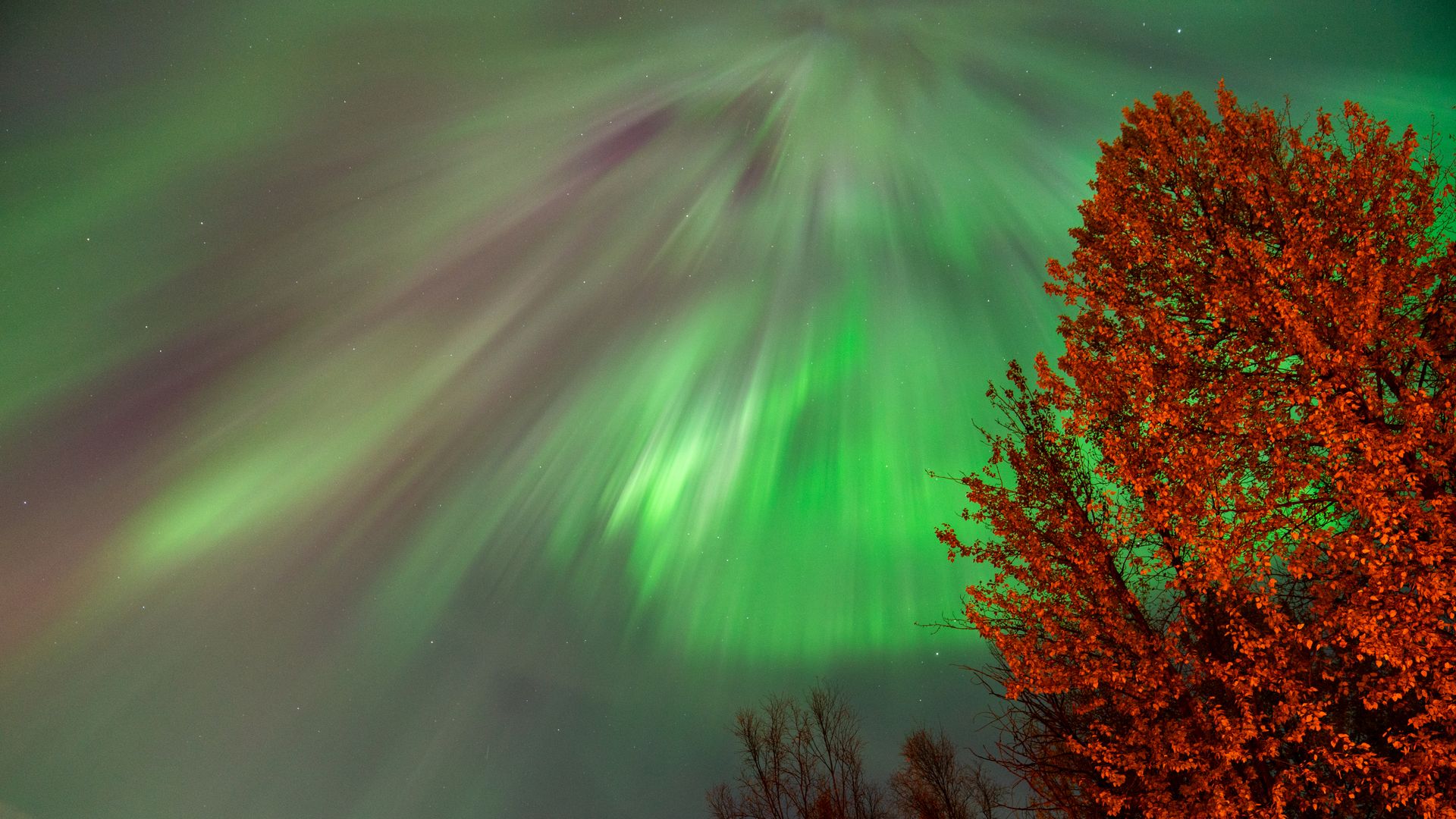
Northern lights (Aurora Borealis) illuminate the sky in Alaska on Oct. 7. Photo: Hasan Akbas /Anadolu via Getty Images
A severe geomagnetic storm could bring the northern lights to a large portion of the country this week, NOAA's Space Weather Prediction Center said Wednesday.
Why it matters: While solar storms can trigger breathtaking celestial light shows in the night sky, they can cause "detrimental impacts" to critical technology and possible widespread voltage control problems, NOAA said.
- It has the potential to disrupt the electric power grid, communications, and navigation, radio and satellite operations, which is more dangerous because of Hurricane Milton.
Solar storm watch for October 2024
Driving the news: NOAA's Space Weather Prediction Center issued a rare G4 geomagnetic storm watch for Thursday and Friday.
- "A fast coronal mass ejection (CME) erupted from the Sun the evening of 8 October, 2024, and is likely to arrive at Earth on 10 October," NOAA said in the watch.
The latest: NOAA issued another watch alert on Thursday and said the geomagnetic storm is expected to last through "tomorrow, October 11th," and noted there was a "possibility that we could reach G5 (Extreme) levels."
- "This storm could impact ongoing recovery efforts for Hurricanes Helene and Milton in several critical ways," NOAA said.
Between the lines: Coronal mass ejections are large bursts of plasma from the Sun that cause geomagnetic storms when they are directed at Earth.
- They have the potential to harm satellites, impact infrastructure and disrupt communications.
Flashback: The prediction center issued storm watches in May for the first time in 19 years.
Northern Lights expected Thursday to Friday
The forecast for Oct. 10-11 said that the "aurora may become visible over much of the northern half of the country, and maybe as far south as Alabama to northern California."
- "When skies are clear, the aurora (Northern Lights) could be visible as far south as Alabama and northern California tonight," NOAA said Thursday.
Aurora viewing tips: Best times to see northern lights
Aurora viewing depends on four factors, according to the SWPC:
1. Geomagnetic activity: "If the geomagnetic field is active, then the aurora will be brighter and further from the poles. Geomagnetic activity is driven by solar activity and solar coronal holes and thus it waxes and wanes with time."
2. Location: Go toward the magnetic poles.
- Alaska is known for being one of the best places to view auroras along with Canada and Scandinavia because of the high northern latitudes, according to the institute.
3. Darkness: It needs to be dark and you'll need to get away from city lights.
The institute notes there is "always some aurora at some place on earth" but it might be faint and occur at very high latitudes. "Sunlight and clouds are the biggest obstacles to auroral observations."
4. Timing: Between 10pm and 2am local time is usually the best time to spot auroras, the prediction center said.
- The best seasons for aurora watching are typically around the spring and fall equinoxes.
More from Axios:
- How to see a once-in-a-lifetime comet Saturday and beyond
- Social Security benefits to increase 2.5% in 2025
- Mega Millions more than doubles lottery ticket price
- Black Friday in October: Here come early holiday sales
Editor's note: This story was updated with updates from NOAA.
