Axios Finish Line: Lead like Sesame Workshop CEO Sherrie Westin

Add Axios as your preferred source to
see more of our stories on Google.
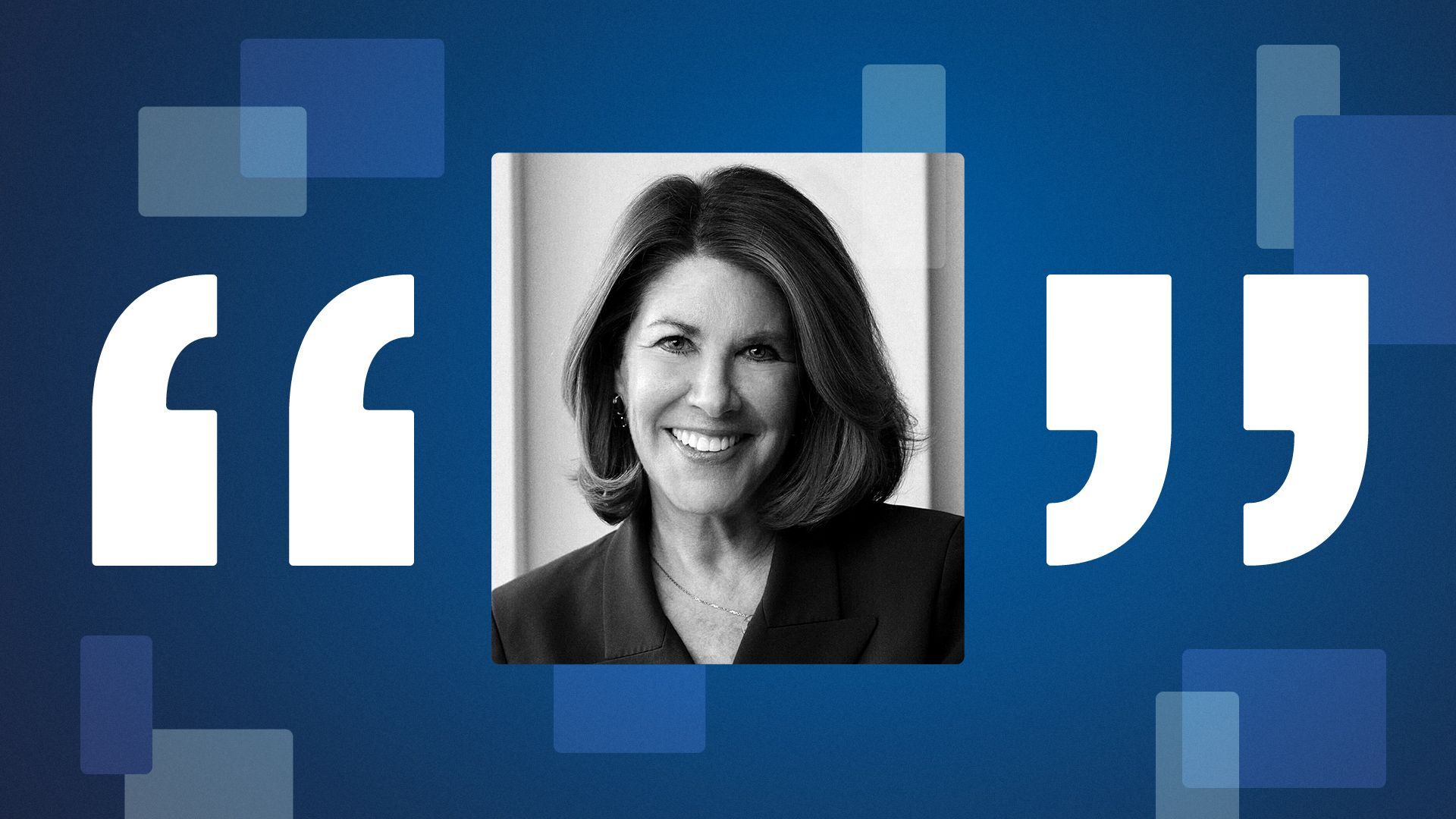
Photo illustration: Axios Visuals. Photo: Sesame Workshop
Axios is back with an interview series on top leaders from business and beyond who discuss lessons on life and leadership.
Last month I interviewed Sherrie Westin, 66, the new CEO of Sesame Workshop — the nonprofit behind "Sesame Street," TV's longest-running children's show. It's been on air since 1969.
Why she matters: Westin — who has been in senior leadership at Sesame for over 20 years and was a senior official in President George H.W. Bush's administration — needs to steer Sesame through an increasingly competitive media landscape and polarized world.
Westin and I sat down on Aug. 13 at her Sesame Workshop office in Manhattan for her first interview since taking the helm as CEO in July:
1. What have been some of the toughest calls you've helped make as president and in other leadership roles at Sesame?
- "Creating the first-ever HIV positive Muppet, which was controversial in the United States, was the right thing to do in South Africa," she said about the collective decision.
- "A, it was that the country wanted and asked for it — it's so important that we're being responsive and not just dictating. And B, it was that we had put so much into the research and creative development to say how much more we'd be able to do if we had this character than if we didn't."
- More recently, Sesame's decision to vaccinate Big Bird against COVID attracted accusations of White House propaganda.
- "What I loved is that before we could do anything, a fan posted a video of Big Bird being vaccinated in 1979 for measles, and [so] obviously it's not White House propaganda, right? It was what is in the best interest of children. And so I — none of us — regretted that for a minute."
- The intrigue: Sesame declined a White House invitation for Big Bird to work with President Biden on a vaccination campaign after the clip went viral, because it wanted to avoid anything that could potentially undermine its credibility as a nonpartisan organization.
- "We don't want to give people a reason not to watch "Sesame Street." But having said that, I think as long as we're always focused on what is truly in the best interest of 2- and 3- and 4-year-olds, then we're going to make the best possible decisions," said Westin.
- She also noted that the toughest calls she's had to make are related to managing the risk and safety of staff. One example: expanding Sesame's presence within the Middle East to open a full-time Sesame Workshop office in Iraq with staff on the ground.
2. Are there topics and issues right now that you feel would be taboo for "Sesame Street" to touch?
- "We would never be partisan. We'd never talk about a campaign," she said.
- "We do parodies, we do humor, but we also try to make sure something [won't be] interpreted as being one side or the other."
3. Is the content made only for children — where parents are never in mind when you're designing a dialogue? Look at the success of Pixar films' "Inside Out 2."
- "No," said Westin. "When [co-founder] Joan Ganz Cooney created 'Sesame,' she had a hunch that the learning would be deeper if an adult were watching with a child."
- "The reason there were muppets and parodies and celebrities and musicians [and] humor was a deliberate appeal to adults."
- Creating content that sparks engagement between children and adults is where Sesame thinks it will have the greatest impact because science shows that a child learns through engagement with an adult, she added.
4. When you see the assassination attempt on President Trump or the rise in gun violence, how do you decide when to bring some of those tough topics into programming?
- "We decide when to address an issue a lot through our partners, valued advisers," she said.
- The show itself would not cover scary news events, partly because that wouldn't be in line with Sesame's approach for its very young audience.
5. There is no "war room" that is responding in real time to these big news events?
- "No. We can't respond to every single crisis. We're not a crisis response organization."
- That's also partly why Sesame has not addressed the assassination attempts on former President Trump directly.
- The other part has to do with the way Sesame develops its content —within and outside of its shows.
- Sesame Workshop has "somewhat evergreen" resources that it can distribute for topics such as gun violence and natural disasters. In other cases, Sesame will adapt existing materials for crises such as Russia's invasion of Ukraine.
- "When you see something on the show, you know that a child can watch it regardless of adults there," she said. For tougher topics, such as parental drug addiction, Sesame creates resources that need adult engagement.
- "It's about what would be an age appropriate way to talk to a child about something that's very frightening," she said.
- Adults often think they shouldn't talk to a child about a challenging issue, but research shows it's always more important to communicate and to acknowledge their feelings and to comfort them, she adds.
6. Sesame's mission is "to help children everywhere grow smarter, stronger and kinder." What is your definition of kindness?
- "Kinder is about empathy. It's about understanding. It's about respect for differences. It's about children seeing what they have in common with one another."
7. Which areas of the world can't Sesame yet reach but wants to?
- "We don't really go into a country unless we're welcomed," she said.
- And because Sesame doesn't want to be "an export from the U.S.," it works with ministries of education and local media producers and educators, which means the organization wouldn't be in a country like Iran and wouldn't be welcome in North Korea.
8. Do you anticipate striking more deals with other streamers? (Sesame's current agreement with HBO Max to air 35 episodes a season expires next year.)
- Westin didn't answer the question directly but said that streaming platforms no longer have the same "expectation for exclusivity" compared with the past.
- She pointed to YouTube as an "incredible platform" that can help generate interest for shows and intellectual property on other apps and services.
- In the U.S., Sesame is on Max, PBS, YouTube, Sesame.org and SesameStreet.org. Globally, Sesame and other platforms.
- Sesame is in conversations with Warner Bros. Discovery and other potential partners.
9. What goes through your mind when you see companies like Paramount and Warner Bros. Discovery writing down billions of dollars in value of their legacy television and cable units?
- "We're in the media business — even though we're a nonprofit, mission-driven organization — so we are not immune to those challenges or those changes," she said. "But this business is really cyclical."
- Since its start, Sesame has been "constantly evolving" and adapting to changing revenue models.
- "There was a time when the DVD business totally funded our work," said Westin. "Going to HBO, when it was the beginning of the streaming business, was a really smart thing to do, a very lucrative deal. It [not only paid] for our production and [allowed us to] give 'Sesame Street' to PBS for free, but also to support our ongoing operations."
- As viewing habits and the industry continue to change, Westin sees a "huge advantage" in Sesame's reputation as a trusted brand to land new opportunities.
- "We have the benefit of having both philanthropic support, donations [and] supporters — as well as our licensing revenues, our distribution fees."
10. What is one unorthodox idea or dimension of your leadership?
- "I have kind of an irrepressible sense of humor, which can get me in trouble," she said.
- "I just like to see the humor in things, so I'm often being facetious — and you realize that people don't understand you're being facetious."
11. What's your blind spot?
- "I can tend to be impatient," she said, because her strengths include having "very good instincts and a strong gut."
- "But the reason it's so important to be patient is to also go through the process to bring others along. And there may be other inputs that help form a decision, so I think it's so important to have the data to support your gut."
12. Of all your accolades, which one has been most meaningful for you?
- "The Smithsonian Ingenuity Award, because it was for the creation of Julia and our autism initiative."
😂 1 fun thing: If you were a muppet, who would you be?
- "Grover, because of his irreverence and sense of humor," she said, laughing, naturally.
More from this series:
- Axios Finish Line: Talking leadership with Robinhood CEO Vlad Tenev
- Axios Finish Line: Lead like Accenture CEO Julie Sweet
- Axios Finish Line: Lead like Brooks Brothers CEO Ken Ohashi
- Axios Finish Line: Lead like Expedia CEO Peter Kern
- Axios Finish Line: Lead like Walgreens CEO Rosalind Brewer
- Axios Finish Line: Lead like IMAX CEO Rich Gelfond
- Axios Finish Line: Lead like La June Montgomery Tabron
