Heat wave scorches Southwest, West as wildfire concerns increase

Add Axios as your preferred source to
see more of our stories on Google.
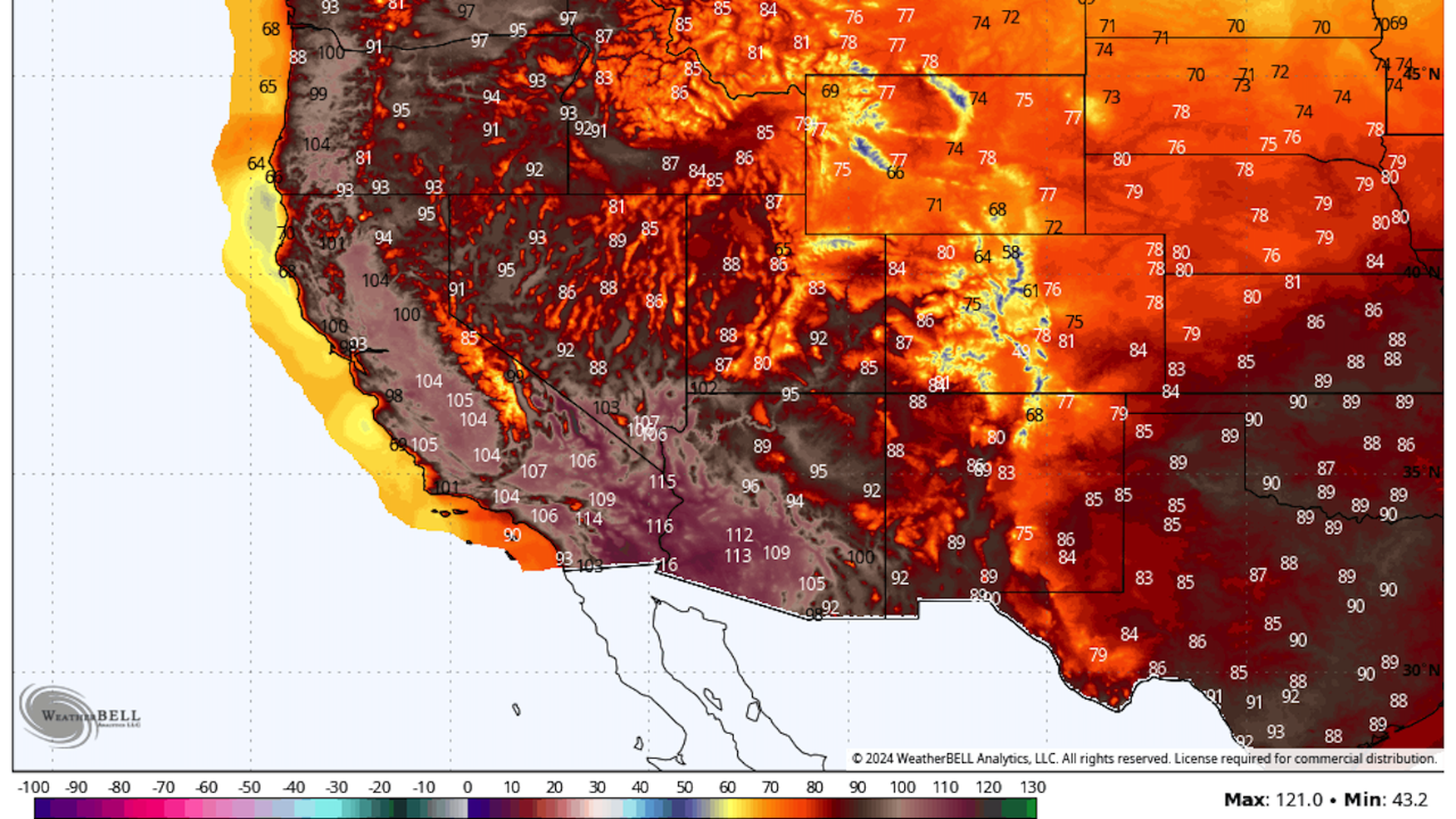
Map showing forecast high temperatures across the West on Sept. 5 from the NWS. Image: Weatherbell.com
After one of the hottest summers on record, many cities in the Southwest and West are bracing for a significant heat wave beginning Wednesday.
Threat level: A strong heat dome will send temperatures soaring into the 100s°F to 110s°F in Phoenix and Las Vegas, with triple-digit heat also affecting much of inland California.
- Coming off the record hot and dry summer, wildfire risks are especially high in California and surrounding states.
- This season has already brought the Park Fire, which stands as California's fourth-largest wildfire on record.
- Oregon has also had a severe wildfire season, and it too will see dangerously hot temperatures combined with gusty, dry winds during this event. New fires ignited in central Oregon over Labor Day weekend from lightning strikes amid dry conditions.
Zoom in: As of Wednesday morning, 61 million people, from Arizona to nearly the entire state of Washington, were under heat warnings, watches and advisories.
- In Phoenix, which had its hottest summer on record, with a three-month average temperature of a staggering 99°F, the city's record-breaking streak of 100-degree days is likely to continue at least into next week.
- As of Tuesday, the streak stood at 100 days straight with highs of at least 100°F, the NWS office in Phoenix posted on X. This is by far the longest on record there.
- The previous record was 76 straight days, set in 1993.
- High temperatures in Phoenix are forecast to range between 106°F to 114°F beginning on Wednesday and lasting into the weekend. Above average temperatures are forecast to continue next week.
What they're saying: "Given that temperatures will be well-above normal, the overall HeatRisk through Friday will be in the major to locally extreme category, meaning that most of the general population will be under the risk of heat-related illnesses if the proper heat precautions are not taken," the NWS forecast office in Phoenix wrote in a forecast discussion issued early Wednesday morning.
- In Los Angeles, where temperatures downtown are forecast to be in the upper 90s°F on Thursday and Friday, the NWS is warning of "boiler room" temperatures.
- For example, Burbank could see highs in the 100s°F through Sunday, according to NWS forecasts.
Zoom out: Excessive heat warnings and heat advisories extend into desert areas of California, where some of the hottest temperatures will be found, northward into the heart of the state's agricultural region, including Sacramento.
- Extreme heat is also expected to affect coastal Oregon, from the California border to Portland, along with much of Washington State, including Seattle.
- Temperatures in Portland, a city where many lack air conditioning and extreme heat is rare at this time of year, are forecast to reach 15–20 degrees above average on Thursday and Friday, before moderating over the weekend. More heat may be on tap there next week.
- The National Weather Service on Wednesday issued red flag warnings for parts of the Cascades in Washington and Oregon, among other areas in the West.
What we're watching: According to the NWS, temperatures are expected to peak in the upper 90s°F to low 100s°F inland and soar into the mid-to-upper 80s°F along the Oregon coast. In fact, there is a 50% to 80% chance that temperatures will reach or exceed 100°F in the Willamette Valley on Friday, the NWS noted.
- This event will also involve areas of Southern California away from the immediate shoreline. This region has escaped some of the extreme heat other areas saw during the summer.
Context: Heat waves are becoming more common, intense and longer-lasting due to human-caused global warming.
- Climate change has been found to yield extreme heat events that would have been virtually impossible in a climate that lacked today's high levels of greenhouse gases, put there largely by burning fossil fuels for energy.
- Multiple states in the West and Southwest, including Arizona, Nevada and California, likely saw their hottest summers on record. Las Vegas saw its hottest summer on record as well, for example.
- Phoenix is one of the fastest-warming cities in the U.S., and is one of an increasing number of urban areas that are working to reduce heat impacts via the work of its chief heat officer.
What's next: While the most intense period of this upcoming heat wave may wane by early next week, longer-range outlooks show the likelihood for more heat events through September.
Editor's note: This article has been updated with details of red flag warnings being issued.
