California's Park Fire wildfire erupts to 4th-largest in state history

Add Axios as your preferred source to
see more of our stories on Google.
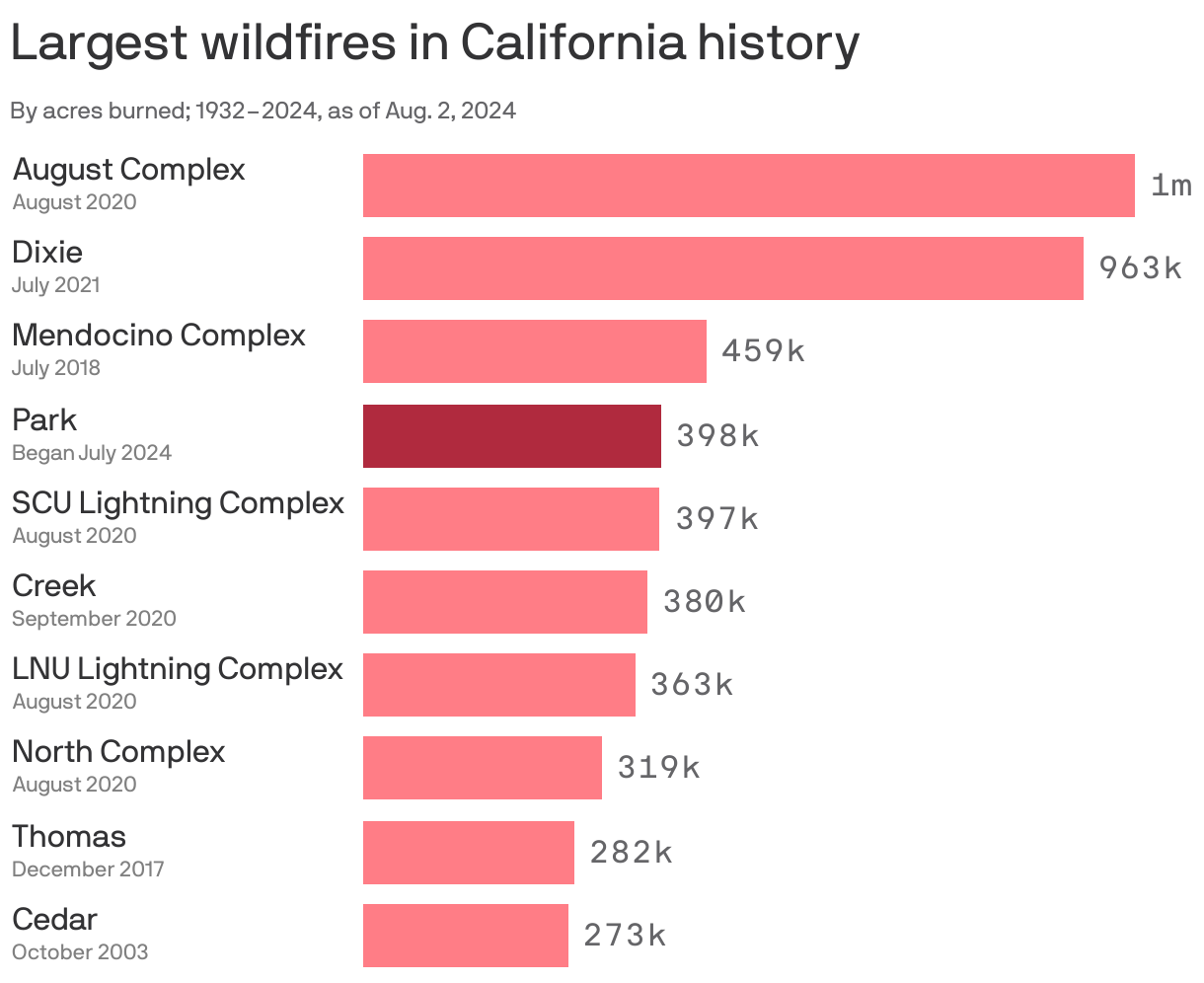
The Park Fire in California now ranks as the state's fourth-largest blaze on record, surpassing the SCU Lightning Complex from 2020.
Why it matters: The record shows how a mixture of long-term climate change, short-term weather conditions and land management can combine to produce a rapidly spreading and massive blaze.
By the numbers: As of Friday morning, the Park Fire had burned 397,629 acres and was 24% contained, passing the SCU Lightning Complex, which burned 396,625 acres.
- The fire is part of a string of recent megafires in the Golden State, and is expected to grow further.
- All besides one of the 20 biggest wildfires recorded in California occurred after the year 2000, per the state's Department of Forestry and Fire Protection data. The exception is the Matilija Fire in 1932.
- Seven of the eight largest fires on record in the state have occurred since 2020.
Zoom in: The Park Fire has grown with a rarely-seen swiftness, having started on July 24 allegedly by an arsonist.
- Months of record heat and dry weather, combined with vegetation growth after last winter's heavy rains and mountain snows, has provided abundant fuel for the fire to burn.
- In addition, the blaze has erupted and moved through areas that have not burned for decades, leaving timber vulnerable to ignition.
Between the lines: Climate "whiplash," featuring sudden oscillations between drought and flood, is worsening in California as the climate warms.
- This trend is likely to continue, studies show, and it may create conditions that are ideal for more large wildfires in the future, including this season.
- The Park Fire grew at staggering rates of more than 100,000 acres per day, particularly during the first few days of its ignition.
- The fire front, where flames advanced on forests and communities, was as wide as 35 miles at times. A rotating plume of smoke was also occasionally observed towering to 30,000 feet.
- There may even have been fire tornadoes embedded within the blaze.
Context: July will go down in history as not just the hottest July on record for many cities in the West — particularly in California — but the hottest month of any month since records began.
- The National Weather Service's Sacramento office said on X Thursday that preliminary data showed "all our official climate sites recorded their hottest July on record (according to average temperatures for the month)!"
- The NWS' Las Vegas office noted on X Thursday that the monthly average temperature was 99.9°F, "setting a new highest monthly average temperature record for July."
- That record narrowly beat the second-hottest month, which occurred last year.
The intrigue: Human-caused climate change is leading to more frequent, severe and longer-lasting heat waves, and is also driving an uptick in large wildfires in the West, among other trends.
- According to Climate Central's Climate Shift Index, 148 million Americans are likely to see temperatures on Friday that were made at least three times more likely due to climate change.
- The index uses peer-reviewed methods to measure the influence of human-caused climate change on daily temperatures.
What's next: Yet another heat wave is building in the West, and thunderstorms are likely during this event.
- The heat and erratic winds are likely to spread the Park Fire and other western blazes further. Lightning, particularly if it occurs in storms that drop little rainfall, could also start new wildfires in the West.
Rebecca Falconer contributed reporting.
