Trump's economic gamble

Add Axios as your preferred source to
see more of our stories on Google.
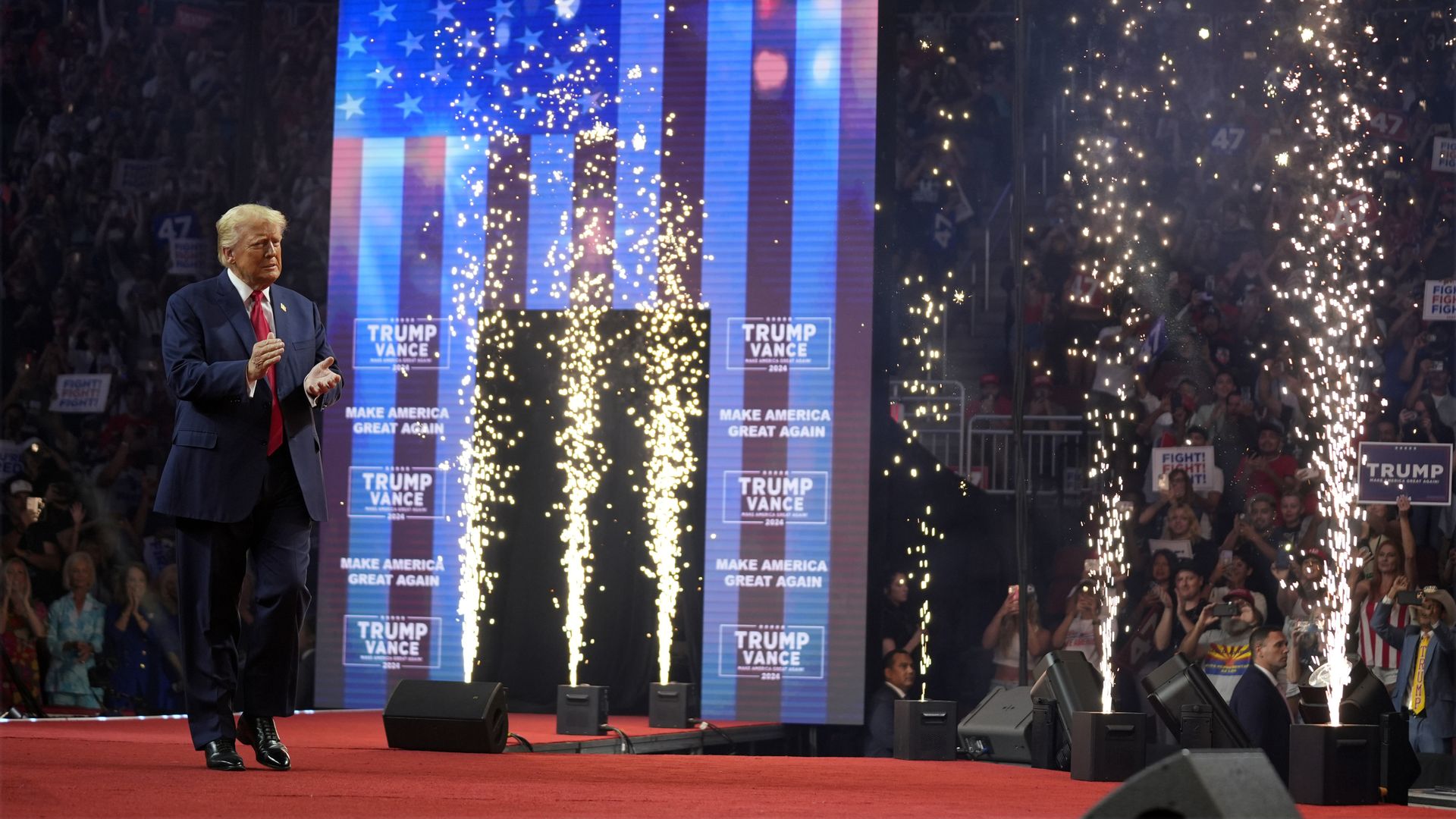
Former President Donald Trump arrives for a campaign rally in Glendale, Ariz., last week. Photo: Evan Vucci/AP
Former President Trump is talking down the economy like his election depends on it.
Why it matters: It might. Trump knows that nothing matters more than economic issues. That makes the next 71 days a battle to convince voters their wallets are still hurting.
- The former president is seizing on every negative bit of economic news to make the point that the economy is much worse than the Biden administration says.
The big picture: Vice President Kamala Harris is doing the opposite and grabbing onto any good news. It's a cherry-picking battle.
- Harris has a much more optimistic view of the economy. Like President Biden, she celebrates a low 4.3% unemployment rate, while acknowledging that prices are too high.
- She has also proposed a ban on "price gouging" for food and groceries, which Trump labeled "Soviet-style" controls.
Zoom in: Trump falsely claimed last week that the Biden administration manipulated jobs data after a standard — and scheduled — revision showed the U.S. economy created 818,000 fewer jobs than previously estimated.
- Trump was wrong on why — and how — the new numbers were released. But the labor market is cooling, news that Trump wants to drive home.
- "Americans overwhelmingly disapprove of Kamalanomics because no one can afford it," RNC spokesperson Anna Kelly says.
- "After three-and-a-half years of sky-high inflation on everything from gas to groceries to housing costs, voters are feeling the pinch as a result of the Harris-Biden spending spree."
Democrats privately cheered Fed chair Jay Powell's Friday comments signaling the "time has come" to start cutting rates.
- Stocks rallied on Powell's Jackson Hole declaration, capping off a week of good vibrations for Democrats.
Between the lines: The risk for Trump is that his doom-and-gloom approach could turn into a self-fulfilling prophecy. If he wins, he'd be inheriting an economy that's slowing down — and will be much harder to speed up with words alone.
- In January, Trump predicted that the economy would "crash," adding that he hoped it would happen in the next twelve months before he expected to take office. "I don't want to be Herbert Hoover," he told Lou Dobbs on Lindell TV.
- Earlier this month, he blamed a global stock market rout on markets reacting to the news that Harris would replace Biden. The S&P 500 has climbed more than 8% since Trump coined the phrase "Kamala crash."
The other side: The danger for Harris is that she loses credibility with voters by hyping an economy that isn't working for them.
Flashback: In presidential campaigns, it's standard practice for the challengers to highlight bad economic data — and stoke consumer concerns.
- When Biden challenged Trump four years ago, he downplayed big jobs reports.
- Much of the 2012 campaign was a contest for President Obama to lower unemployment below 8%. When it dropped below that threshold, some serious people falsely suggested the numbers were rigged by these "Chicago guys."
- In 2004, Sen. John Kerry, the Democrat's nominee, unsuccessfully tried to convince voters that President George W. Bush was to blame for high gas prices. One key driver behind that strategy: Gene Sperling, now an economic adviser for Harris.
Zoom out: Trump still outpolls Harris on who Americans trust more to manage the economy, but voters believe Harris had limited influence on Biden's economic policies.
- Those two readings give Trump an urgent need to convince voters that the economy is underperforming under the Biden administration — and that both Biden and Harris are to blame.
- While the University of Michigan consumer sentiment survey ticked up slightly in August, it's still well below pre-pandemic norms and down from earlier in the summer.
The intrigue: For nearly two years, economists have been puzzled by the difference between actual economic data (largely positive) and how consumers say they feel about the economy (much more negative).
- One explanation for the discrepancy is that highly partisan Americans tend to feel worse about the economy when the opposite party controls the White House. That influence may be more pronounced among Republicans.
- The other explanation: Americans really hate inflation.
