Harris seeks to shatter glass ceiling that Clinton cracked — but her approach differs

Add Axios as your preferred source to
see more of our stories on Google.
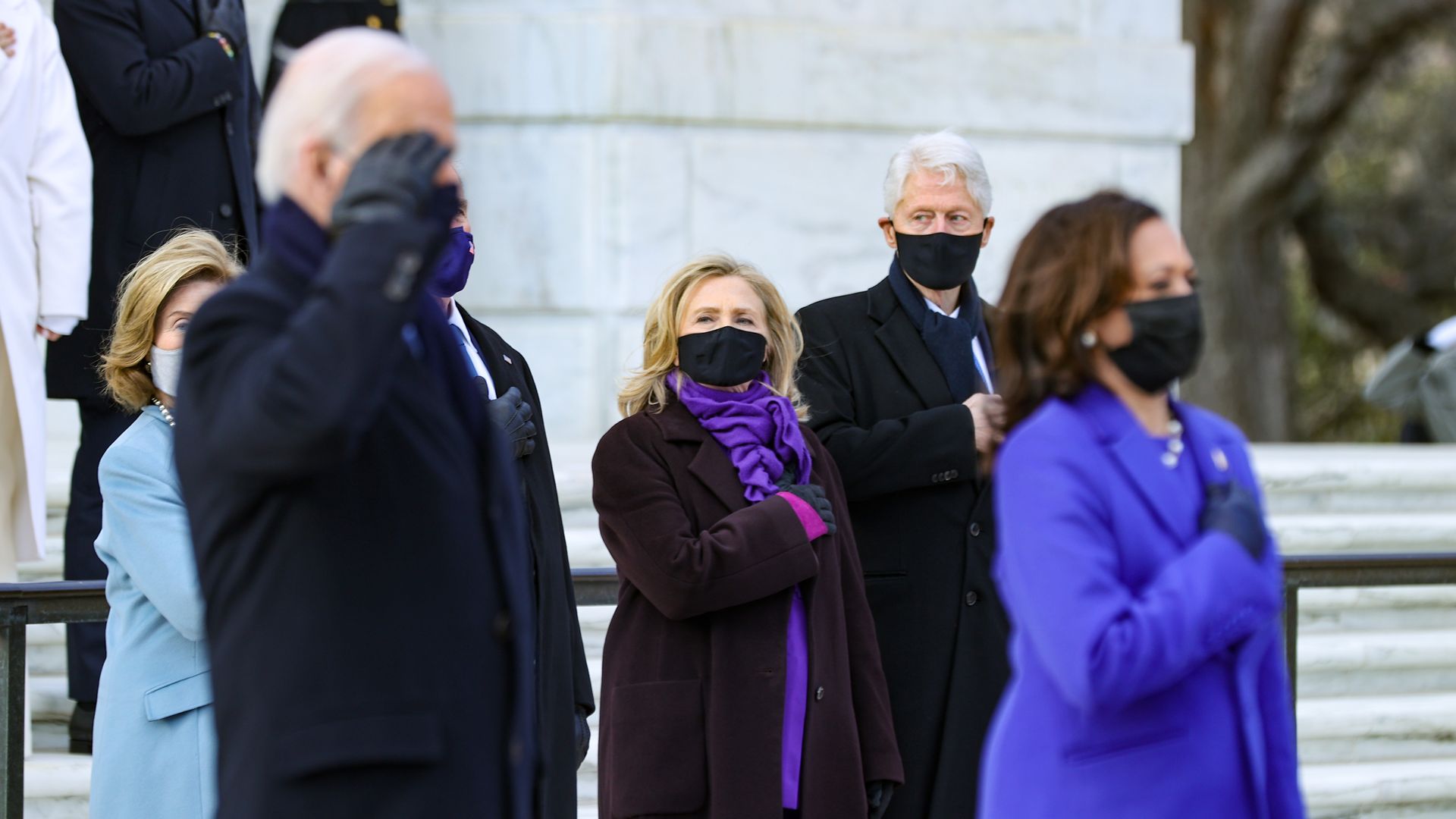
President Biden and Vice President Kamala Harris attend a wreath-laying ceremony at Arlington National Cemetery's Tomb of the Unknown Soldier after the 59th presidential inauguration ceremony on Jan. 20, 2021. Photo: Chip Somodevilla/Getty Images
So far, Vice President Kamala Harris has avoided making the fact that she could be the first female president a central part of her campaign messaging — though her opponents have not shied away from comments targeting her gender or race.
Why it matters: Harris' approach is a departure from Hillary Clinton's in 2016, where the symbolic "highest and hardest glass ceiling" blocking women from the White House was a campaign focal point.
- Still, Harris has faced assaults on her race and gender from opponents who have labeled her as a "DEI" candidate. Former President Trump has also attacked her, with recent comments about her appearance and making false accusations questioning her multiracial identity.
Flashback: In some ways, the 2024 matchup is reminiscent of 2016: A woman with vast political experience is running against the businessman-turned-candidate.
- In her emotional 2016 presidential concession speech, Clinton reflected on a pillar of her campaign: "I know we have still not shattered that highest and hardest glass ceiling — but some day someone will and hopefully sooner than we might think right now."
Between the lines: While Clinton's campaign, embodied by the slogan "I'm with her," put the gender barrier on full display, Harris' camp has largely avoided broad messaging framing just how historic her victory would be.
- Instead, comparisons have been drawn between Harris' time on the trail and Obama's 2008 campaign (both in terms of enthusiasm and approach).
- Clinton, writing in a New York Times op-ed last month, shared, "While it still pains me that I couldn't break that highest, hardest glass ceiling, I'm proud that my two presidential campaigns made it seem normal to have a woman at the top of the ticket."
State of play: On Monday, Clinton will address the Democratic National Convention in hopes that another woman will shatter that still-intact ceiling.
Zoom in: In her advertisements and stump speeches, Harris has highlighted her middle-class background as the daughter of a working mother, and she's emphasized her time as a district attorney and California attorney general.
- She's largely letting supporters carry the message of race and gender — whether through mass Zoom calls like the #WinWithBlackWomen gathering or the boost she's received from members of the "Divine Nine" prestigious Black sororities and fraternities.
- And her close allies have also leaned in to the historic nature of her run, with Harris' running mate, Gov. Tim Walz, often introducing or referring to her as "madam president."
- Walz, speaking to delegates Monday, offered a "trick I've learned in life: Surround yourself with smart women and listen to them, and you'll do just fine."
Zoom out: In the 2018 midterms, a record number of women ran for the House, and in 2022, Axios reported that more women were running for statewide offices than ever before.
- Between Election Day 2016 and June 2017, more than 15,000 women reached out to EMILYs List to express interest in running for office, the organization reported, compared to 920 from the start of 2015 to the end of 2016.
- "There's been so much progress in such a short period of time, in fact, that it almost feels normal that so many women are running for office," Amanda Litman, the co-founder of Run for Something and a member of Clinton's 2016 campaign, wrote for The Daily Beast.
The bottom line: Just because Harris doesn't often reference her gender, that doesn't mean the topic is not deeply infused in this race, as gender has become an increasingly stark partisan divider.
- The latest CBS/YouGov polling showed Harris with a 12-point lead among likely women voters, while Trump held a 9-point lead among men.
Go deeper: Behind the Curtain: Trump's "caught on tape" women problem
