Harris puts Democratic Party's "backbone" front and center: Black women


Add Axios as your preferred source to
see more of our stories on Google.
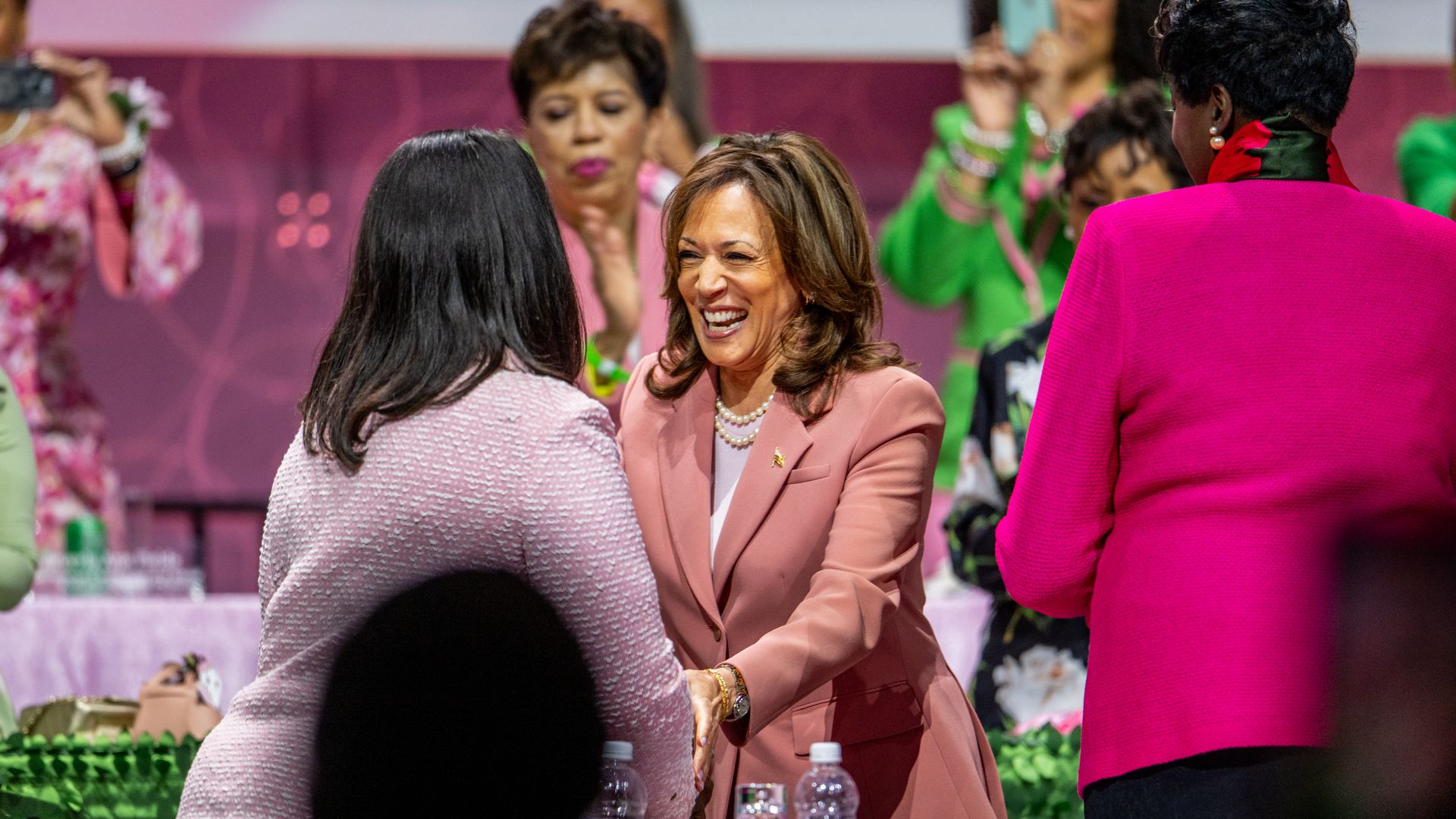
Vice President Kamala Harris meets Alpha Kappa Alpha Sorority members this month. Photo: Brandon Bell/Getty Images
Vice President Harris' sudden presidential candidacy is quickly galvanizing a massive and politically powerful network of Black women who have long been described as the "backbone" of the Democratic Party.
Why it matters: About 93% of Black women who voted in 2020 supported Biden, according to an AP survey of 110,000 voters.
- But this marks the first time the top of the ticket reflects the important demographic — and experts tell Axios that Black women's organizing power will be key for Harris.
Case in point: Within hours of Sunday's bombshell announcement, more than 90,000 tuned into a call organized by #WinWithBlackWomen to support Harris. They raised $1.5 million in three hours, organizers said.
- "We come together to lift one another up. And when we are standing on business, we are an unstoppable force of nature," Zeta Phi Beta International President Stacie NC Grant, who was on the call, told Axios. "That's what that call was."
- (A similar call by Win With Black Men on Monday drew 232,000 participants and raised $1.3 million within hours, per organizers.)
Driving the news: Harris will speak at Zeta's national convention, a historically Black sorority, in Indianapolis on Wednesday — putting on prominent display the historic political activism of the "Divine Nine," historically Black sororities and fraternities.
- On Monday, the group's governing body, National Pan-Hellenic Council, Inc. announced an "unprecedented," albeit nonpartisan, get-out-the-vote campaign.
At the national convention for her own sorority — Alpha Kappa Alpha — this month, Harris called out the group's political legacy, saying that "for 116 years the members of our sorority have been on the frontlines of the fight to realize the promise of America. This year let us continue that work."
The big picture: Black women have historically been in a unique position to mobilize a broad coalition of voters because "of many of the issues that Black women's experiences can speak to," said Emory political science professor Pearl Dowe who studies Black women's political ambition and leadership.
- This has translated to Black candidates winning state and local races in which Black voters did not make up the majority of constituents they would represent, she said.
Flashback: Essence Johnson, chair of the Cobb County Democratic Committee in Georgia, pointed out that Black women were at the forefront of the suffrage movement and "were the ones that were helping white women organize with the hope of one day being able to cast our ballot," Johnson said.
- Fannie Lou Hamer's civil and voting rights activism in Mississippi and U.S. Rep. Shirley Chisholm's historic run for the White House in 1972 started the "trend of putting ourselves out there," Johnson told Axios.
- Black women's turnout and organizing were key to former Democratic Alabama Sen. Doug Jones' victory in 2017 — and Georgia Democrats' wins in 2020, Emory political scientist Andra Gillespie said.
They've "been playing this role in Democratic Party politics for a long period of time," she added.
What we're watching: Black women and others who are getting behind Harris will need to prepare themselves for attacks that feed into racial and gender stereotypes, Gillespie said.
- She noted JD Vance's comments Saturday in Michigan where he rhetorically asked what Harris has done "other than collect a check" were a nod to the "welfare queen" stereotype often tied to Black women.
- "Those are all going to be the true tests of the sustainability of the energy and the momentum that I think many people have observed over the last 48 hours," Gillespie told Axios.
