Biden's handoff to Harris set for DNC in Chicago

Add Axios as your preferred source to
see more of our stories on Google.
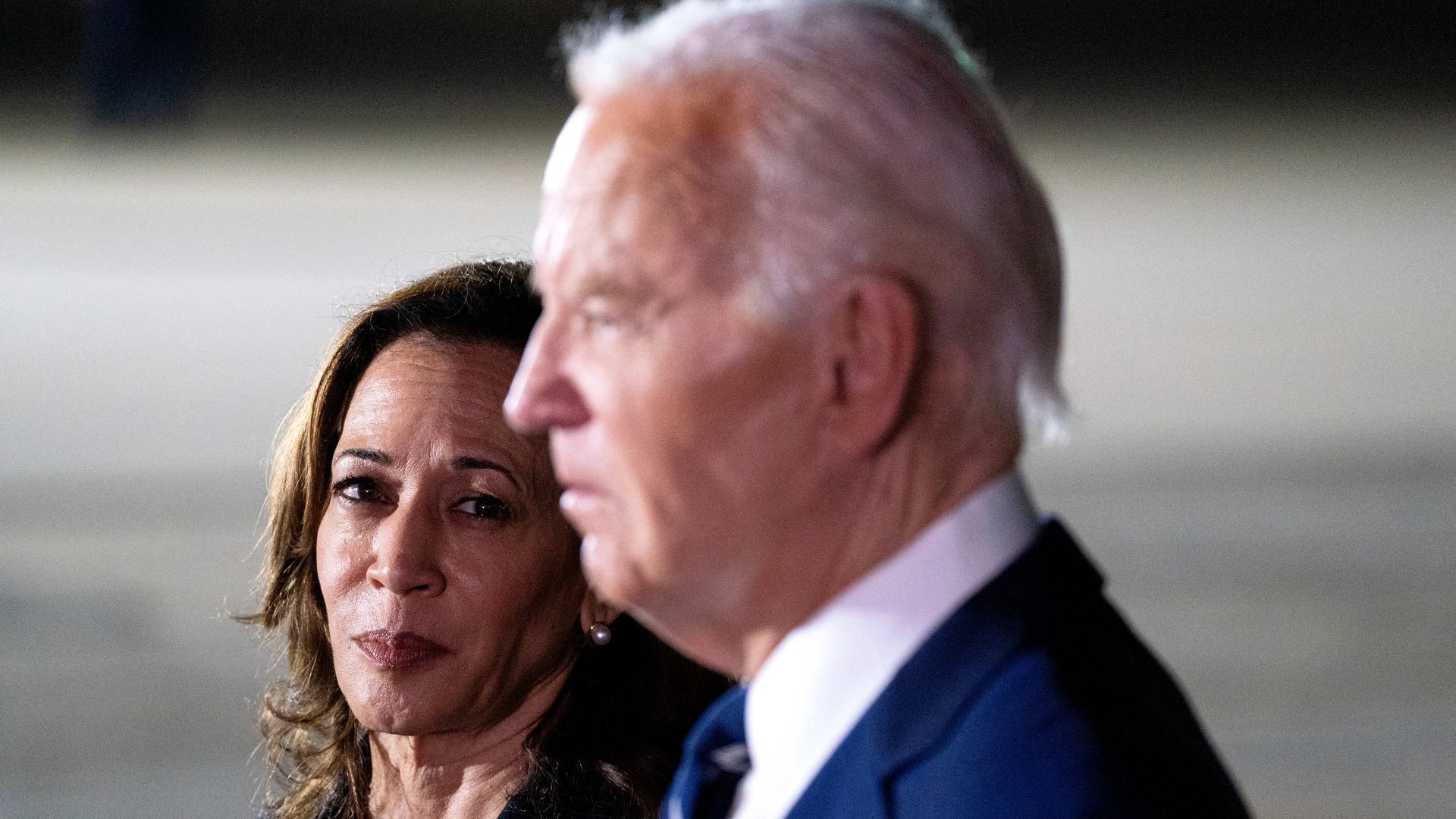
Vice President Kamala Harris and President Biden speak to reporters at Joint Base Andrews on Aug. 1. Photo: Ken Cedeno/UPI/Bloomberg via Getty Images
President Biden plans to address the Democratic National Convention on its opening night, touting his partnership with Vice President Kamala Harris.
Why it matters: Biden's speech Monday night in Chicago will amount to a changing of the guard ceremony for Democrats, as the president kicks off a convention that he had intended to close as his party's nominee.
- It will be a goodbye that Biden resisted for weeks, as pressure built within the party for him to drop out of the race after his disastrous debate against Donald Trump in June.
- Now Biden, as a sitting president who wanted another term, will be in the unusual position of celebrating his own accomplishments while trying to persuade Americans to pick another Democrat for the White House.
- Democrats want Biden to focus on his legislative legacy, including the passage of a bipartisan infrastructure law, a massive climate and health care bill, and the Chips and Science Act.
- Party planners typically have months to plan four nights of political choreography. Since Biden's sudden withdrawal on July 21, they've had four weeks to rework a convention that will honor Biden and re-introduce Harris to America.
Driving the news: Former Secretary of State Hillary Clinton also is slated to speak Monday night. Former President Obama will take the prime-time speaking slot on Tuesday night, as NBC News first reported and Axios confirmed.
- Per tradition, Wednesday night will be devoted to the vice-presidential pick, with Minnesota Gov. Tim Walz (D) speaking after former President Clinton, widely regarded as one of the party's best setup speakers.
- The convention will culminate in Harris' acceptance speech Thursday night.
- "To paraphrase one of President Biden's favorite poems, it's a convention lineup well-constructed to make hope and history rhyme," said Jeff Nussbaum, a former Biden speechwriter.
Between the lines: Democrats have enjoyed great fundraising success from their "three presidents" routine.
- Now they'll try to tease out the act over three nights.
What we're hearing: The speeches are being drafted but much of the speaker lineup is in flux.
- "Beyond the nominee acceptance speeches on Wednesday and Thursday night, programming has not been finalized or announced yet," a convention official said.
Zoom out: For both parties, choreography has replaced drama at their summer conventions.
- The goal is to use modern stagecraft and TV production tricks to introduce their ticket to a public that doesn't follow the campaign as closely as political obsessives do.
- Organizers will try to create moments and personal stories that can be shared on social media and continue to be part of the party's messaging long after the convention.
- The DNC's storyline will be familiar: Democrats are focused on America's future, while Trump is obsessed with himself and the past.
Zoom in: Bill Clinton is likely to attempt to address the economy under Biden — a persistent vulnerability in polls that Republicans want Harris to answer for.
- The 42nd president is likely to make a sweeping argument for why the middle class has prospered under Biden, with record-low unemployment and an economy that has defied expectations.
What we're watching: Like rock concerts, conventions are designed to build to a climactic moment: the nominee's acceptance speech. Unlike concerts, there's no encore.
- That puts an enormous amount of pressure on party planners to avoid any technical, stylistic or strategic snafus.
Flashback: Buy anyone from Mitt Romney's 2012 campaign a drink and you'll likely hear about their own private torment when Clinton Eastwood decided to interview a chair at the GOP convention in Tampa, Fla.
- Then ask an Obama veteran what they remember most about their 2012 convention in Charlotte. Most will cite Bill Clinton's speech, in which he used a mix of statistics and anecdotes to defend Obama's record on the economy and foreign policy.
- Obama himself struggled to explain how good he thought it was, eventually settling on making Clinton the "Secretary of Explaining Stuff."
