Algerian boxer in center of gender controversy wins quarterfinal match

Add Axios as your preferred source to
see more of our stories on Google.
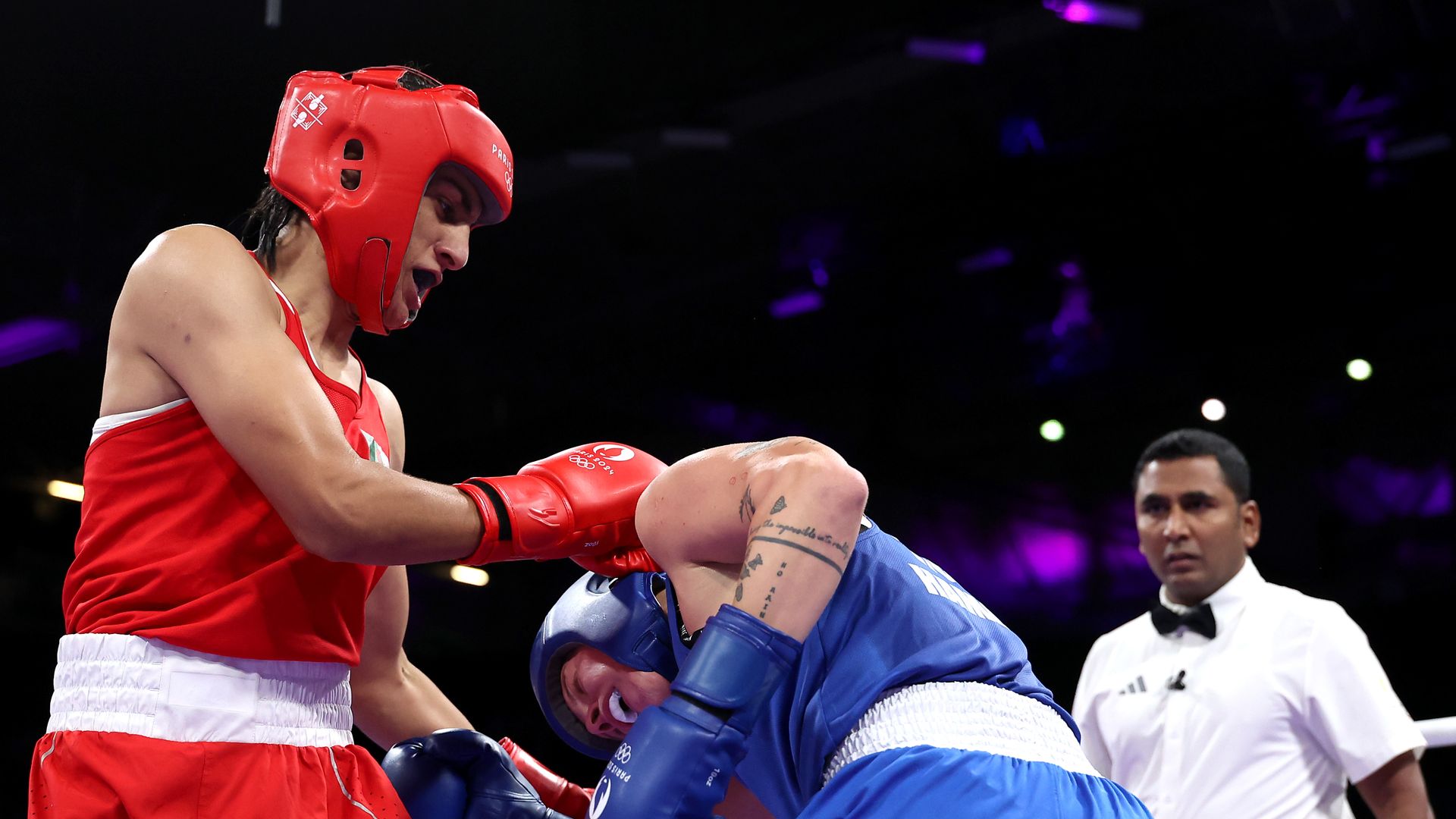
Imane Khelif of Team Algeria and Anna Luca Hamori of Team Hungary exchange punches during the Women's 66kg Quarter-final round match of the Paris Olympics on Aug. 3, 2024. Photo: Richard Pelham/Getty Images
Algeria's Imane Khelif defeated Hungary's Anna Luca Hamori in a unanimous decision in the quarterfinals of the women's under-66 kilogram (145.5 pounds) competition on Saturday.
Why it matters: Though she has competed in the Olympics before and was cleared to compete again this year by Olympic officials, Khelif has been the target of a social media firestorm fueled by a wave of misinformation and disinformation regarding her gender.
State of play: The two athletes exchanged handshakes after their match, with Khelif outscoring Hamori in all three rounds.
- Both athletes landed a few punches in the first round, with most judges scoring it 10-9 in favor of Khelif.
- The second round featured both more landed punches, with most judges again scoring the round 10-9 for Khelif.
- The large, solidly pro-Algeria crowd cheered loudly for Khelif as she entered the arena, booing and whistling as Hamori was introduced.
Driving the news: In Khelif's prior match, Italian boxer Angela Carini stopped fighting after 46 seconds and refused to shake the Algerian's hand, sparking what quickly became a global controversy, although Carini later apologized.
Catch up quick: Khelif, who is not transgender and was assigned female at birth, was banned in 2023 by the International Boxing Association for failing an unspecified gender test.
- Khelif is one of two boxers competing in Paris who was previously banned from competition by the IBA — a boxing governing body that the International Olympic Committee no longer recognizes. The IBA asserted Khelif failed gender testing, without giving specific details.
- The IOC, which is running the Paris 2024 boxing competition, has stood by the right of Khelif and Lin Yu-ting, who was also banned by the IBA, to compete at the Paris Olympics. The IOC does not have a specific rule on intersex boxers or mandating specific testosterone levels.
- Khelif has faced attacks from right-wing politicians including former President Trump, J.D. Vance and Marjorie Taylor-Greene, as well as Elon Musk, J.K. Rowling and others who frequently post anti-transgender views.
What they're saying: Hamori spoke briefly to reporters, saying she was thankful to her family and supporters. She declined to comment to Axios on whether she regretted her Instagram posts on Friday attacking Khelif, but did wish luck to her and the other semifinalists.
- "This was a hard fight, but I think I got to do everything I wanted before the fight," Hamori said. "I think it was a good fight, I am so proud of myself, and I am so grateful to be here."
- Hungarian IOC member Balász Furjes praised Hamori's skill and expressed hope that the IOC will take appropriate actions, without getting into specifics.
- "Olympians are always willing to fight bravely," he said. "That is what Luca (Hamori) has just done."
- Khelif exited the mixed zone without commenting to print and online reporters.
What's next: With the win, Khelif advances to Tuesday's semifinals and is guaranteed a medal. Both competitors who lose their semifinals receive bronze.
The big picture: The controversy in Paris comes amid a broader debate over what rules should govern the inclusion of both transgender and intersex athletes — those whose biology does not neatly break down into male or female.
- There are a variety of intersex conditions, also known as differences of sex development. In addition, some women naturally produce higher levels of testosterone.
- The IOC revised its policy on transgender and intersex athletes in 2021, encouraging a balancing of fairness and inclusion, but leaving the thorny details to the international federations that govern each sport.
Zoom in: While there are no transgender women known to be competing in Paris, there are several transgender and nonbinary athletes who were assigned female at birth competing in the women's category.
- The women's boxing competition includes Hergie Bacyadan of the Philippines — who was assigned female at birth but identifies as male. Bacyadan lost his match on Wednesday but made history as the first openly transgender male to compete in the Olympics.
- Also competing in Paris in the women's division of other Olympic sports are two other athletes who identify as transgender and non-binary — Canadian gold-medal winning soccer player Quinn and U.S. runner Nikki Hiltz.
Between the lines: This year's issues with boxing are further complicated because the IOC revoked its recognition of the sport's prior governing body in 2023 after suspending it in 2019.
- It then set up a temporary 2024 Paris Boxing Unit and is encouraging the various national boxing authorities to establish a new international boxing federation.
Editor's note: This story has been updated with the latest details and a statement from Hamori.
