Abandoned boxing match unleashes a gender storm at Paris Olympics

Add Axios as your preferred source to
see more of our stories on Google.
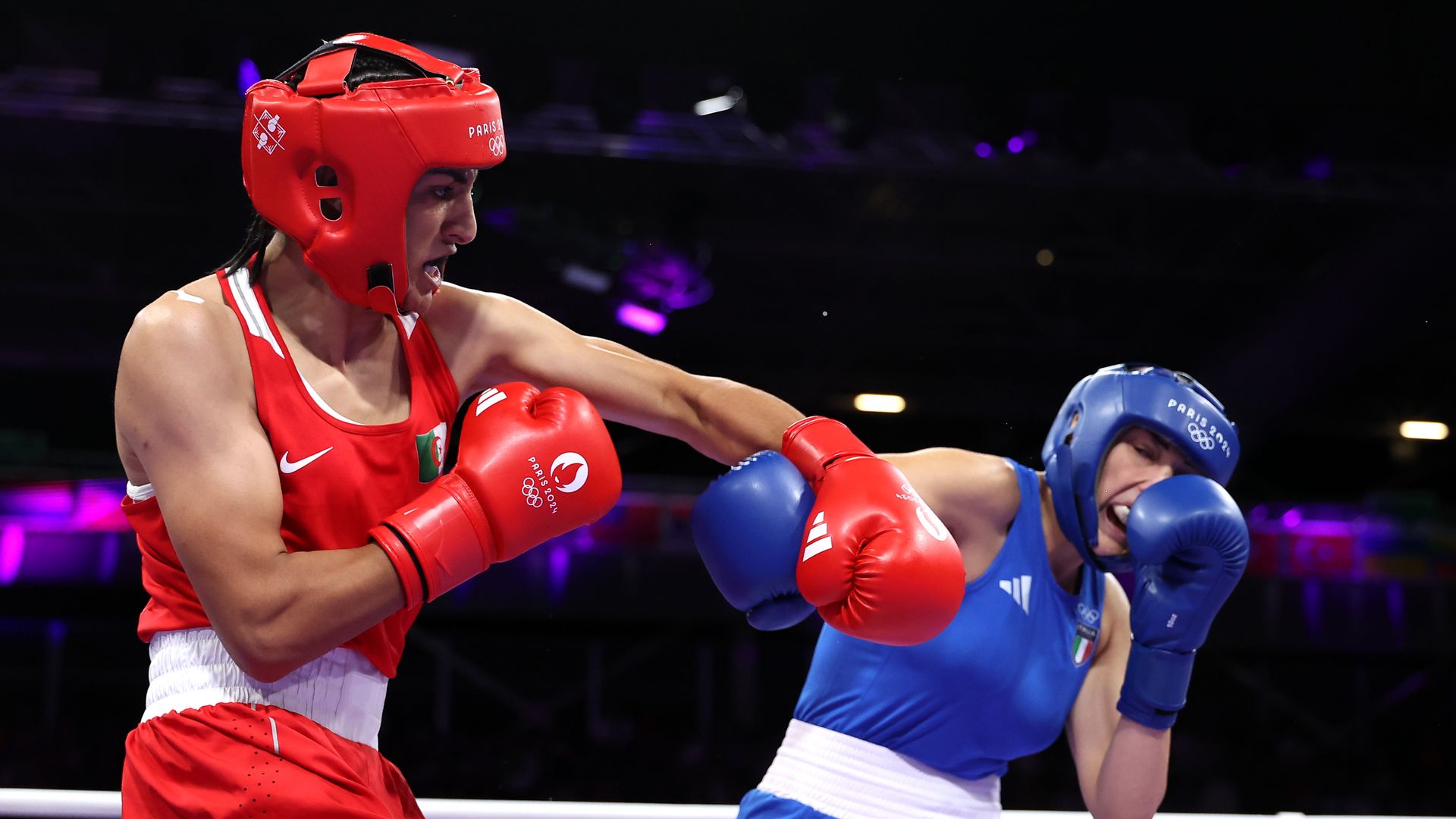
Imane Khelif of Team Algeria and Angela Carini of Team Italy square off during the Paris Olympics' women's 66kg preliminary round match on Aug. 1. Photo: Richard Pelham/Getty Images
Algerian boxer Imane Khelif weathered a toxic storm of transphobic abuse on social media after her Italian opponent quit 46 seconds into their Thursday bout, dragging the Olympic Games into a bitter and misinformation-filled debate over transgender and intersex athletes.
Why it matters: Human biology is complex, and transgender advocates have long warned that transphobia and a constant stream of online misinformation will also harm cisgendered men and women who don't comport to perceived societal norms about identity.
- Khelif, who is not transgender, is one of two boxers competing in Paris who was previously banned from competition by the IBA — a boxing governing body that the International Olympic Committee no longer recognizes. The IBA asserted Khelif failed gender testing.
- The IBA offered no specifics, and there is no publicly available data to suggest Khelif is transgender or intersex. However, some women have naturally higher levels of testosterone.
- The IOC, which is running the Paris 2024 boxing competition, does not have a specific rule on intersex boxers or mandating specific testosterone levels.
The online misinformation conflates several complicated issues.
- The IOC allowed both Khelif and Lin Yu-ting, who was also banned by the IBA, to compete at the Paris Olympics.
- The IBA condemned their inclusion, saying it will "never support any boxing bouts between the genders," implying Khelif and Lin are biologically male without any evidence.
- Khelif's bout with Italian boxer Angela Carini drew online attacks from prominent Republicans as well as celebrities like J.K. Rowling and Elon Musk, both known for posting extensive anti-transgender rhetoric.
The IOC and the Paris 2024 Paris Boxing Unit quickly issued a joint statement defending the eligibility of Khelif and Lin.
- "All athletes participating in the boxing tournament of the Olympic Games Paris 2024 comply with the competition's eligibility and entry regulations, as well as all applicable medical regulations set by the Paris 2024 Boxing Unit," they said. "As with previous Olympic boxing competitions, the gender and age of the athletes are based on their passport."
- Khelif previously participated in the Tokyo Olympics without incident, losing to eventual gold medalist Kellie Harrington of Ireland.
- Carini said she would like to apologize to Khelif for failing to shake her hand at the end of the bout, according to media reports.
- "I'm sorry for my opponent, too. If the IOC said she can fight, I respect that decision," she said.
What they're saying: Olympic rugby player Ilona Maher, who is not transgender but has received extensive attacks over her gender presentation, has used her TikTok account to spread a message of positivity for all body types at the Olympics.
- "I get the comments of being called a man, being called too masculine, because I have muscles," Maher told Time. "I know that it's from very sad, insecure people online. But I know they're saying it to other girls as well. And that's what I don't like."
- Amy Broadhurst, who beat Khelif in 2022, also posted on X her support for the boxer.
- "Personally I don't think she has done anything to 'cheat,'" she said. She added Khelif's body is "the way she was born & that's out of her control."
Meanwhile, athletes who are actually transgender and nonbinary are also making a mark at the Paris Games, though no transgender women (athletes assigned male at birth who later transitioned) are known to be competing in Paris.
- The women's boxing competition includes Hergie Bacyadan of the Philippines — who was assigned female at birth but identifies as male. Bacyadan lost his match on Wednesday but made history as the first openly transgender male to compete in the Olympics.
- There are also at least two transgender and nonbinary athletes — also assigned female at birth — who are competing in the women's division of other Olympic sports — Canadian gold-medal winning soccer player Quinn and U.S. runner Nikki Hiltz.
- And then there is another set of female athletes, including Maher, whose appearance some people have just decided is too masculine and who are being subjected to transphobic abuse and being accused of secretly being men, an accusation not infrequently leveled against elite female athletes.
Between the lines: All of this comes amid a global debate on the inclusion of transgender and intersex women in elite sport.
- Similar issues have occurred in high school sports after a number of U.S. states have banned transgender girls from competing on female sports teams.
The IOC revised its policy on transgender and intersex athletes in 2021, encouraging a balancing of fairness and inclusion, but leaving the thorny details to the international federations that govern each sport.
- Several such bodies, including the ones that govern swimming and track and field, have passed policies that make it all but impossible for transgender women to compete in the female category.
- The Tokyo Games featured the first openly transgender and non-binary athletes, including the first transgender women. New Zealand weightlifter Laurel Hubbard became the first transgender woman to compete openly at the Games, but failed to complete a successful lift, while BMX rider Chelsea Wolfe served as an alternate for Team USA.
Along with the debate over trans athletes, there is a separate but related question of how best to address intersex athletes — those whose biology does not neatly break down into male and female. There are a variety of intersex conditions. In addition, some female bodies just naturally produce high testosterone. A number of such athletes, including South Africa's Caster Semenya have been excluded from past Olympics.
- This year's issues with boxing are further complicated because the IOC revoked its recognition of the sport's prior governing body in 2023 after suspending it in 2019. It then set up a temporary 2024 Paris Boxing Unit and is encouraging the various national boxing authorities to establish a new international boxing federation.
What's next: Khelif is scheduled to compete in a quarterfinal bout Saturday against Hungary's Luca Hamori. According to a multiple social media posts, Hamori used her Instagram feed to share memes mocking Khelif, although none appeared in a recent check of her feed.
- An IOC representative initially declined to comment if any action was being considered or taken against Hamori for those posts. The posts have since been taken down.
Before the posts were deleted, the Algerian Olympic Committee filed an official complaint.
- Asked whether the IOC asked or told the Hungarian athlete to take down her posts, an IOC representative told Axios that "As always, we are in regular contact with all NOCs on Games-related matters."
Editor's note: This story has been updated with the latest details, including a statement from the IOC.
