Israel's new powder keg


Add Axios as your preferred source to
see more of our stories on Google.
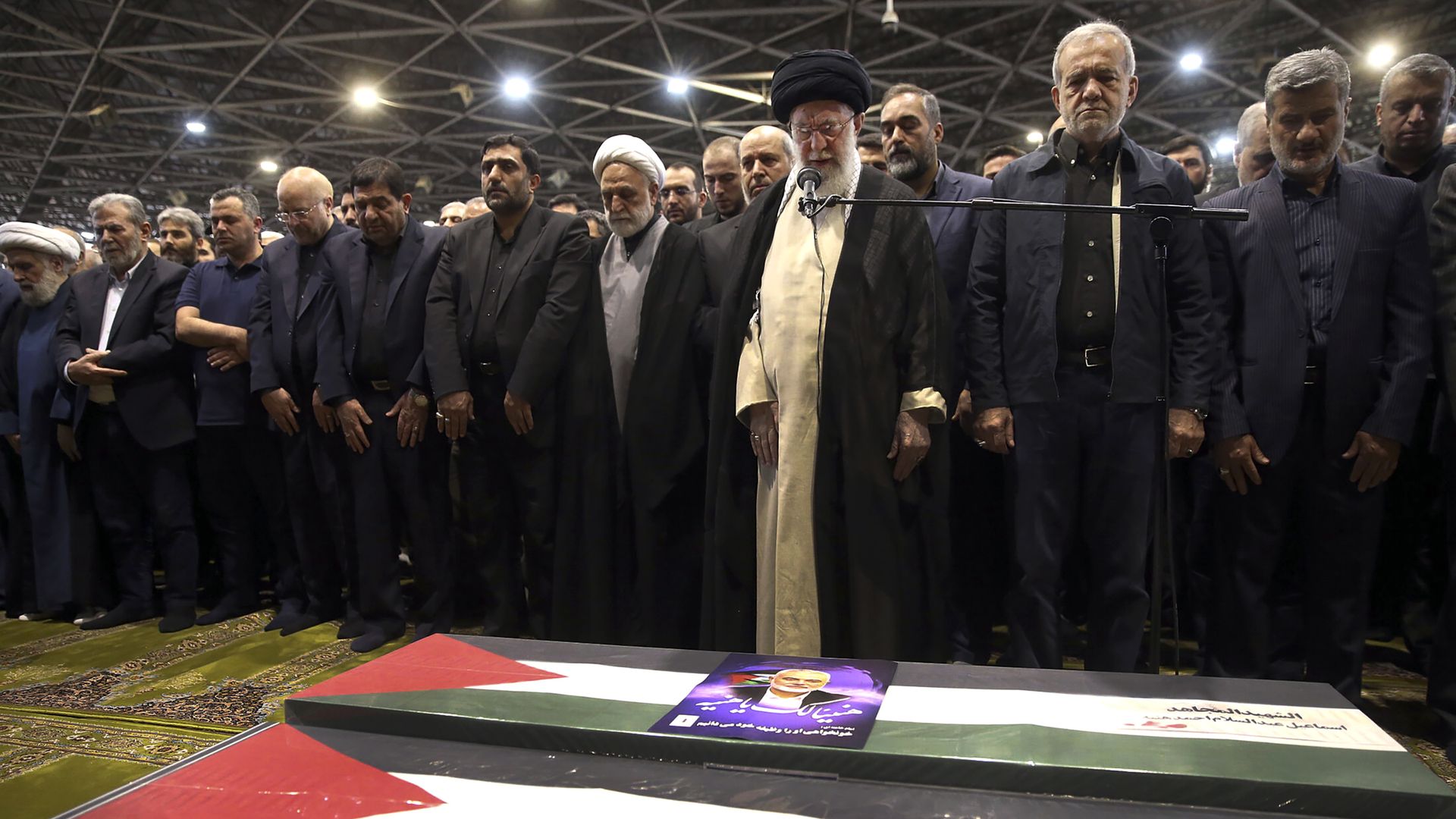
Iranian Supreme Leader Ayatollah Ali Khamenei leads a prayer for slain Hamas leader Ismail Haniyeh in Tehran. Photo: Office of the Iranian Supreme Leader/AP
Israel's assassination spree in Iran and Lebanon has brought the Middle East closer to a devastating regional war than at any point since Hamas' Oct. 7 terrorist attack.
Why it matters: The dangerous spiral of escalation could drag the U.S. deeper into the regional crisis and lead to mass suffering well beyond Gaza, where hopes for a ceasefire and hostage deal are slipping away after months of careful negotiations.
- For President Biden, who has vowed to use his remaining months in office to end the Israel-Hamas war and bring home the hostages, the stakes are legacy-defining.
- Biden reaffirmed his commitment to Israel's security in a call with Prime Minister Benjamin Netanyahu on Thursday, where the two leaders discussed "new military deployments" to protect Israel from Iran.
The big picture: For 10 months now, the Israel-Hamas war has spawned spurts of violence elsewhere in the Middle East. The latest tensions threaten to escalate into all-out war across multiple fronts.
- Iran: The Biden administration is convinced Iran is going to attack Israel within days in retaliation for the assassination of Hamas political leader Ismail Haniyeh in Tehran earlier this week.
- Lebanon: Hezbollah leader Hassan Nasrallah vowed to exact revenge Thursday for Israel's assassination of senior military commander Fuad Shukr in Beirut. "We are not talking about separate fronts anymore," Nasrallah said at Shukr's funeral, warning of a "new phase" of the war.
- Yemen: The leader of the Iran-backed Houthi rebels pledged a "military response" Thursday in response to Israel's assassination of Haniyeh. Two weeks ago, Israel struck Yemen for the first time in retaliation for more than 200 Houthi attacks against Israeli targets, including a drone strike on Tel Aviv.
- Iraq: After months of an unofficial "ceasefire," pro-Iranian Shia militias in Iraq resumed their attacks on U.S. forces in the region. The U.S. struck a militia base in southern Iraq this week in response to the growing threat.
Flashback: On several occasions since Oct. 7, Israel has pulled back from the brink of a cataclysmic, multi-front war.
- On Oct. 11, the Israeli security cabinet — still shocked by Hamas' surprise attack and fearing another front in the north — considered a massive strike on Hezbollah. Netanyahu decided against it.
- On April 13, Iran launched 350 missiles and drones at Israel for the first time in history in retaliation for Israel killing one of its generals in Syria. Under U.S. pressure, Netanyahu decided not to immediately respond and instead ordered a symbolic strike on Iran.
- Now, U.S. officials fear the events of recent days and weeks have created a series of open scores that Iran and its proxies in the region are determined to settle.
Behind the scenes: Biden and his top aides are highly frustrated by the current situation.
- U.S. officials don't mourn either Hezbollah's Shukr, who was involved in killing 241 U.S. Marines in Beirut in 1983, or Hamas' Haniyeh, who celebrated the Oct. 7 massacre.
- But after Biden met with Netanyahu last week in the Oval Office, U.S. officials thought they were making progress toward a Gaza hostage and ceasefire deal.
- Then Israel killed Haniyeh, who represented Hamas in those talks, without consulting Washington. The administration's insistence that a ceasefire is still within reach is starting to ring hollow.
Netanyahu, on the other hand, feels emboldened. In terms of his political survival, this was the prime minister's best week since Oct. 7.
- Netanyahu has delivered mostly welcome news to the Israeli people: the killing of Haniyeh, Shukr and confirmation of Hamas military leader Mohammed Deif's death in an Israeli strike last month.
- In a call that two U.S. officials described as "tough," Biden told Netanyahu that the U.S. would help Israel defend itself against a new Iranian attack — but stressed that de-escalation must be the priority.
What to watch: The Biden administration is concerned it may be more difficult to mobilize the same international and regional coalition of countries that helped Israel repulse the previous Iranian attack in April.
