U.S. concerned Hamas leader's assassination could derail Gaza hostage-ceasefire talks

Add Axios as your preferred source to
see more of our stories on Google.
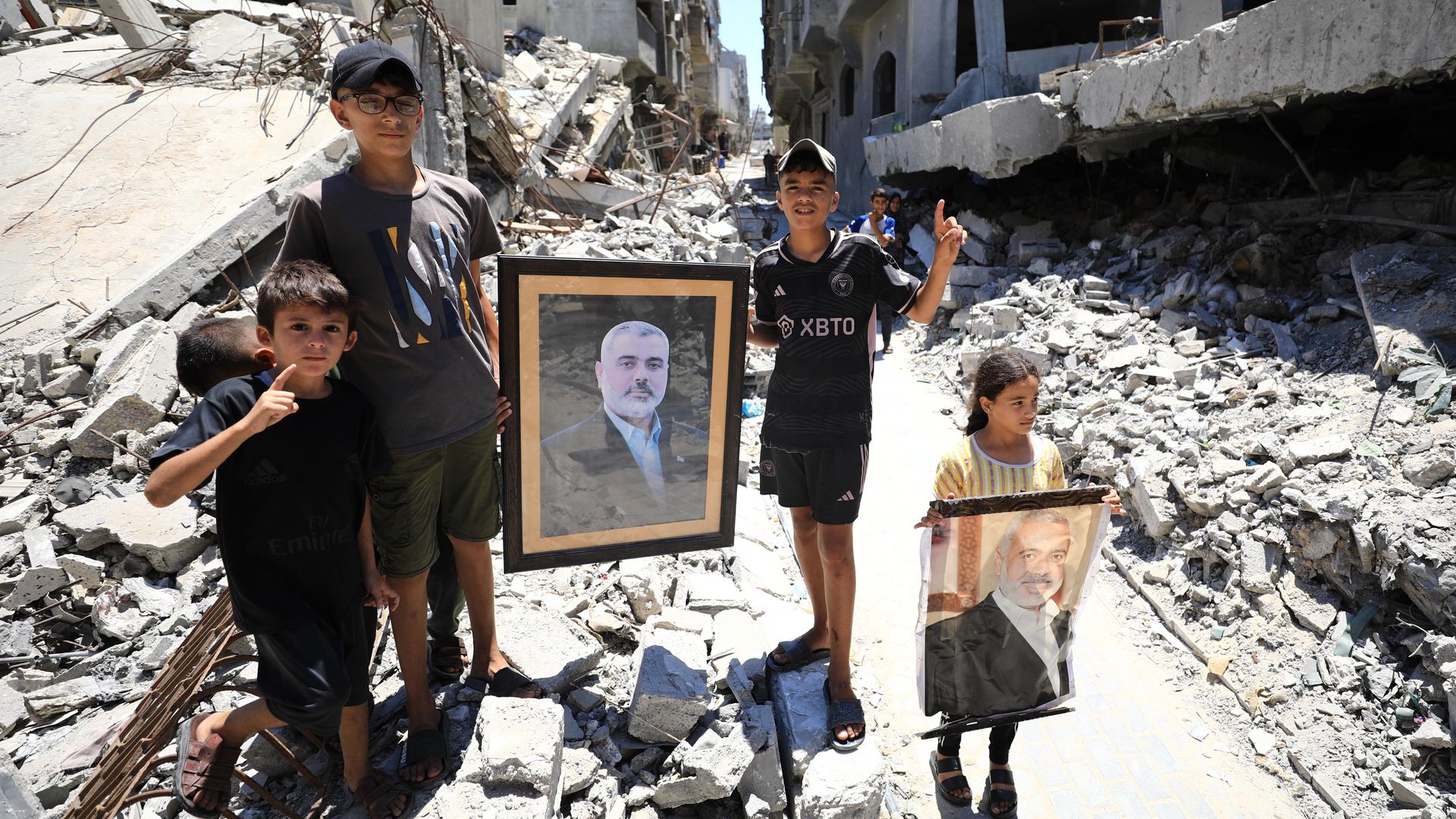
Palestinians carry the portrait of Hamas political bureau chief Ismail Haniyeh as they stand on the debris of a destroyed building belonging to Haniyeh in Al-Shati refugee camp of Gaza City on July 31, 2024. Photo: Dawoud Abo Alkas/Anadolu via Getty Images
The Biden administration is "very concerned" the assassination of Hamas' political leader Ismail Haniyeh could derail negotiations over the Gaza hostage and ceasefire deal and increase the risk of a regional war, three U.S. officials said.
Why it matters: The Biden administration has put a hostage and ceasefire deal between Israel and Hamas at the center of its entire post-war strategy in the Middle East.
- President Biden is personally involved in efforts to reach an agreement and sees it as a key factor in defining his legacy.
- Haniyeh was the key interlocutor with Qatari and Egyptian mediators in the negotiations over the deal.
The latest: White House spokesperson John Kirby said in a briefing with reporters on Wednesday that it is "too soon to know" how Haniyeh's assassination would influence the Gaza hostage and ceasefire talks.
- "This doesn't mean we are going to stop working on it," he said.
Driving the news: Haniyeh was killed on Tuesday night when he was sleeping in an Iranian government official guest residence in Tehran. His deputy Khalil al-Haia said a missile hit his bedroom and killed him.
- Hamas and the Iranian government accused Israel of killing Haniyeh and said they will retaliate.
- The Israeli Prime Minister's office and Ministry of Defense declined to comment.
But U.S. and Israeli officials say Israel was behind the assassination.
- U.S. Secretary of State Antony Blinken said on Wednesday that the U.S. wasn't aware of the assassination before it happened and wasn't involved.
In a statement on Wednesday, Israeli Prime Minister Benjamin Netanyahu said Israel "will exert a cost" from anybody who attacks it "from any arena."
State of play: Qatari Prime Minister Mohammed Bin Abdul Rahman al-Thani, who is a key mediator in the indirect negotiations between Israel and Hamas, expressed concern about the future of the deal.
- "Political assassinations and continued targeting of civilians in Gaza while talks continue leads us to ask, how can mediation succeed when one party assassinates the negotiator on the other side? Peace needs serious partners and a global stance against the disregard for human life," he wrote on his X account.
- Israeli officials said they expect the negotiations will be suspended in the immediate term.
Shortly after al-Thani's comments, Blinken called the Qatari prime minister and "emphasized the importance of continuing to work to reach a ceasefire and hostage deal in Gaza," State Department spokesperson Matthew Miller said in a statement.
- Miller added that Blinken told his Qatari counterpart the U.S. would continue to work to ensure an agreement is reached.
- Israeli Minister of Defense Yoav Gallant spoke on Wednesday with U.S. Secretary of Defense Lloyd Austin and told him that "especially during these times, Israel is working to achieve a framework for the release of hostages," Gallant's office said.
- The White House declined to comment.
What they're saying: A U.S. official told Axios there is recognition within the Biden administration that Haniyeh was "a bad guy" but at the same time there is grave concern this assassination could also derail the hostage and ceasefire talks.
The big picture: Biden administration officials are also concerned the assassination in Tehran could make it much harder to avoid a regional war.
- After an Israeli strike on Beirut killed a top Hezbollah military commander on Tuesday, Biden administration officials felt even if Hezbollah responds, it will happen in a way that doesn't lead to an all-out war.
- Kirby even said in recent days that the scenario of a war between Israel and Hezbollah was "exaggerated."
But Haniyeh's assassination created a much more dangerous situation with a higher potential for escalation, a U.S. official said, adding he was "bewildered" by the Israeli assassination of Haniyeh in Tehran and the timing of it.
- U.S. officials are concerned that the killing of Hezbollah's top military adviser in Beirut together with the Haniyeh assassination in Tehran could create a critical mass of pressure on Iran, Hezbollah and other proxies to respond in a much harsher way than they originally planned.
- Gallant told Austin "Israel does not seek war" but stressed that the Israel Defense Forces "remains prepared to respond to any attack by Hezbollah," the Israeli Ministry of Defense said in a statement.
In Wednesday's briefing, Kirby said there is no indication that an all-out war between Israel and Hezbollah is imminent.
- "We are obviously concerned about an escalation and that complicates what we are trying to get done and this is a ceasefire and release of hostages," he said.
- "When you have dramatic events it doesn't make the task of achieving that any easier."
- The U.S. State Department on Wednesday said U.S. citizens shouldn't travel to Lebanon "due to rising tensions between Hezbollah and Israel."
Editor's note: This story has been updated with a statement from Netanyahu, comments from Kirby and the State Department's travel advisory.
