What to know about Venezuela's presidential election on Sunday

Add Axios as your preferred source to
see more of our stories on Google.
Venezuelans will head to the polls on Sunday to vote for the country's next president in an election mired with allegations of electoral interference.
Why it matters: Years-long political and economic destabilization has forced millions of Venezuelans to flee to nearby countries and the U.S.
- The U.S. in April reinstated oil sanctions, saying the government of President Nicolás Maduro, who is seeking a third six-year term, broke promises for a fair election.
State of play: Polls show Edmundo González Urrutia, who represents the opposition coalition, has a wide lead over Maduro.
- Maduro has been in power since the death of his predecessor, Hugo Chávez, in 2013. He's a member of the United Socialist Party of Venezuela (USPV), the policies of which are widely known as chavismo.
- USPV has been accused of interfering in past elections and of stifling the opposition again this year by arresting dozens of opposition campaign workers, reversing invitations for some international electoral observers, kicking out the UN's Human Rights office and banning key candidates from running.
- In the latest turn of events, the opposition has said Maduro's allies are blocking poll watchers from being credentialed.
Flashback: González Urrutia was not initially supposed to be the opposition's candidate for president — María Corina Machado, a former member of Congress, overwhelmingly won the coalition's primaries in October.
- But within a week of the primary, the Maduro regime had suspended the results of the election and eventually barred Machado from running. González Urrutia, a former diplomat, was chosen to run in her place.
The other side: Maduro pushed back against U.S. government allegations that his government broke its commitments for fair elections. He blames U.S. oil and gas sanctions for Venezuela's economic collapse.
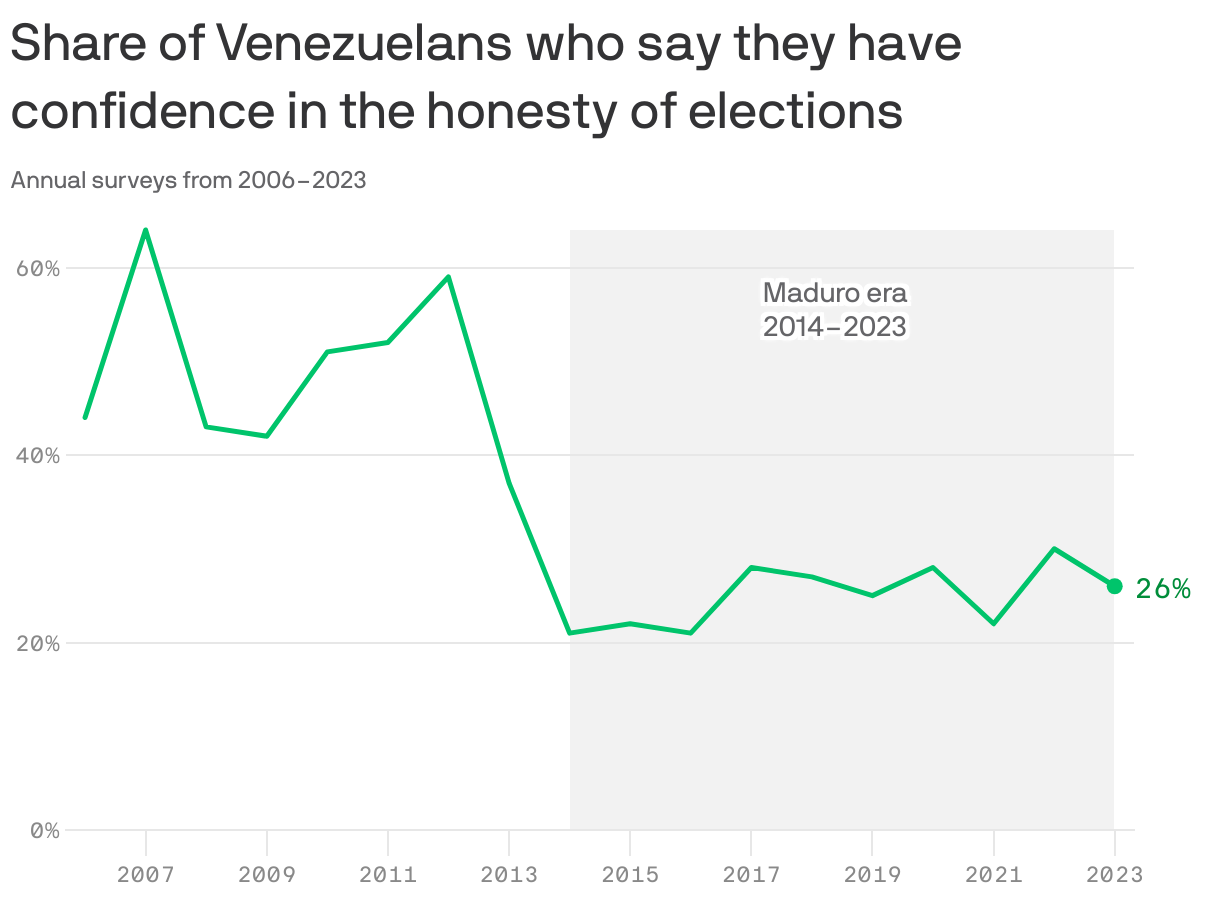
The big picture: As democratic institutions have crumbled under Maduro, so has faith in elections. Only 26% of Venezuelans in late 2023 said they have confidence in the honesty of elections, according to the latest polling by Gallup.
- 68% said they struggle to afford food, and 54% said they do not feel safe walking alone at night.
- "The Maduro era has been characterized by a lot of frustration from the population," says Jesus Rios, Gallup's regional director for Latin America.
- "All around our key metrics, we see the deterioration during the Maduro era," Rios said, adding that normally when Gallup sees those kinds of negative responses in other countries, "we see changes of government, we see revolts, we see conflict."
- While there's been some conflict in Venezuela, there hasn't been a change of government, and that's "something that calls attention," Rios says.
What we're watching: It's unclear how quickly the results will be tallied after Sunday's elections, or whether the Maduro regime will even acknowledge them.
- Venezuela's electoral commission, CNE, is allied with Maduro.
Subscribe to Axios Latino to get vital news about Latinos and Latin America, delivered to your inbox on Tuesdays and Thursdays.
