Harris plans to finish Biden's progressive agenda

Add Axios as your preferred source to
see more of our stories on Google.
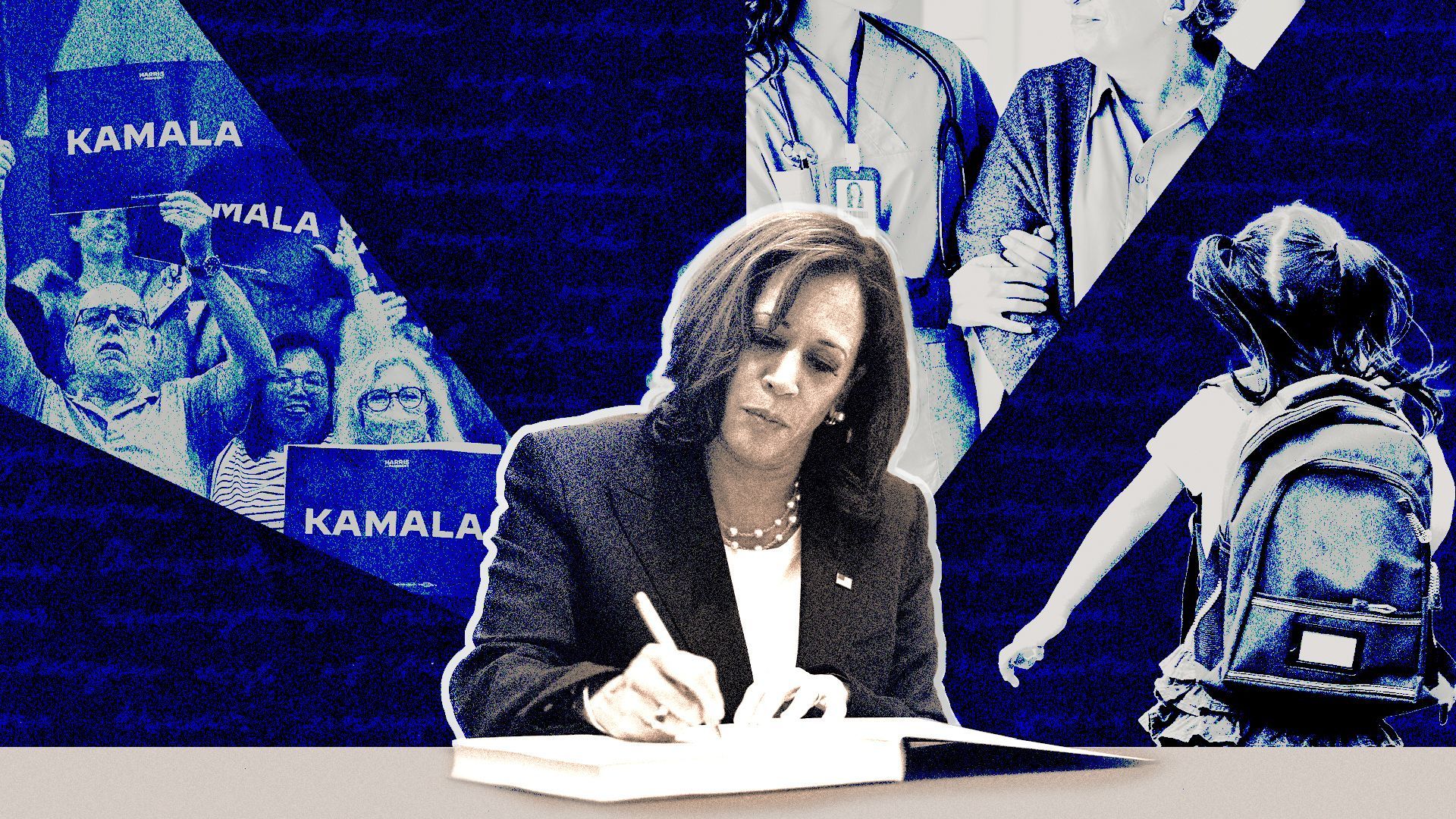
Photo illustration: Gabriella Turrisi. Photo: Brendan Smialowski/AFP via Getty Images, Jim Vondruska via Getty Images
Vice President Kamala Harris has used her first days as Democrats' likely nominee for president to make it clear that she'll pursue big — and expensive — parts of Joe Biden's domestic agenda that never made it across the finish line.
Why it matters: Harris is signaling that even as Democrats play defense on Biden's mixed economic record, she's eager to go on offense for the next four years.
- Her plans include pushing for nearly $2 trillion to establish universal pre-K education and improve elderly care and child care — as well as a permanent tax cut for working-class families.
- Her instincts are to go further than Biden's attempt to raise corporate taxes to 28%, according to people familiar with the matter who recall that Harris backed raising them to 35% in 2020.
Driving the news: Harris previewed her economic priorities when she dropped by her campaign headquarters in Wilmington, Del., on Monday, and then again at her rally in Milwaukee on Tuesday.
- "We believe in a future where no child has to grow up in poverty," she said in Wilmington. "And where every person has access to paid family leave and affordable child care."
- That's music — and code — to progressives' ears.
- As a senator, Harris was a champion of the expanded child tax credit, which provided annual tax breaks of up to $3,600 per child for families. Biden included it in his $1.9 trillion COVID relief bill, but it expired after one year.
- Harris led the internal — and ultimately unsuccessful — effort to restore some version of the tax credit.
Zoom out: In the 2020 Democratic primary, Harris campaigned as a progressive. She supported Medicare for All, before she was against it. She supported a fracking ban before walking back on that position once she was Biden's running mate.
- As vice president, she has governed as a moderate, helping Biden to push through his Bipartisan Infrastructure Law, the Chips and Sciences Act and the Inflation Reduction Act.
- In the administration's most heated economic debate — whether to lower some of Donald Trump's tariffs to help lower inflation — Harris sided with Biden and argued to keep the tariffs in place.
- More broadly, she has embraced the pillars of Biden's new industrial policy, and accepted the emerging consensus that tariffs are a legitimate tool in international economics.
- "She's a classic progressive who is skeptical of trade but doesn't want to go as far as Trump in terms of imposing blanket tariffs," a former Biden administration official said.
- "Right now, on economic policy, she is the midpoint of the Democratic Party, which is far from the center" of the overall political conversation, the official said.
Flashback: In one of her first acts as vice president, Harris convened a group of small business owners to signal that her sympathy rested with scrappy entrepreneurs and not big corporations.
- It's a point she has made on the road all year, announcing new grants for women and minority-owned businesses in swing states.
- Weeks into her term as vice president, she called JPMorgan Chase CEO Jamie Dimon and Bank of America CEO Brian Moynihan to press them to issue more loans to minority and low-income communities under the Paycheck Protection Program.
- People familiar with the discussions said her message was clear: We are willing to work with you, but we also are watching you.
