Exclusive: Company to unveil first CO2 capture module for mass production

Add Axios as your preferred source to
see more of our stories on Google.
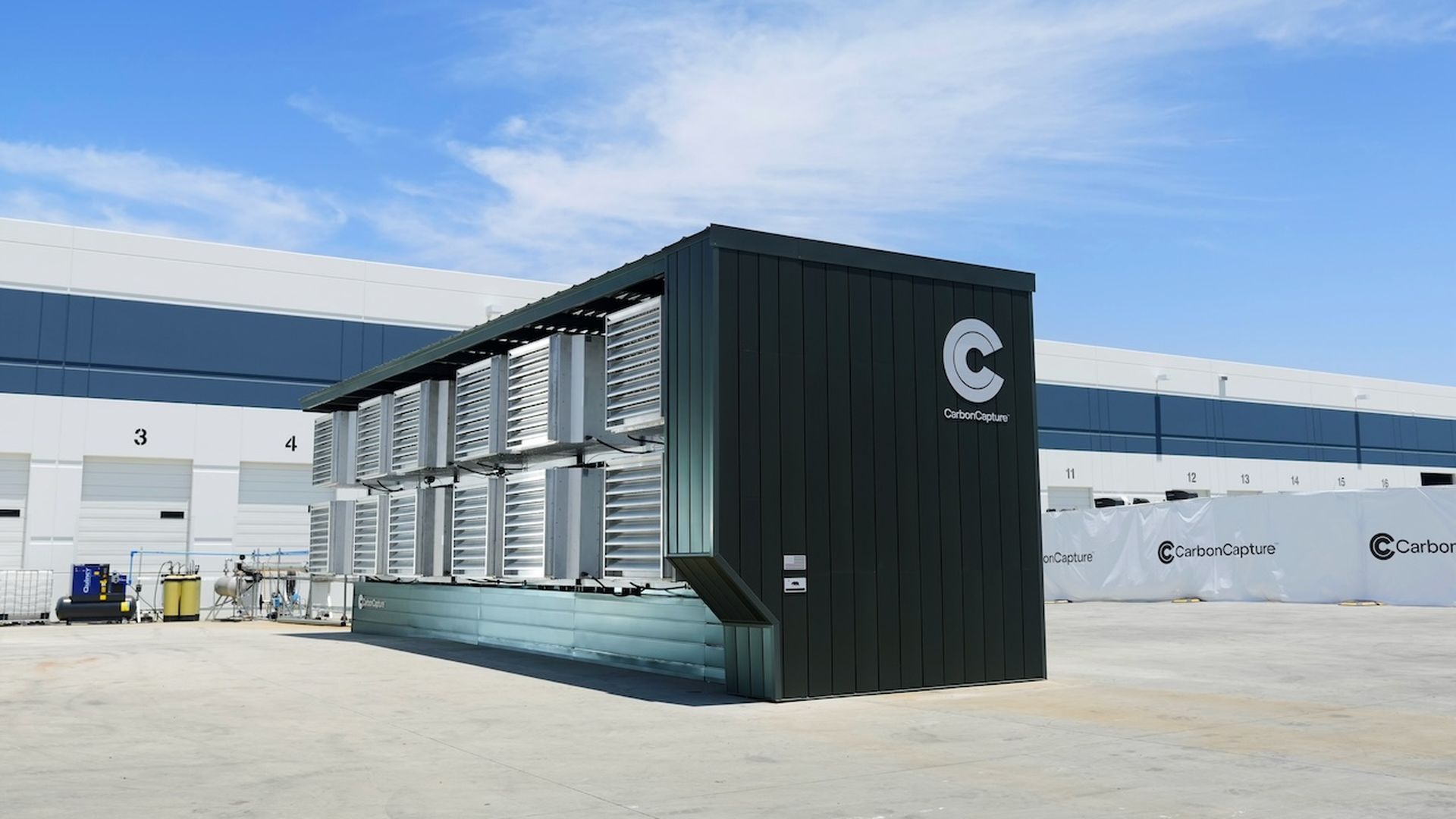
Direct Air Capture module from CarbonCapture Inc. Photo: CarbonCapture Inc.
CarbonCapture Inc. will unveil the first direct air capture module designed for mass production in the U.S. today near Los Angeles.
Why it matters: Scaling direct air capture requires progressing from absorbing and trapping megatons of carbon dioxide from the air, to drawing down gigatons of legacy emissions and emissions from hard-to-abate sectors.
- A design like CarbonCapture's that allows for mass production has the potential to help do that.
At present, direct air capture technology is expensive, energy-intensive and far from scaling up to the point where scientists say it would make a significant difference in fighting climate change.
Zoom in: The company's modular units, known as the Leo Series, will be capable of capturing more than 500 tons of CO2 per year, the company claims.
- It said that each module is the size of a standard shipping container, and they will be built at a factory that will be capable of churning out 4,000 of them per year.
- The company, which attracted a $80 million Series A funding round in March that was led by Prime Movers Lab and included Aramco Ventures and Amazon Climate Pledge Fund, plans to deploy its first Leo Series next year.
The modules are set to be manufactured at the company's planned facility in Mesa, Ariz.
- The modules use sorbents to absorb CO2 from the air. Over time, improvements in sorbents can allow for built modules to be upgraded to be capable of absorbing more CO2.
- The modular approach also may provide opportunities to drive down the cost of DAC by deploying more modules and achieving efficiencies from mass production, similar to the build-up of larger solar arrays over time.
Between the lines: The modular approach to sorbent-based direct air capture is similar to one of CarbonCapture's competitors, the Swiss firm Climeworks.
- However, Patricia Loria, vice president of business development at CarbonCapture., told Axios there's an advantage to having more than one company working to push the envelope on sorbent-based ways to extract the CO2 from the air.
- CarbonCapture CEO Adrian Corless told Axios that his company has partnerships with research institutions to develop more effective sorbents, allowing modules to be updated and become more effective over time.
- He also noted his firm's intention to "develop a supply chain and to manufacture these modules in the US," which Climeworks is not doing.
Zoom out: The factory is large enough to produce the modules while also supplying Project Bison, which is the company's removal project in Wyoming, as well as the Southwest Regional Direct Air Capture Hub.
- The Energy Department supports both via grants under the $3.5 billion Regional Direct Air Capture Hubs program.
- While the Energy Department is spending big to spur the development of the air capture industry, studies show that far more money, development and deployment are needed in order to limit human-caused global warming to the Paris targets.
- That is on top of the top near-term priority, which is rapidly reducing greenhouse gas emissions.
What they're saying: "If we think about this decade as a critical decade to get direct air capture to fully commercial scale, then taking the step of developing a modular unit and a manufacturing facility to produce that technology at scale for projects on the ground, that is a big step and it's worthy of recognition," Brad Crabtree, the Energy Department's assistant secretary for fossil energy and carbon management, told Axios.
