What to know about the Russia-North Korea alliance


Add Axios as your preferred source to
see more of our stories on Google.
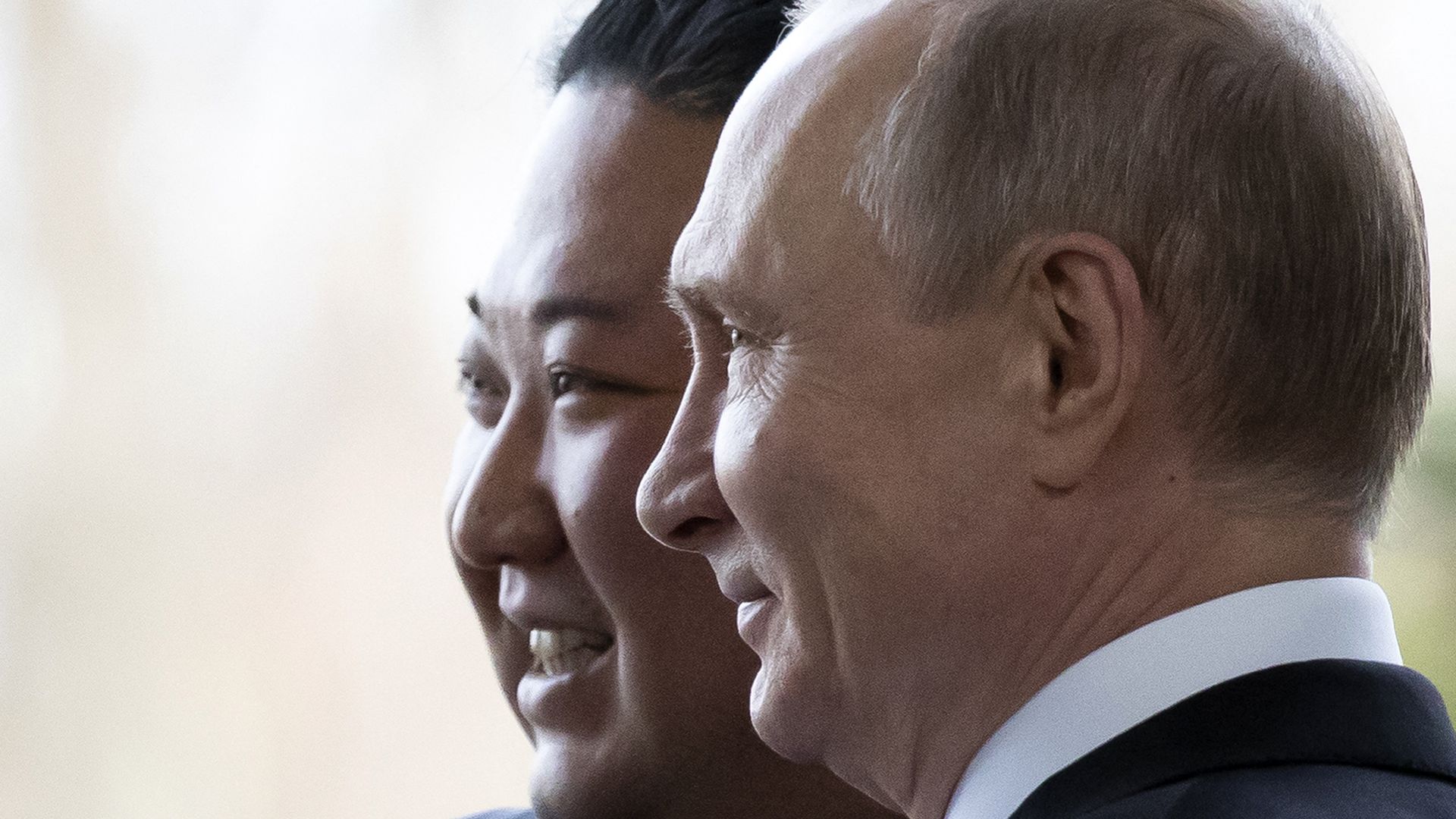
Russian President Vladimir Putin and North Korean leader Kim Jong Un in Vladivostok, Russia, in April 2019. Photo: Alexander Zemlianicchenko/POOL/AFP via Getty Images
The U.S. confirmed Wednesday that North Korea has deployed troops to Russia, a significant development that could aid the Kremlin's forces in the war in Ukraine.
Why it matters: The deployment is the latest sign of a strengthening alliance between Moscow and Pyongyang, two of the U.S.'s staunchest foes.
Catch up quick: Secretary of Defense Lloyd Austin's confirmed the deployment. He said the U.S. is still trying to determine what their purpose is, but warned it would be a "very serious issue" is North Korea intends to be a co-belligerent in Russia's war in Ukraine.
- The development could indicate Russian President Vladimir Putin is in "more trouble than most people realize," Austin added.
- Ukrainian President Volodymyr Zelensky warned last week that at least 10,000 North Korean troops would soon join Russia in its war against his country.
What are North Korea and Russia's relations?
Moscow and Pyongyang's relationship was complicated by the fall of the Soviet Union but has recently strengthened amid their shared animosity toward democratic values, like freedom of speech, that are threats to their regimes.
- But recent moves have also stemmed from short-term convenience, particularly after Ukraine's significant impact on Russia's military and with North Korea's continued isolation due to its nuclear provocations.
- Russian President Vladimir Putin needs additional munitions to strike both civilian and military targets across Ukraine, while North Korean dictator Kim Jong-un's Hermit Kingdom desperately needs food imports, access to newer technologies — specifically new space capabilities — as well as avenues to the world financial system to evade Western sanctions.
State of play: The two countries' relationship particularly expanded after Kim visited Putin in Russia's far east in September 2023. Kim had made similar visits in the past, but last year's trip was their first since the start of the invasion of Ukraine.
- In June, Putin traveled to North Korea to meet with Kim and the pair agreed to strengthen military ties. The two nations signed a mutual defense partnership agreement during the visit.
- Even before then, U.S. officials claimed to have intelligence showing that Russia bought millions of rockets and artillery shells from North Korea, which secretly supplied the armaments by disguising them as shipments to other countries.
What does the alliance mean for the U.S.?
The Russia-North Korea partnership significantly complicates U.S. foreign policy. Past U.S. administrations have used carrots, like food aid, and sticks, like sanctions, to try to constrain Pyongyang.
- Russia seems willing to provide carrots of its own, and make it harder for the U.S. to wield the stick, by vetoing UN Security Council sanctions.
- U.S. analysts fear the relationship may bolster Kim's confidence, leading to more provocations against South Korea and Japan, like its volley of bags of trash across the demarcation line separating the two Koreas.
What Russia has gained from the alliance?
U.S. officials later said that since Kim and Putin's 2023 meeting, North Korea had sent Russia around 260,000 metric tons of munitions or munitions-related materials.
- The additional artillery and rockets from North Korea allowed Russia to maintain its high rate of fire throughout the invasion, which has been estimated to be at least 10,000 artillery shells per day.
- Months after Kim's visit, U.S. officials claimed Russia had started using North Korean ballistic missiles against Ukraine and by December 2023 had fired over 40 of the missiles.
How does North Korea benefit from helping Russia?
It's unclear what specifically North Korea has gained through the weapons sales beyond hard currency and food.
- National Security Council spokesperson John Kirby said in January that North Korea desires "fighter aircraft, surface-to-air missiles, armored vehicles, ballistic missile production equipment or materials" from Russia, while U.S. intelligence has suggested it's received "diplomatic, economic, and military concessions."
- Other intelligence suggests that includes Russian oil and Moscow helping with North Korea's first successful satellite launch earlier this year.
- Because Russia is using North Korean armaments on the battlefield, Pyongyang is gaining information on how its weapons systems, specifically its ballistic missiles, perform.
Zoom in: North Korea has gained sanctions relief from its burgeoning relationship with Russia.
- The armaments transfers from North Korea to Russia violated United Nations Security Council arms sanctions against North Korea that Russia supported after Pyongyang's nuclear and missile tests in the 2000s and 2010s.
- Russia blocked additional sanctions against North Korea for its ballistic missile tests in 2022 and 2023 and in March 2024 prevented the renewal of a panel of experts that monitor the implementation of UN sanctions on Pyongyang.
- Russia has also unlocked millions of dollars of North Korean assets that were previously frozen in Russian financial institutions, which may also be helping Pyongyang skirt sanctions.
What does it mean for the rest of the world
Russia and North Korea are just one aspect of a wider anti-West coalition that's coalesced around Russia's invasion of Ukraine.
- The Kremlin has received significant military assistance from Iran, and it receives material support and political cover from China.
- Beijing is at most ambivalent toward Russia's invasion, as it has not condemned it and has abstained during United Nations votes against the war and Russia's illegal annexation of Ukrainian territory.
The big picture: The consistent element between these regimes is a desire to undermine democratic intuitions and principles in favor of their model of strong-man authoritarianism.
- They also have territorial ambitions of their own, with North Korea claiming to represent all of the Korean people, China open to forcibly annexing Taiwan and Iran seeking to become a regional hegemony in the Middle East.
Go deeper: What to know about Putin's BRICS summit with world leaders
