Eclipse eye safety: How to safely see Monday's eclipse

Add Axios as your preferred source to
see more of our stories on Google.
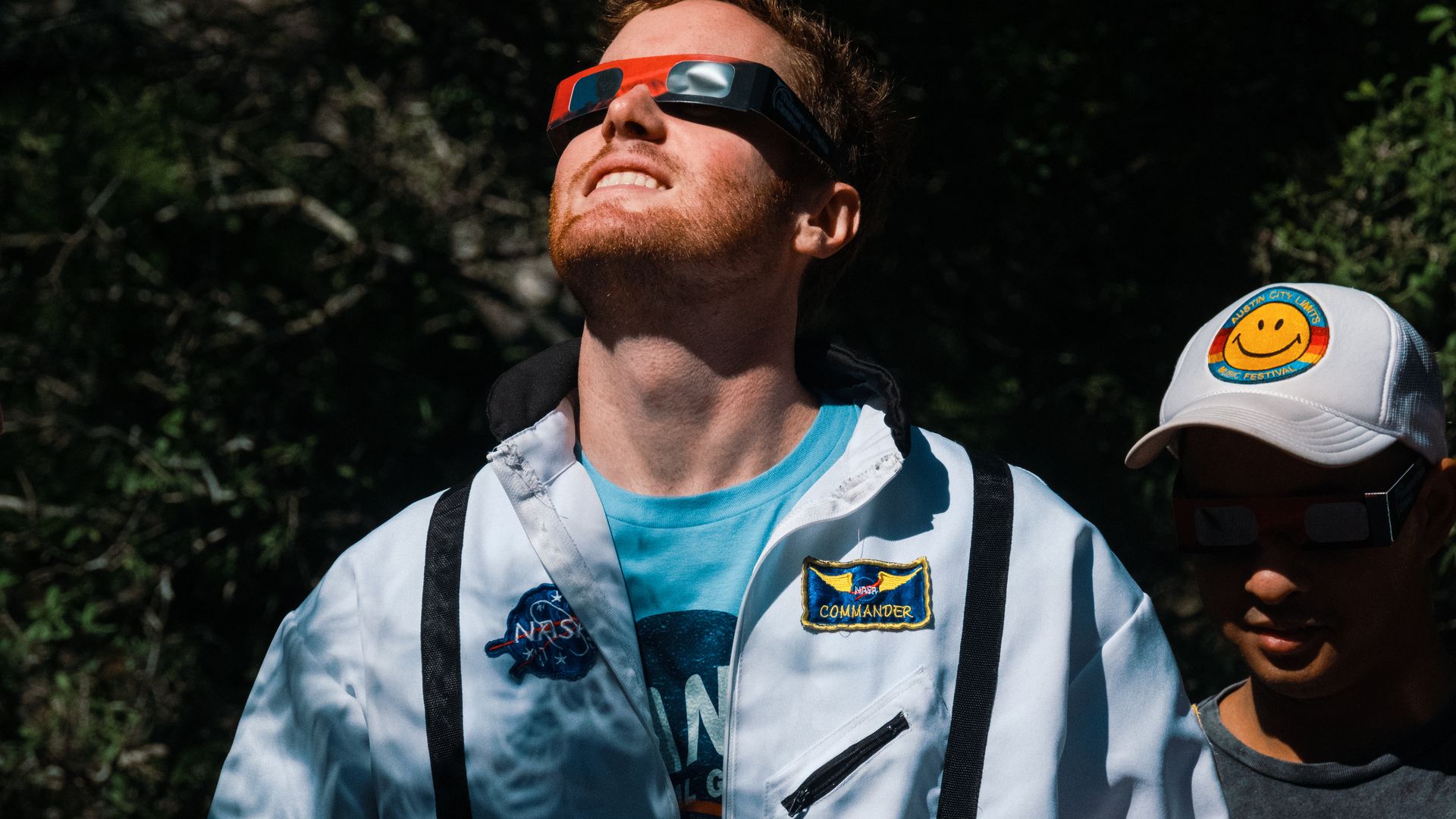
Spectators in Driftwood, Texas wear solar viewing glasses during October's solar eclipse. Photo: Jordan Vonderhaar/Bloomberg via Getty Images
For most of the country, looking at Monday's rare solar eclipse — even a quick glance — can cause eye damage if you don't wear the right protective eyewear.
Why it matters: NASA warns "it is not safe to look directly at the Sun without specialized eye protection for solar viewing" except during the brief total phase of a total solar eclipse.
- Staring straight at the Sun during partial solar eclipses can cause permanent damage to the retina, according to the American Astronomical Society.
- This can also cause blindness or "solar retinopathy."
Driving the news: Hospitals are on high alert for increased traffic accidents, the potential for mass casualty events and eye damage, Axios' Maya Goldman reports.
- Follow Axios' live eclipse updates here throughout the day Monday.
Solar eclipse glasses are not the same as sunglasses
Threat level: Sunglasses aren't safe for viewing the Sun during the eclipse.
- Safe solar viewers are "thousands of times darker" than the darkest sunglasses and comply with the ISO 12312-2 international standard, according to the American Astronomical Society.
What they're saying: The society is warning of counterfeit and fake eclipse glasses that have been circulating and suggests trying on your pair before the eclipse.
- "You shouldn't be able to see anything through them, except perhaps very bright lights, which should appear very faint through the glasses," the society said.
- "If you can see anything else, such as household furnishings or pictures on the wall, your glasses aren't dark enough for solar viewing."
When and where it's safe to take eclipse glasses off
The big picture: The path of totality will pass over parts of 15 states and should completely engulf several major cities in darkness, including Dallas, Indianapolis and Cleveland.
- It's only safe to view the eclipse without protection in places in the path of totality and only during the brief period when you can't see any part of the Sun through eclipse glasses or a solar viewer, NASA explains.
Yes, but: Put your glasses on as soon as the Sun begins to reappear to look at the remaining partial phases, the Astronomical Society said.
Keep eclipse glasses on with partial eclipse
Most people outside the path of totality will instead see a partial eclipse, which makes the Sun look like a crescent.
- "In those areas, there is no safe time to look at the sun with the naked eye. You must protect your eyes while watching the entire eclipse," the American Academy of Ophthalmology advises.
Where to buy eclipse glasses: Walmart, Staples and more stores
National chains including Walmart, Home Depot, Lowe's, Staples, 7-Eleven and Kroger are selling eclipse glasses but availability can vary by location, the Astronomical Society notes.
- Meijer, H-E-B, Buc-ee's, Menards and Wegmans were also listed on the Astronomical Society's website.
Free eclipse glasses at Warby Parker, Sonic and libraries
Some businesses are giving away free glasses — while supplies last — including Warby Parker stores.
- Sonic Drive-In has a new cotton candy and dragon fruit-flavored black slush, which the chain says represents the eclipse's "temporary darkness," that comes with free glasses.
- Libraries across the country have been distributing free eclipse glasses as part of the Gordon and Betty Moore Foundation-funded Solar Eclipse Activities for Libraries project for both the October eclipse and this week's total eclipse.
- The same eclipse glasses that were distributed before October's eclipse can be used on Monday.
Eclipse eye damage symptoms
Context: Nonprofit Prevent Blindness says eye symptoms that can occur after looking at a solar eclipse include loss of central vision, distorted vision and altered color vision.
- The organization recommends seeking treatment from an eye care professional if you notice symptoms.
- The eye damage can be temporary or permanent and it can take a few hours to a few days to realize the damage has occurred, the New Mexico Department of Health said.
DIY options if you don't have eclipse glasses
NASA says if you don't have eclipse glasses or a handheld solar viewer, you can use an indirect viewing method like creating a pinhole projector or eclipse projector.
- The indirect methods do not involve looking at the Sun.
More from Axios:
- Everything you need to know about Monday's solar eclipse
- Why some will stay inside during the eclipse
- Solar eclipse playlist: Grab your glasses and hit play
Editor's note: This story was updated with a link to Axios' live eclipse blog. Follow along for updates Monday, April 8.
