Scoop: Democrats press Harvard, MIT and Penn on antisemitism

Add Axios as your preferred source to
see more of our stories on Google.
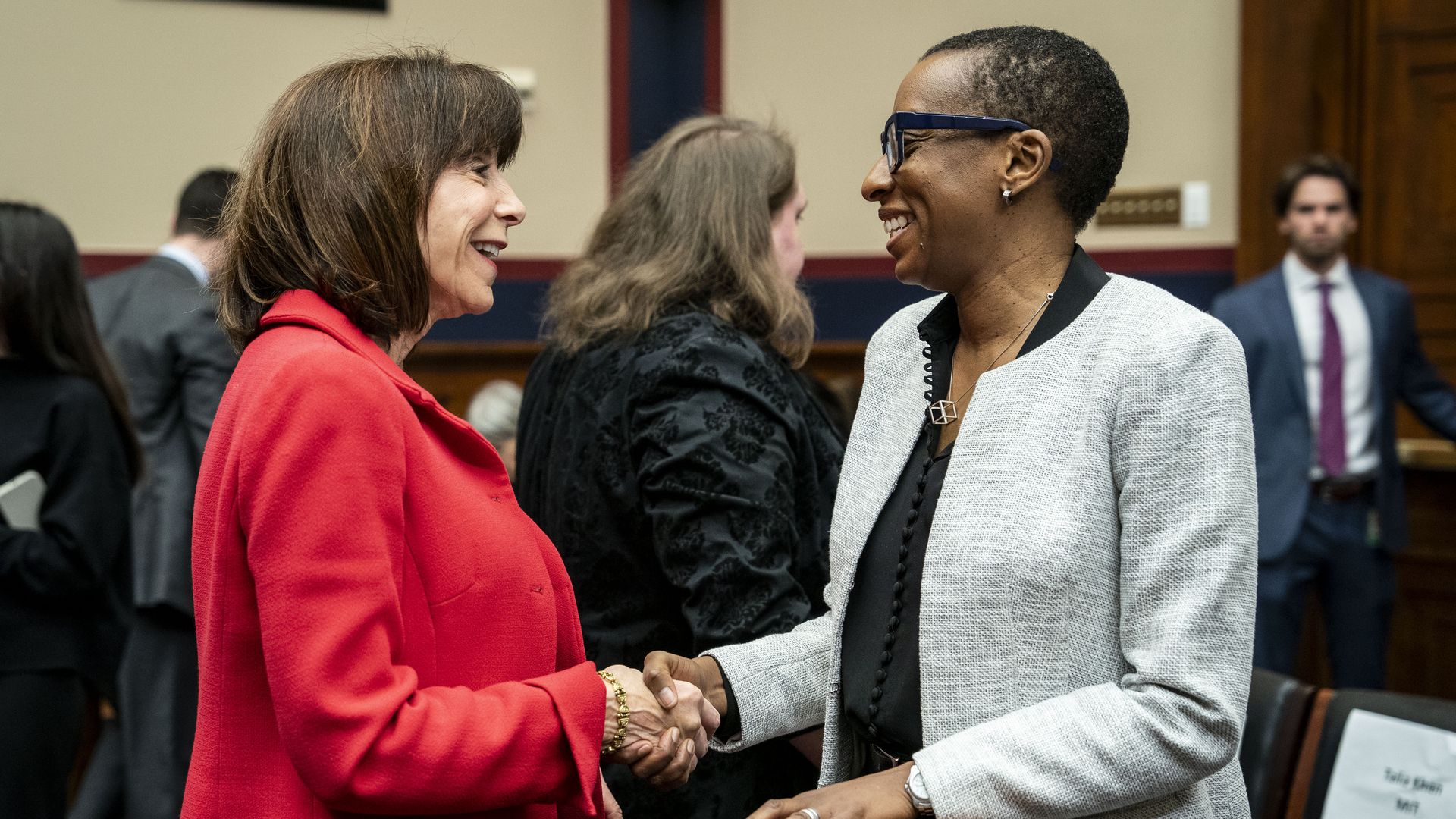
Rep. Kathy Manning and Harvard President Claudine Gay. Photo: Haiyun Jiang/Bloomberg via Getty Images.
House Democrats are demanding answers from Harvard, MIT and the University of Pennsylvania about antisemitism on their campuses in a letter citing their presidents' "unacceptable" congressional testimony this week, Axios has learned.
Why it matters: It's the starkest example yet of widespread disapproval among Democrats toward the unwillingness of the colleges' presidents to say that chants endorsing violence against Jews would be grounds for punishment.
- The White House and Pennsylvania Gov. Josh Shapiro (D) have also spoken out against their answers.
Driving the news: In a letter to the boards of Harvard, MIT and Penn, just over a dozen Democrats led by Rep. Kathy Manning (D-N.C.) asked "whether the testimony provided by your university presidents align with the values and policies of your respective institutions."
- Pointing to statistics showing a sharp rise in recent antisemitic incidents, they wrote that "Jewish students should have found comfort on their campuses" but face "an increasingly hostile educational environment."
- "We ask you to review and update your school policies and codes of conduct to ensure that they protect students from hate, and detail what action steps you are taking to combat antisemitism and to ensure Jewish and Israeli students, teachers, and faculty are safe on your campuses."
- The lawmakers asked for a "swift and comprehensive response."
Zoom in: Most of the 13 members on the letter are staunchly pro-Israel moderates, though some signers, including Reps. Jerry Nadler (D-N.Y.) and Grace Meng (D-N.Y.), are more progressive.
- Others, such as Rep. Susan Wild (D-Pa.), have been critical of the Israeli war effort at times and called for greater humanitarian aid to Gaza.
The backdrop: At a House Education & Workforce Committee hearing on Tuesday, Rep. Elise Stefanik (R-N.Y.) asked Harvard President Claudine Gay, MIT President Sally Kornbluth and Penn President Elizabeth Magill whether "calling for the genocide of Jews" violates their schools' codes of conduct.
- Each president said the answer depends on context. Gay, for instance, said it matters whether the speech is "targeted at an individual."
- Magill said calls for a "intifada" and "global revolution" are "very disturbing" and "hateful," but "whether it rises to the level of incitement to violence under [Penn's policies] I think is a much more difficult question."
What they're saying: "We've seen students pushed, spat upon and punched," Manning told Axios in an interview.
- The North Carolina Democrat has met with student groups who have "talked to me at length about their fears, and intimidation and hostility that they see."
- Manning said she thinks "most" Democrats are "horrified" about the situation on college campuses, saying she "wanted this letter to be timely" but believes hundreds would have signed onto it if she had waited until the House returned to session.
- As for Republicans, Manning said that she doesn't share the position that many of them have taken that the three presidents should resign: "I think that's beyond the scope of our responsibility."
The other side: The Foundation for Individual Rights and Expression (FIRE), which advocates fiercely for free speech on college campuses, has pushed back on criticism of the testimony, arguing that context does indeed matter and that censorship would ultimately be more harmful than the speech itself.
- "Even a narrow ban on calls for genocide — a term with a contested meaning — would inevitably be enforced in an arbitrary or viewpoint-discriminatory manner," FIRE said in a post on X.
After the testimony earlier this week, Magill said Wednesday that Penn's rules "need to be clarified and evaluated."
- In an interview with Harvard's student paper on Thursday, Gay said she is "sorry" and that she "failed to convey what is my truth."
- The board of MIT, for its part, offered its "full and unreserved support" for Kornbluth.
The big picture: The three colleges have faced intense political and financial backlash, both internal and external, in the wake of the testimony.
- A Penn donor withdrew a planned $100 million gift to the university in protest of the testimony and the board of advisers for Penn's Wharton business school has called on Magill to resign.
- Stefanik, who grilled the presidents over whether calls for the genocide of Jews would lead to repercussions, is also leading an investigation into the three universities and others over the questions.
Editor's note: This article was corrected to note that Gay's interview was on Thursday.
