Americans hunt for air purifiers as Canada wildfire smoke drifts over

Add Axios as your preferred source to
see more of our stories on Google.
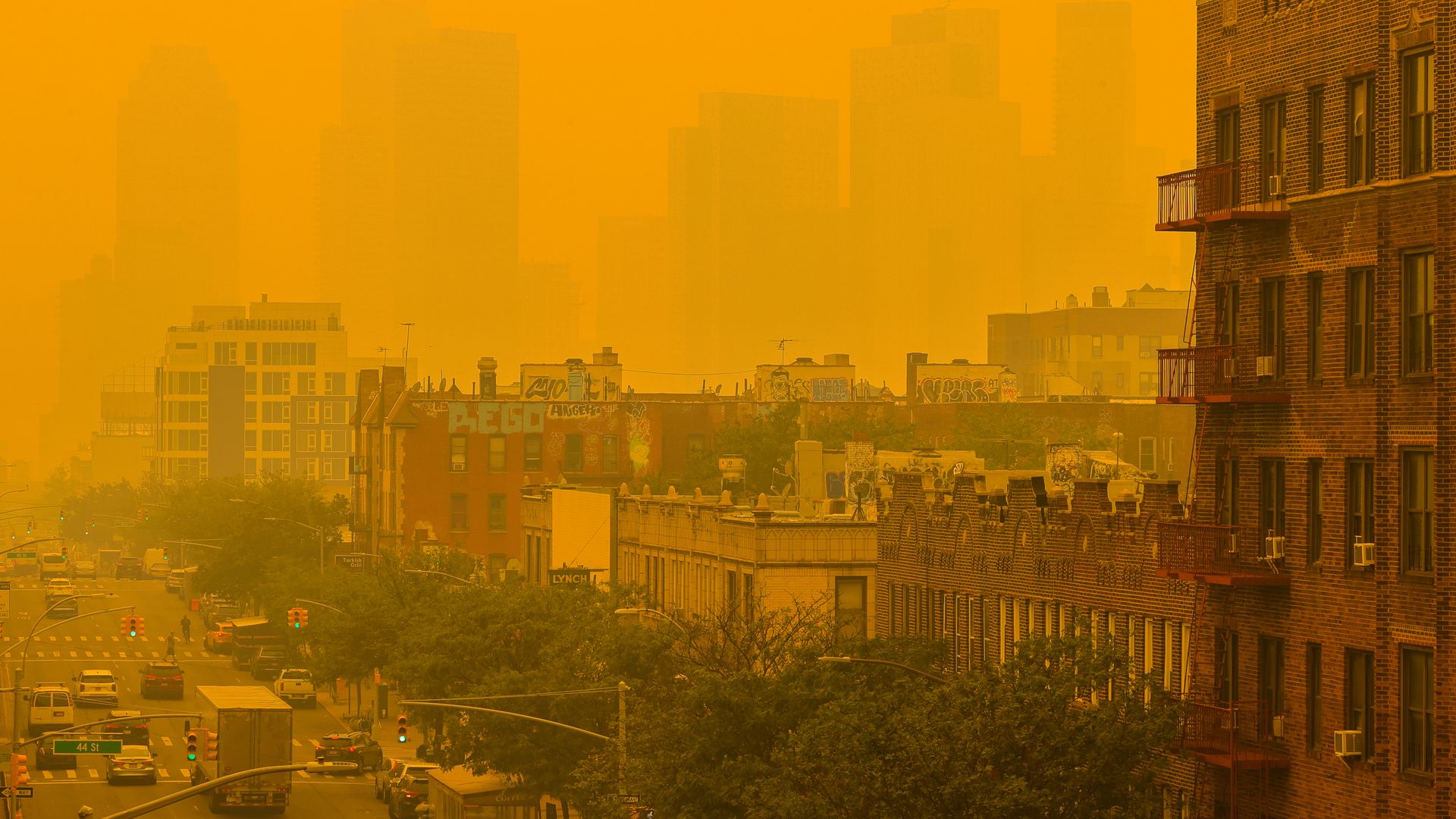
A view of a hazy New York City as smoke from Canadian wildfires blanketed the northeast U.S. Photo: Selcuk Acar/Anadolu Agency via Getty Images
Americans are snapping up air purifiers to thwart the effects of Canadian wildfire smoke sweeping across parts of the country.
Why it matters: "The microscopic particles in smoke can get deep into your lungs and cause bronchitis, asthma attacks, heart attacks, and strokes, as well as other problems," Consumer Reports writes, summarizing info from the Environmental Protection Agency and the Centers for Disease Control and Prevention.
- These particles can be deadly for people living with heart and lung disease, while children who inhale wildfire smoke "can experience chest pain and tightness, wheezing, coughing, dizziness, and trouble breathing," CR reports.
Driving the news: Retailers that sell air purifiers are running out in some areas, while consumers are scouring the internet for options.
- As of Thursday morning, Google searches for "air purifier" had increased by more than 450% over the previous day, according to Google Trends data provided to Axios. Other searches — like "do air purifiers help with wildfire smoke" — also soared in popularity.
- In Lehigh Valley in Pennsylvania, shoppers looking for air purifiers were greeted with bare shelves at local Target, Lowe's, Walmart and Home Depot stores, LehighValleyNews.com reported.
- “There doesn’t seem to be any air purifiers,” Freemansburg resident Dominick Medina told the site as he was searching for one.
- In the New York City area, some Target shelves "where expensive air purifiers are normally stocked were emptied," Fox News reported.
The impact: The stocks of several air purifier makers have jumped in recent days, with manufacturers Whirlpool and Carrier Global each up about 8%.
- "Ongoing concerns regarding indoor air quality in light of climate change and pollution" are significant factors driving demand for the air purification industry, IBISWorld industry analyst Evan Jozkowski wrote in a March report.
Be smart: "Not all air purifiers do a good job of removing smoke particulates," Consumer Reports warns. "The most effective against smoke have a HEPA filter and a large fan that helps to force air through a fine mesh to trap particles."
- CR adds: "The best air purifiers fitted with HEPA filters can reduce particle concentrations by as much as 85 percent, according to the EPA. If you want to get rid of the smell of smoke in addition to particles, you’ll want an air purifier that also has a large carbon filter to absorb odors."
Between the lines: HEPA air purifiers can cost anywhere from $50 to more than $1,000.
- CR recommends buying a device that can purify the air in rooms larger than 350 square feet.
Go deeper:
