Senate GOP dodges recruitment land mine

Add Axios as your preferred source to
see more of our stories on Google.
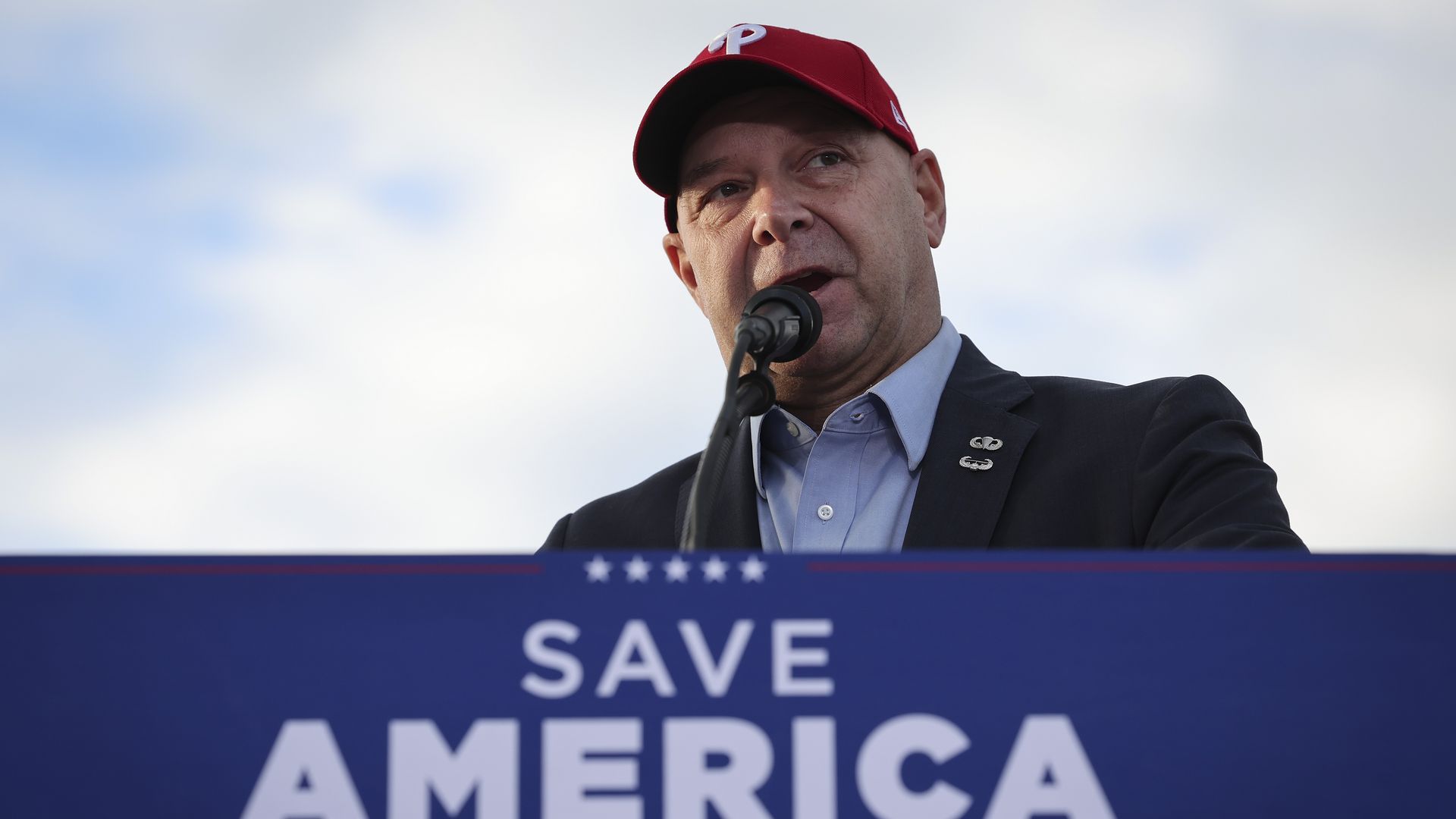
Doug Mastriano at a rally with Trump last November. Photo: Win McNamee/Getty Images
Senate Republicans received a jolt of good news this week after right-wing Pennsylvania state Sen. Doug Mastriano, who badly lost the state governor's race in 2022, decided not to run for Senate against Sen. Bob Casey (D-Pa.).
Why it matters: Mastriano's passing on the Senate run will vault Pennsylvania's Senate race up the ranks of top GOP pickup opportunities. Mastriano's gubernatorial campaign, which he lost by 15 points, was a drag on every Pennsylvania Republican running last year.
- Dave McCormick, a former hedge fund CEO and military veteran, is now likely to run for the seat, with an announcement likely later in the summer.
- If McCormick runs, it would be the GOP's first purple-state recruiting success — which has been a significant challenge, given former President Trump's staying power in national politics.
Driving the news: In his statement on Facebook Live posted Thursday, Mastriano sounded like he'd back the eventual GOP nominee. "Whoever is that nominee, I will support them," he said.
Between the lines: Sen. Steve Daines (R-Mont.) has played a much more active role in recruiting and dissuading candidates than Sen. Rick Scott (R-Fla.), his predecessor as chair of the National Republican Senatorial Committee.
- Daines publicly championed McCormick's candidacy in March. "He’d be a very strong candidate in the primary and the general," Daines said.
- Even Trump, a close ally of Daines, reportedly expressed concerns about Mastriano as a losing candidate who could jeopardize his ability to contest Pennsylvania in 2024. Mastriano was one of the lineup of Trump-endorsed Republicans in swing states who badly underperformed in the midterms.
By the numbers: If McCormick is the GOP nominee, he'd start out as an underdog against Casey.
- A Susquehanna Polling and Research survey released this month found Casey leading McCormick by 12 points (53%-41%).
- A March Franklin and Marshall poll found Casey's lead over McCormick at 7 points (42-35%), with only middling favorability ratings. (He led Mastriano by 16 points, by comparison.) 29% of registered voters rated Casey's job performance as "excellent" or "good" while 48% rated it either "fair" or "poor."
- Pennsylvania backed Biden by only 1 point in 2020 — and is expected to be one of the most closely contested swing states in 2024 (along with Wisconsin, Nevada, Georgia and Arizona).
The big picture: The GOP's improving fortunes in Pennsylvania is another example of how behind-the-scenes recruitment (and in this case, relying on allies to persuade a weak candidate not to run) is paying off for the party during Daines' leadership of the NRSC.
- Daines persuaded popular West Virginia Gov. Jim Justice to run for Senate against Sen. Joe Manchin (D-W.Va.), though Justice faces a contested primary against Rep. Alex Mooney (R-W.Va.). Manchin hasn't yet committed to running for a third term.
- Daines personally encouraged businessman and military veteran Tim Sheehy to run against Sen. Jon Tester (D-Mont.). As a former Navy SEAL and Purple Heart recipient, Sheehy has a tailor-made political profile (on paper). He is also capable of self-funding the contest.
Zoom in: Also encouraging for national Republicans: Hard-right candidates — such as Rep. Matt Rosendale of Montana and Rep. Warren Davidson of Ohio — aren't acting like serious Senate candidates.
- Rosendale raised just $127,000 in the last fundraising quarter, apparently alienating some donors over his vote against Kevin McCarthy for House speaker.
Reality check: The likelihood that Trump will be the GOP's presidential nominee is also making it tougher for recruiting in purple states, like Wisconsin and Michigan.
- Right-wing former Arizona gubernatorial candidate Kari Lake is still seriously considering a Senate campaign in Arizona, in what's shaping up as a wild, unpredictable (potential) three-way contest. She met with NRSC officials this month, and told Arizona reporters this week she "hasn't made up her mind" about the race.
- One of the few moderate Republican contenders in Arizona, businesswoman Karrin Taylor Robson (who lost the GOP primary to Lake in 2020), announced this week she wouldn't run for the Senate.
The bottom line: The pathway to a GOP Senate majority — winning at least two of the red-state seats that Trump carried — has looked favorable. But the one factor holding the party back was the prospect of weak candidates emerging.
- With Mastriano's departure, Rosendale's lack of preparation and the emergence of a capable field in Ohio, Daines can feel good about how things are shaping up for Senate Republicans in 2024.
