Axios Future of Defense
May 20, 2026

Good morning from downtown Taipei.
- The food's hot. The beer's cold. The trains are fast. What more do you want?
🇰🇷 Situational awareness: The U.S. approved a potential $3 billion sale of MH-60R helicopters to South Korea. It also gave the nod to a $1.2 billion AH-64E Apache upgrade program.
Next up: African info warfare, nuclear-powered battleships and a Project NYX update.
Today's newsletter is 1,800 words, a 7-minute read.
1 big thing: On island time

TAIPEI — There's a postmortem playing out here after Chinese President Xi Jinping warned President Trump to be careful on Taiwan, and Trump responded with ambivalence about U.S. arms sales and the island's chances in any conflict.
Why it matters: Some Trump advisers left the summit thinking a Chinese move on Taiwan was growing more likely. But in Taipei there was no panic, at least on the surface.
- Taiwanese officials continue to advocate for arms deliveries, while also emphasizing the need to shore up self-defense initiatives, indigenous defense-tech and critical infrastructure.
- And while Trump and Xi's remarks were closely scrutinized, Taiwanese officials and citizens tell me they're accustomed to life in the shadow of potential war.
There is unsurprisingly a "very high degree of sensitivity" in Taiwan about military aggression and information warfare from China, said Tsung-Yi Tang, a representative for civil-defense organization Kuma Academy.
- "But in terms of the daily operations, actually we are still more relaxed."
What they're saying: Luo Wen-jia, secretary-general of the Straits Exchange Foundation, on Monday told visiting journalists the world must understand Taiwan will neither provoke China nor let it trample over the island.
- It's a delicate dance.
- "Taiwan needs to strengthen our own self-defense. We need to make adjustments in terms of national defense," he said through an interpreter. "We also have to think about Taiwan's uniqueness, our geopolitics and what kind of risks will arise."
- The SEF is a semi-official organization that handles civil and business affairs between Taiwan and China. It has offices just blocks from the national defense ministry.
- "It's not that Taiwanese people are naive. We do know that, given this hostility and difficult situation, we still need to be optimistic," he added. "Of course we do not want to see war."
State of play: Trump said after the meeting that he was unsure whether he'd approve a $14 billion arms package for Taiwan, which his administration has delayed despite bipartisan support.
- He also suggested the weapons wouldn't make a difference should Beijing make a move.
- "When you look at the odds, China is a very powerful, big country. That's a very small island," he told Fox News. "It's 59 miles away. 59 miles. We are 9,500 miles away."
- "They ought to both cool it," Trump said of China and Taiwan.
The other side: Leaders including President Lai Ching-te pushed back on Trump's characterization of the weapons as a bargaining chip in the U.S.-China relationship.
- "China's military threat remains the primary source of regional instability, driving countries in the first island chain to strengthen their defense capabilities in coordination with the United States," the foreign affairs ministry said in a statement.
- "U.S. arms sales to Taiwan are both part of U.S. security commitments under the Taiwan Relations Act and a key element of collective deterrence against regional threats."
- Washington has been arming Taipei for decades. Trump 2.0 in December blessed an $11 billion weapons shipment that included HIMARS launchers and howitzers.
Threat level: Xi has instructed his military to be prepared for a takeover as soon as 2027.
- While many doubt that timetable, preparations are undoubtedly ongoing. The People's Liberation Army encircled the island in 2025 and entered its air defense identification zone more than 3,000 times in 2024.
- Digital networks, too, are bombarded daily.
Between the lines: Despite Trump's skepticism, Taiwan is no easy target, even for a force as large as the PLA.
- It's insulated by rough seas and steep mountains, and its whole-of-society approach to defense has been invigorated by Ukraine's fortitude.
- Ahead of the Trump-Xi summit, Taiwan's military kicked off live-fire beach defense drills.
More from Axios:
Lockheed tapped for Taiwan F-16 sensors
U.S. and China could agree on AI guidelines, says Hicks
Drills, deals and doubts in the Pacific as Trump visits China
Editor's note: This trip, attended by more than a dozen members of the media, was organized and partially funded by the Taiwanese government.
2. New night vision

L3Harris Technologies anticipates receiving its first Nova night-vision production order from the U.S. Army as soon as this summer, but the exact size or number of devices remains unclear.
Why it matters: It's a milestone for the service's Binocular Night Observation Device effort, meant to democratize night vision and replace older models, like the AN/PVS-14.
Driving the news: L3Harris let a small group of reporters try on and test out Nova last week, in a blacked-out hotel conference room.
- Camouflage-adorned mannequins and obstacles were easily seen through the system's greyish-green illumination.
State of play: The Army in February awarded L3Harris a $466 million BiNOD contract. It also tapped Elbit Systems of America ($451 million) and Photonis Defense ($353 million).
Zoom in: Nova's a brand-new design, according to executives. It comprises two flippable monoculars and a bridge.
- It weighs a little more than a pound. It features USB-C ports and can run for 30 hours on a single AA battery.
What they're saying: "I will tell you that our BiNOD offering is about one-third the price, the cost, of an ENVG-B," said Sam Mehta, president of space and mission systems and communications and spectrum dominance.
- "We're talking about equipping tens of thousands of folks in the Army not only at the tactical edge, but also the folks who are doing things like logistics, the folks that are doing things like supporting the front lines, transportation."
- L3Harris had delivered 25,000 ENVG-Bs as of December.
Go deeper: L3Harris-Palantir combo nets night vision production gains
3. Bad info
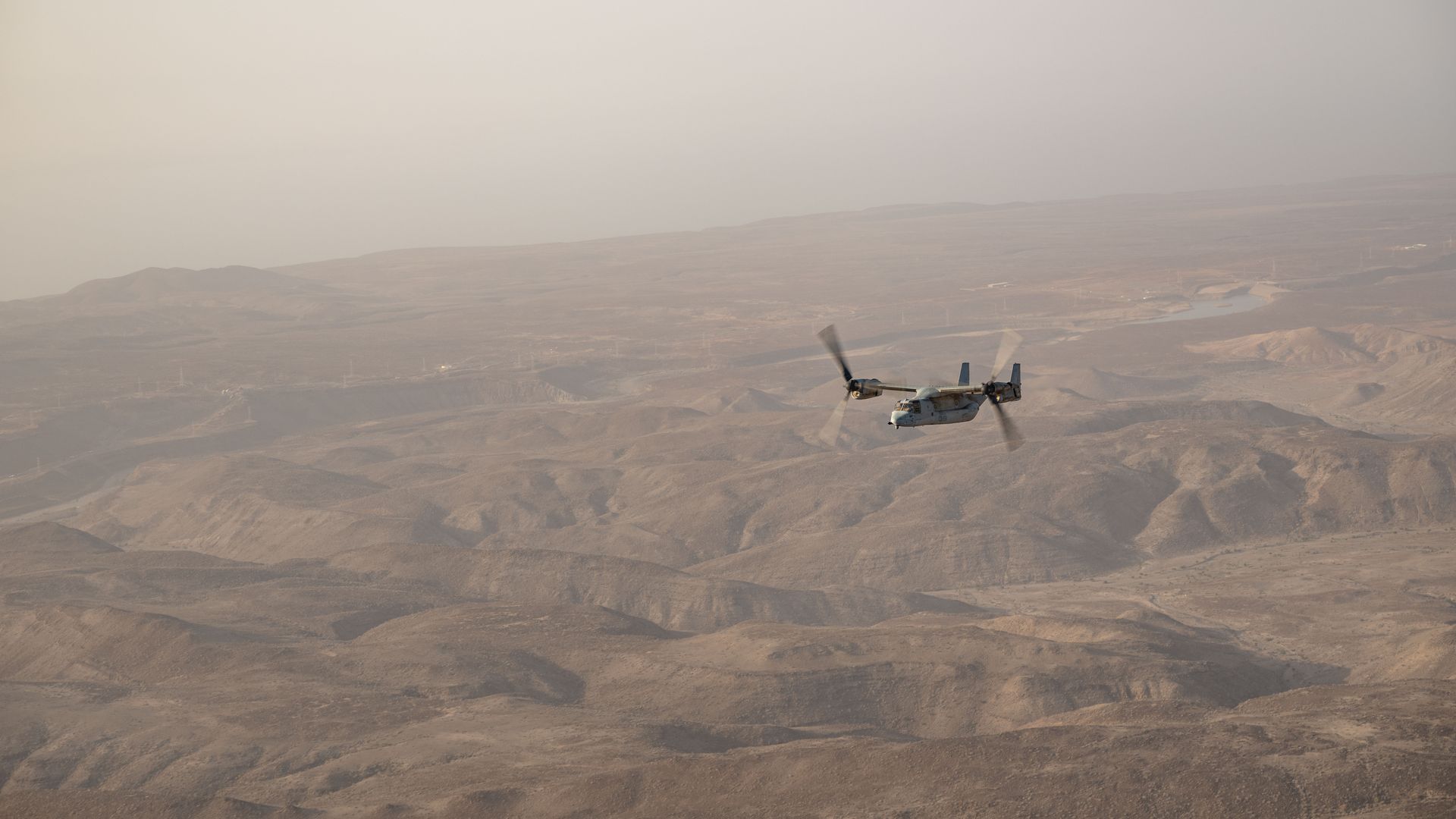
Inconsistent budgets are undercutting the U.S. military's ability to influence opinions and curry favor in Africa, according to the American commander in the region.
Why it matters: Both Russia and China have embedded themselves across the continent. Jihadist extremism is also a major concern.
What they're saying: "With a 75% reduction in our regional posture over the past decade, compounded by the drawdown of our allies, we struggle with an intelligence black hole," Gen. Dagvin Anderson told the Senate Armed Services Committee.
- "Without sufficient indicators and warnings, we risk being blind to the gathering dangers and threats in the region," he added.
- "Our adversaries are very active in the information domain."
Context: Information warfare means a dozen different things to a dozen different people. It can cover everything from weather analysis to data manipulation to social media campaigns to command-and-control interference.
By the numbers: A recent $94 million request for information-operation activities in Africa was only funded at $19 million, according to Sen. Mark Kelly (D-Ariz.).
- Such limited spending puts American troops in a reactive, not proactive, posture, according to Anderson.
- "What the fuller funding would do, especially if it's consistent over time," he said, "would allow us to build an information campaign and address these issues across the continent."
What we're watching: Prioritization. The most recent National Defense Strategy features the word "Africa" only twice.
Go deeper: The American war too few talk about
4. Trump goes nuclear
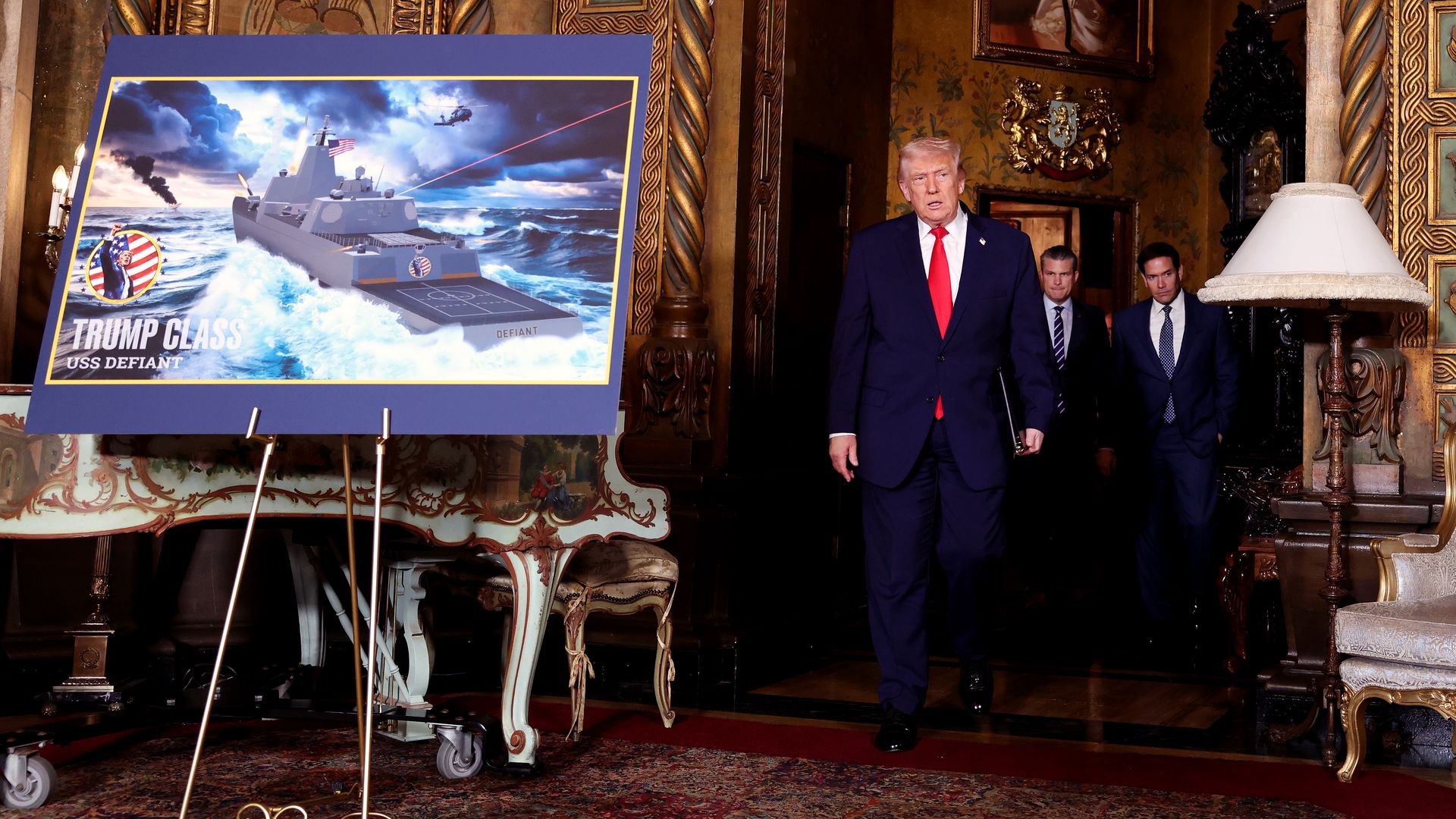
The Trump-class battleship, the first of which is estimated to cost more than $17 billion, will be nuclear-powered, according to Chief of Naval Operations Adm. Daryl Caudle.
Why it matters: The pronouncement ends months of debate about how — and how fast — the battleship will get around.
- Navy leadership as late as the end of April described nuclear propulsion as "unlikely." Specs first published months ago have been in flux.
What they're saying: "I'm thrilled we finally landed on the fact that it's going to be nuclear," Caudle said during testimony on the Hill.
- "We batted it around — to deliver it sooner, to make it conventional — and we came back around full circle to make it nuclear. That's the exact right answer."
Zoom in: The battleship will be equipped with the same power plant, the A1B, seen aboard the Gerald R. Ford aircraft carrier, the world's largest warship.
- "All of that technology that's going into the design of the nuclear battleship, from the reactor plant perspective, is all pull-through technology from the Ford class, as are most of the combat systems, radar systems, missile systems," Caudle said.
- "What's new is the hull form."
The intrigue: Aircraft carriers are, for now, the only nuclear-powered surface ships in the Navy's inventory.
What's next: The service wants 15 battleships by 2056, Breaking Defense reported. Three will cost more than $43 billion.
Go deeper: Introducing Trump's puzzling nuclear-armed battleship
5. Quick hits
🇬🇧 The U.K. Defense Ministry shortlisted Anduril Industries, BAE Systems, Tekever and Thales for Project NYX, meant to develop drone wingmen for Apache helicopter crews.
- Why it matters: The Brits are moving fast. Two of these companies could be selected to develop prototypes this fall. Fielding could happen in 2030.
- 💭 My thought bubble: There are CCAs everywhere for those with the eyes to see.
🔋 The 350th Spectrum Warfare Wing activated the 337th Electronic Warfare Squadron, designed to develop, test and deploy mission data for the Lockheed Martin-made F-35.
- Why it matters: The unit supports countries including Australia, Canada and the Netherlands. Its portfolio is expanding to include Belgium, Israel, Japan, Poland and others.
- 💭 My thought bubble: I've been keeping tabs on the 350th for years. Example one. Example two.
💸 Arkeus, a defense-tech startup focused on sensing, raised $18 million. The Series A was led by QIC Ventures. Other backers include R+VC and Folklore Ventures.
- Why it matters: "The next generation of autonomy isn't limited by platforms; it's limited by perception," CEO Simon Olsen said in a statement. "Decision-making is moving closer to the edge, and that requires a completely different approach to sensing and autonomy."
- 💭 My thought bubble: My colleague Natalie Breymeyer covered it, here. Barratt Dewey at Tectonic has a deeper dive, as well.
💥 The Defense Department wants to buy more than 12,000 Blackbeard hypersonic missiles from Castelion over five years. The arrangement, with caveats, is part of a larger stockpile announcement made May 13.
- Why it matters: "We will deliver affordable mass for our warfighters at unprecedented speed," Pentagon CTO Emil Michael said in a statement.
- 💭 My thought bubble: All eyes on Project Ranger!
6. Check this out
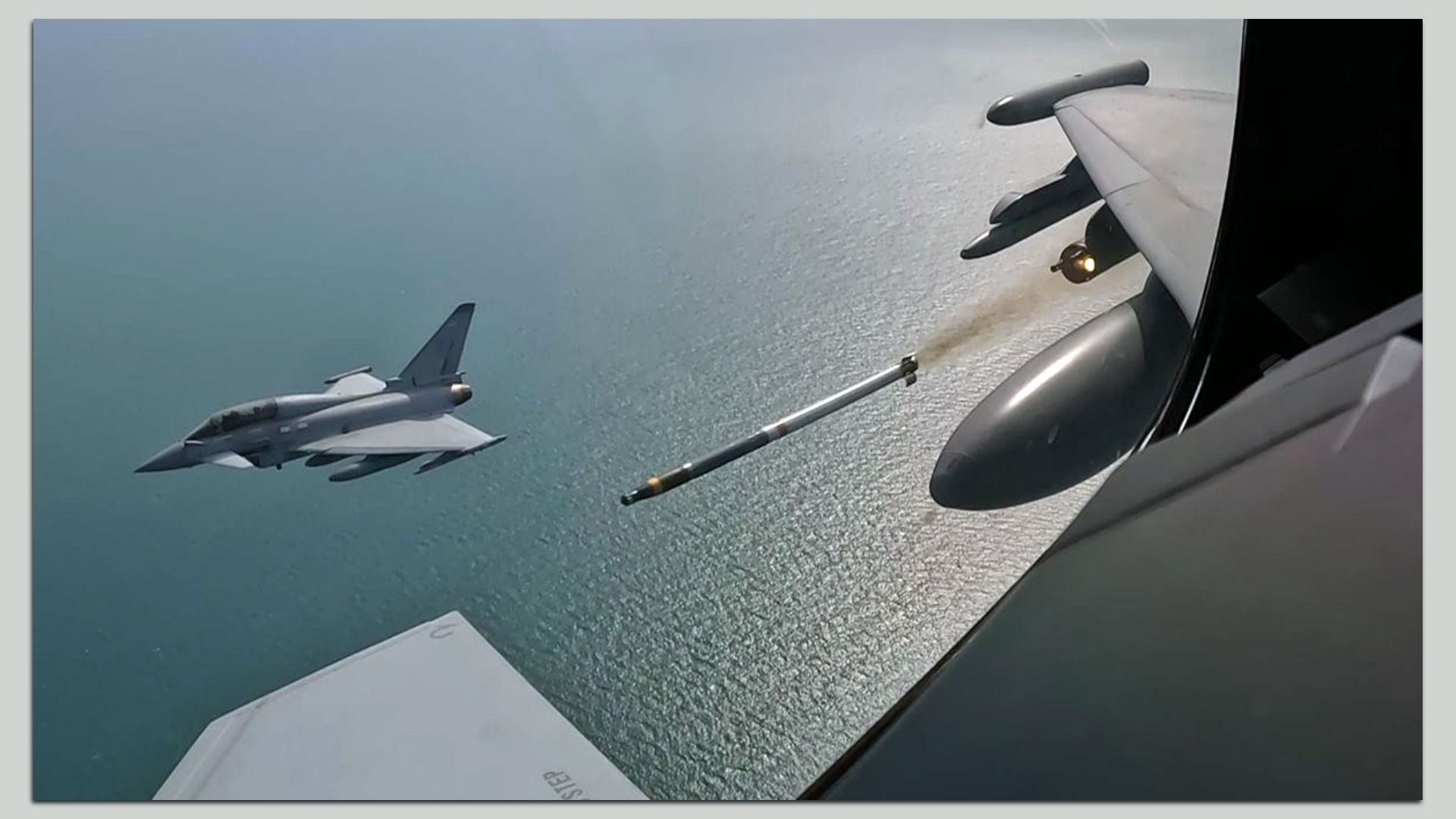
British Royal Air Force Typhoons equipped with the Advanced Precision Kill Weapon System have flown multiple sorties over the Middle East.
- The news follows ground-target testing in March and air-to-air trials in April.
Why it matters: Everyone and their mother, it seems, is adopting this low-cost drone blaster.
Go deeper: Defense industry must collaborate more in Middle East, says Dunford
Shoutout to Dave Lawler for editing and Matt Piper for copy editing.
👋🏼 Thanks, as always, for reading and sharing. Tell your friends to subscribe here.
Sign up for Axios Future of Defense