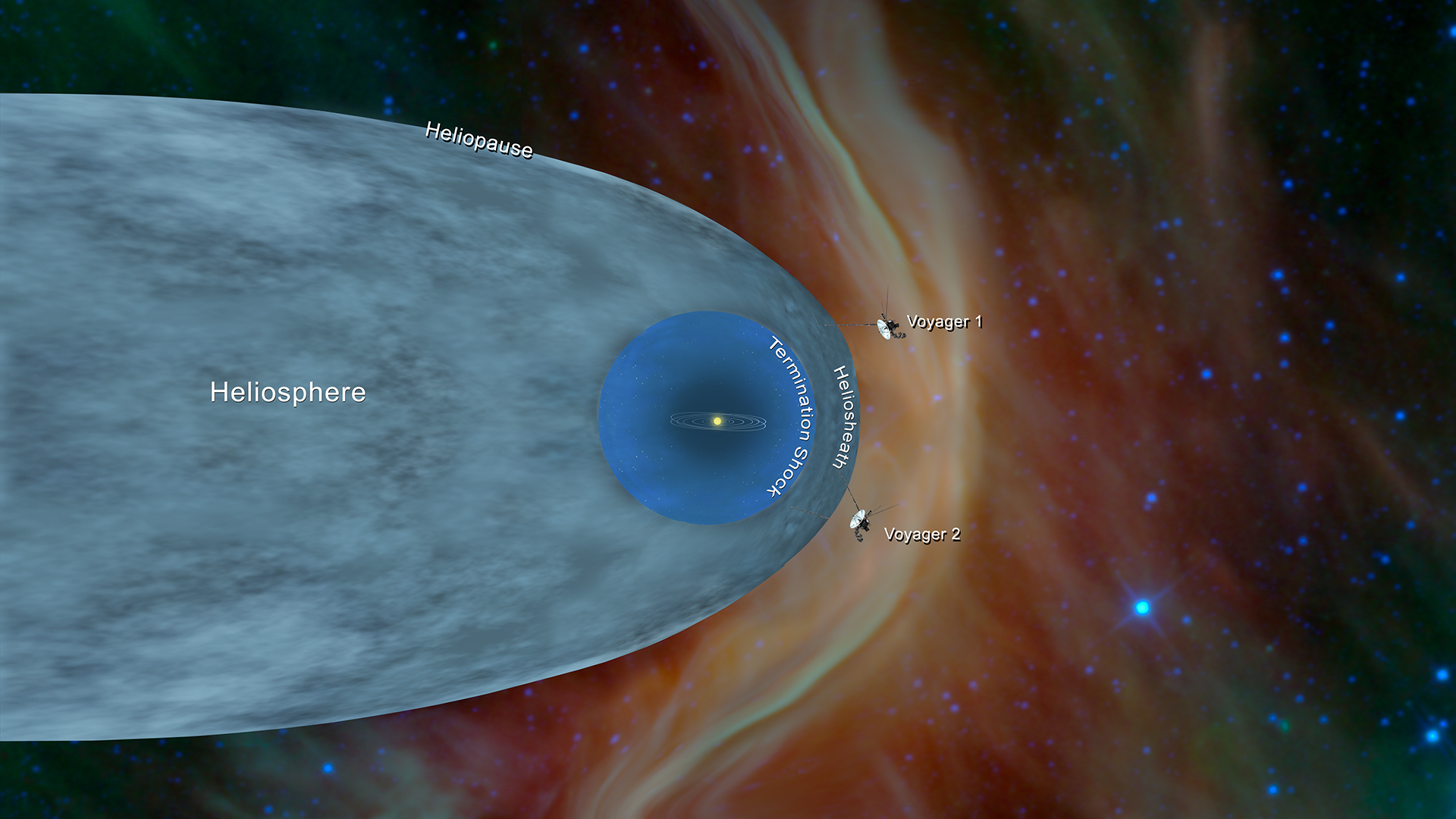
NASA's Voyager 2 probe has reached interstellar space at about 11 billion miles from Earth, making it only the second human-made object to do so, according to the space agency.
Why it matters: Voyager 2, which joins its twin Voyager 1 in crossing the heliopause (the boundary between the hot solar wind and cold, interstellar space), will provide scientists with crucial observations about the kinds of particles and forces the spacecraft encounters, such as cosmic rays. This is huge, given that a key instrument aboard Voyager 1 stopped working before that spacecraft crossed the boundary.
NASA's OSIRIS-REx spacecraft, which has intercepted the near-Earth asteroid Bennu, has recently found molecular evidence of water locked deep inside the asteroid, NASA said Monday.
Why it matters: This is NASA’s first asteroid sample return mission, and analyzing Bennu could provide scientists with a trove of new information about the asteroid's composition and ultimately lead to new discoveries about how life evolved in the universe. Asteroids are time capsules of the early solar system and are believed to contain information about the origins of planets and the natural resources that enabled life to develop.


/2018/12/10/1544472896308.gif?w=3840)