February 15, 2024

It's Thursday! Ready for recess?
- We'll be on a reduced publishing schedule next week, but you'll see us in your inbox with a deeply reported newsletter worth your time.
🗣 Situational awareness: The FTC is seeking public comment about a proposed rule to combat AI impersonation of individuals, the agency announced today.
1 big thing: New version of KOSA picks up speed

Illustration: Shoshana Gordon/Axios
Senators dropped an updated version of the Kids Online Safety Act today and announced new sponsors, including Senate Majority Leader Chuck Schumer, Maria and Ashley report.
Why it matters: Momentum is building for the children's online safety bill, which senators are determined to pass to show they're taking the issue seriously following a heated hearing with tech executives last month.
The latest: KOSA now has 62 cosponsors and includes some key legislative changes, per an announcement from bill leads Sens. Marsha Blackburn and Richard Blumenthal.
- Many of the negotiated provisions were first reported by Maria and Ashley on Wednesday.
- Those include moving some enforcement to the Federal Trade Commission from state attorneys general.
- That helped assuage fears from some LGBTQ+ rights groups that political posturing from state AGs would lead to criminalizing online content for marginalized groups.
- The "duty of care" language in the bill was limited to platform design features to prevent and mitigate specific harms, such as mental health disorders, physical violence or sexual exploitation.
The other side: Fight for the Future director Evan Greer said in a statement that, based on the group's initial read of the bill, the duty of care language doesn't go far enough.
- "As we have said for months, the fundamental problem with KOSA is that its duty of care covers content specific aspects of content recommendation systems, and the new changes fail to address that."
- Several industry groups also still oppose KOSA, citing concerns with too much data collection and censorship.
What they're saying: A group of seven LGBTQ+ advocacy groups said they aren't opposing KOSA as a result of the changes.
- The changes "significantly mitigate the risk of it being misused to suppress LGBTQ+ resources or stifle young people's access to online communities," they wrote in a Feb. 15 letter to Blumenthal.
- Youth-led coalition Design it for Us: "The latest improvements to the Kids Online Safety Act are welcome changes that would ensure this bill cannot be weaponized to restrict civil liberties — the result of the tireless advocacy of young people desperate for change to protect our generation online."
- Sen. Ron Wyden said he's still reviewing the legislation, but "thanks to advocates and productive work by Senators Schumer and Cantwell, the new version of KOSA represents a significant improvement."
Energy and Commerce Committee chair Cathy McMorris Rodgers told Maria on Thursday she is still committed to comprehensive data privacy, even though "the timeline has slipped" on reintroducing the American Data Privacy and Protection Act.
- "You talk to Common Sense Media and they will say they are the strongest provisions [in ADPPA] there are to protect kids online," CMR said, referring to an advocacy group that has been among the most vocal backers of KOSA.
- Greer said Fight for the Future would "redouble" House efforts to make sure that if the bill moves forward "it is amended to ensure it will protect all kids, rather than endangering some of the most vulnerable."
What's next: Bill backers face a packed calendar as the Senate deals with impeachment drama and yet another looming government shutdown.
- In addition to the struggle to find floor time in the Senate, the bill still lacks a House companion.
- Meanwhile, Sen. Ed Markey announced Commerce chair Maria Cantwell and ranking member Ted Cruz are backing his updated kids online protection bill, COPPA 2.0, which is seen by supporters as a natural companion to KOSA.
2. Biden TikTok debut raises lawmakers' eyebrows
Illustration: Shoshana Gordon/Axios
Members of Congress who have been pushing for restrictions on TikTok in the U.S. were alarmed to see that the Biden campaign joined the platform this week in an attempt to connect with younger voters, Ashley reports.
What they're saying: "In the best-case scenario, TikTok is CCP spyware —that's why governments have banned it on official phones," Rep. Mike Gallagher, who has called TikTok "digital fentanyl" and co-sponsors the Anti-Social CCP Act in the House, told Ashley via a spokesperson.
- "In the worst-case scenario, TikTok is perhaps the largest-scale malign influence operation ever conducted."
Sen. Mark Warner, co-sponsor of the RESTRICT Act, which could allow for a TikTok ban, said he was concerned about the Biden campaign's use of the app.
- "The Chinese Communist Party can not only get access to the data, but more importantly, they can potentially drive the algorithms in terms of what you're seeing," he said at an event at the Virginia Tech Research Center in Arlington this week, per a recording shared by Warner's office.
Sen. Josh Hawley wrote on X: "Biden campaign bragging about using a Chinese spy app even though Biden signed a law banning it on all federal devices."
Context: Federal employees are not allowed to have TikTok on government devices, thanks to a bill President Biden signed in 2022.
- Meanwhile, a government review of TikTok's ownership structure with Beijing-based parent company ByteDance has been ongoing for years with no formal resolution.
- Last year, Axios reported that the Biden administration told TikTok it would be banned if ByteDance didn't sell it.
What's next: In regards to the RESTRICT Act, Warner said "it's going to have to re-emerge."
- "We were willing to make some amendments. [Senate Commerce chair Maria] Cantwell is working on a variation of it."
- "I've talked to Republican members in the House and the Senate who particularly after October 7 have been concerned about TikTok portrayal of the war in Gaza... I'm still optimistic there can be another path."
- The House Energy and Commerce Committee grilled TikTok CEO Shou Zi Chew last year, and he appeared again recently before the Senate Judiciary Committee, but nothing has come out of that legislatively.
3. First look: XR Association leans into policy world
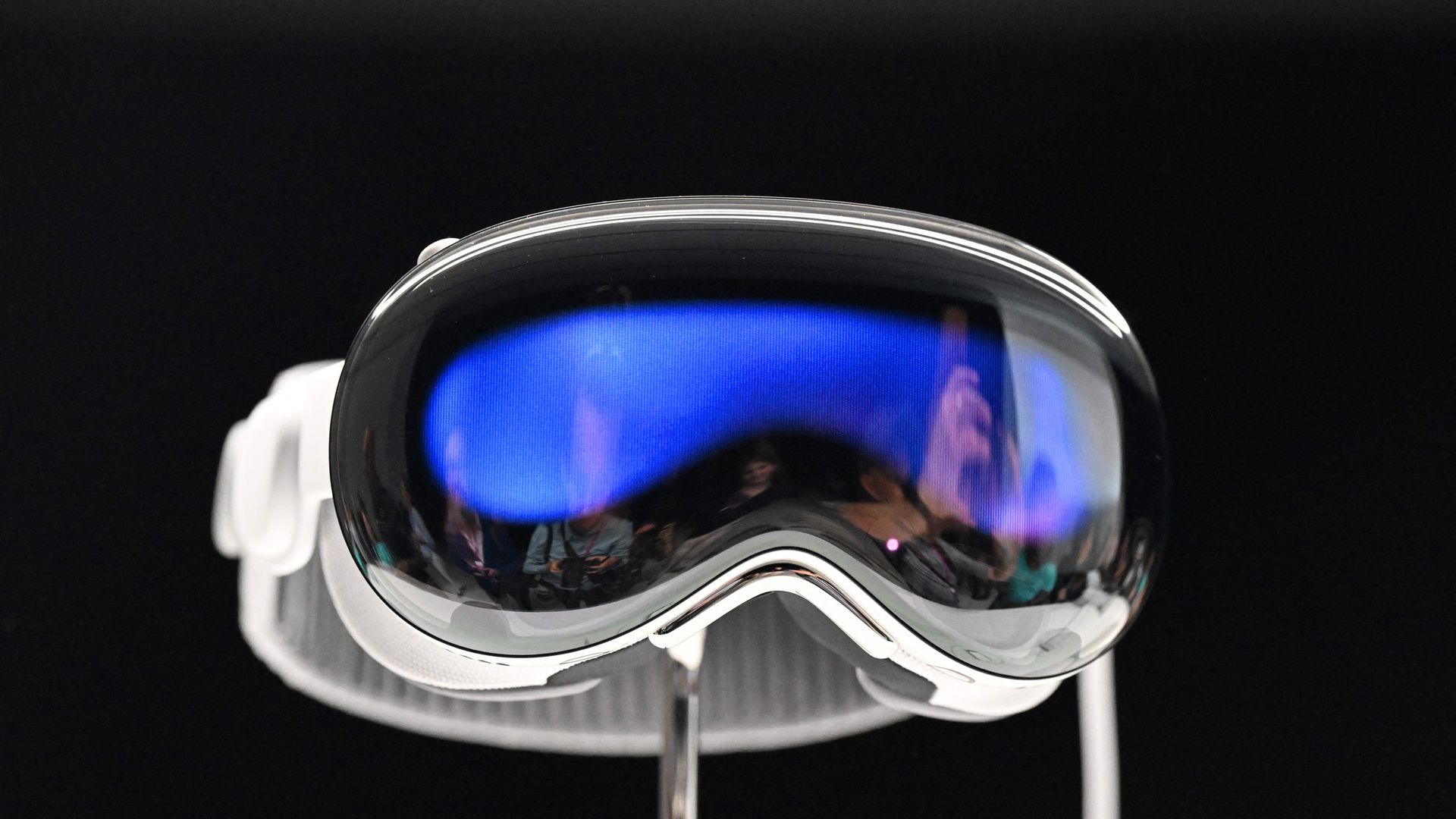
Apple's new Vision Pro virtual reality headset. Photo: Josh Edelson/AFP via Getty Images
The XR Association — a D.C. trade group that promotes "responsible development and thoughtful advancement" of virtual, augmented and mixed reality — announced new policy initiatives today, per an announcement shared first with Ashley.
Why it matters: As excitement over virtual worlds grows thanks to recent product rollouts from Big Tech, such as Apple's Vision Pro, the policy group in Washington representing those technologies wants to work with lawmakers well before any new laws are considered.
What they're saying: "Oftentimes with any type of new and emerging technology, we all get wrapped up in the optimism of it," Elizabeth Hyman, CEO of the XR Association, tells Ashley.
- "But sometimes, [that means] you don't necessarily face up to some of the challenges and the ways in which we want to educate policymakers and others for when this is a front and center discussion in the policy world."
Details: The policy paper lays out nine initiatives, including:
- Convening parents and youth to discuss safety in XR.
- A literature review about the impacts of XR on young people.
- Publishing a developers' guide
- Focusing on privacy and tools to combat harassment in XR spaces.
- Pushing companies to focus on safe and inclusive XR.
XR technology may be nascent, but stories have already emerged about bullying and harassment.
Between the lines: Often, conversations in Washington about emerging technologies happen after the technologies have already been heavily used (and abused) by the public, spurring a cycle of outrage being followed by lawmakers spinning their wheels on bills that often don't pass.
- In the AI and XR worlds, there's a recognition of what social media platforms already went through and a sense that it can be prevented by working with lawmakers earlier.
4. Catch me up: AI news at home and abroad
Illustration: Tiffany Herring/Axios
🇺🇸 AI in the states: Nearly all of the state legislatures currently in session are considering AI-related bills and nearly half of those bills address deepfakes, according to an analysis by BSA, shared exclusively with our Axios AI+ colleague Ryan Heath.
- Inside Indiana's plan to combat election deepfakes, from Axios Indianapolis' Arika Herron.
- Plus, a look at how Colorado school districts are approaching AI, from Axios Denver's Esteban L. Hernandez.
🇯🇵 AI in Japan: Japan's ruling party is pushing for AI legislation this year, according to reports.
🇩🇪 AI in Germany: Microsoft's Brad Smith today announced plans to invest $3.4 billion over the next two years in German AI infrastructure, Bloomberg reports.
🇫🇷 AI in France: Google is opening an AI research hub in Paris that will host at least 300 scientists and engineers, according to Le Monde.
✅ Thank you for reading Axios Pro Policy, and thanks to editors Mackenzie Weinger and David Nather and copy editor Carlos Cunha.
- Do you know someone who needs this newsletter? Have them sign up here.
Editor's note: This newsletter has been updated to remove an incorrect pronoun reference to Evan Greer.
View archive