May 22, 2024

Happy hump day! House Republicans are again putting the spotlight on FDA drug approvals and the regulation of diagnostic tests at a critical point in the calendar, as the FY25 appropriations process starts up.
🚨 Situational awareness: Maxine Dexter, one of the Democratic physician candidates we profiled last month, won yesterday's primary in a deep blue Oregon district to succeed retiring Rep. Earl Blumenauer, defeating the sister of Rep. Pramila Jayapal.
1 big thing: Republicans put more heat on the FDA
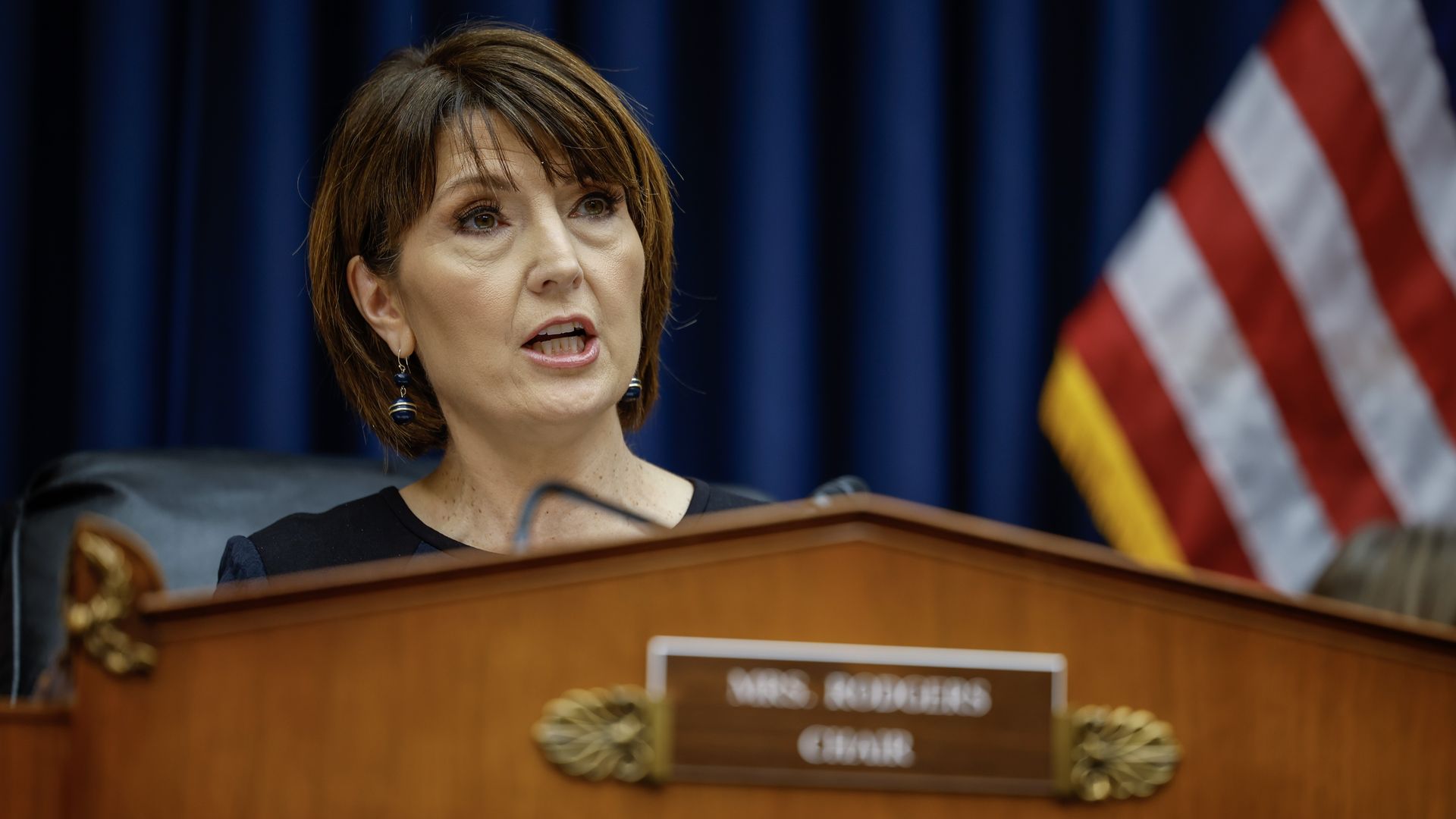
Rep. Cathy McMorris Rodgers at an Energy and Commerce hearing. Photo: Chip Somodevilla/Getty Images
The FDA's drug approvals and oversight of lab-developed tests are again emerging as hot topics as House Republicans crank up oversight of the agency and the FY25 appropriations process begins to play out, Victoria reports.
Why it matters: GOP lawmakers want to assure that Medicare will cover drugs that get expedited FDA approval based on preliminary evidence.
- Past Biden administration restrictions on Medicare coverage for a class of Alzheimer's drugs have angered some Republicans and renewed a debate over exactly when seniors should have access to new treatments.
- There's also lingering tension over the FDA's recent decision to exercise its authority and treat in-vitro diagnostic tests as medical devices.
Driving the news: At a House Energy and Commerce health subcommittee hearing today, Chair Cathy McMorris Rodgers expressed concern over whether the accelerated approval program being fully utilized, saying it "should be leveraged now more than ever."
- She pressed top officials to confirm whether biologics approved under accelerated approval had the full FDA gold standard of approval, noting that Secretary Xavier Becerra had previously said treatments approved through the pathway didn't turn out to be effective.
- "When we use accelerated approval, we make a determination," Patrizia Cavazzoni, director of the FDA's Center for Drug Evaluation and Research, responded. "We stand by our standard."
- The 2022 omnibus included limited reforms to accelerated approval allowing the FDA to more easily pull drugs from the market if there is poor efficacy data and to require certain types of trial design and data as a condition for approval.
Rodgers also took the agency to task for unilaterally deciding to regulate lab-developed tests instead of wait for authorizing legislation.
- She has pressed for its recently finalized rule on diagnostic tests to be rescinded, saying Congress needs to give FDA such authority and that acting alone would quash innovation.
- "FDA has unilaterally decided it can regulate, by its own estimate, 80,000 tests," she said.
The other side: E&C Ranking Member Frank Pallone, meanwhile, emphasized the issue of drug shortages, and how Congress could give the FDA more authority to prevent them.
- Particularly he asked if companies should be required to report drug shortages driven by demand — a situation that's received more attention as supplies of weight-loss medicines like Wegovy and Mounjaro have tightened.
2. What we're hearing: Sanders on Novo Nordisk

Sen. Bernie Sanders. Photo: Alex Wong/Getty Images
Peter caught up with Senate HELP Chair Bernie Sanders to get an update on whether he plans to call the CEO of Novo Nordisk to testify about the price of the company's blockbuster weight-loss drugs Wegovy and Ozempic.
What he's saying: "We are not quite at that point," he said, emphasizing "quite."
- "Right now, as you may know, we're doing an investigation to better understand what's going on and why the prices they charge are so very high."
- "We hope that they will understand that the American people will not accept paying 10 times more for the same product that is sold around the rest of the world. I hope that will happen. But are we prepared to have a hearing? Absolutely."
Sanders spoke in April with Novo Nordisk CEO Lars Fruergaard Jørgensen but didn't get an immediate commitment to lower costs.
3. Bill of the week: Prior authorization

Illustration: Gabriella Turrisi/Axios
Sens. Roger Marshall and Ben Ray Luján want to overhaul the process for accessing prescription drugs that require a health insurer's approval.
Why it matters: It could be part of a new wave of legislation to streamline prior authorization requests that increasingly annoy patients and doctors.
- The Biden administration finalized a rule in January to change how insurers in programs like Medicare Advantage handle pre-approvals of medical items and services.
What's inside: The bill would require private health plans starting in 2027 to provide secure electronic transmission of prior authorization requests for prescription drugs.
- It doesn't spell out penalties for noncompliant insurers.
- Marshall has recounted his experiences as a practicing OB/GYN in contending prior authorization jeopardizes patient care.
- Sens. Sheldon Whitehouse, Roger Wicker and Joe Manchin are co-sponsoring the measure.
The other side: Several large insurers rolled back their prior authorization requirements as regulators signaled they would move to restrict the practice. The industry still defends pre-approvals, saying it prevents unnecessary and low-value care.
Flashback: The House in 2022 passed a prior authorization reform package that later stalled over cost concerns.
- Prior authorization changes were considered for inclusion in one version of the House's health price transparency bill, but were dropped from the final package that was passed in December.
What we're watching: Whether the new Biden rule, which is expected to save about $15 billion over a decade, could lower the cost of legislative fixes.
✅ Thank you for reading Axios Pro Policy, and thanks to editors Adriel Bettelheim and David Nather and senior copy editor Bryan McBournie. Do you know someone who needs this newsletter? Have them sign up here.
View archive