
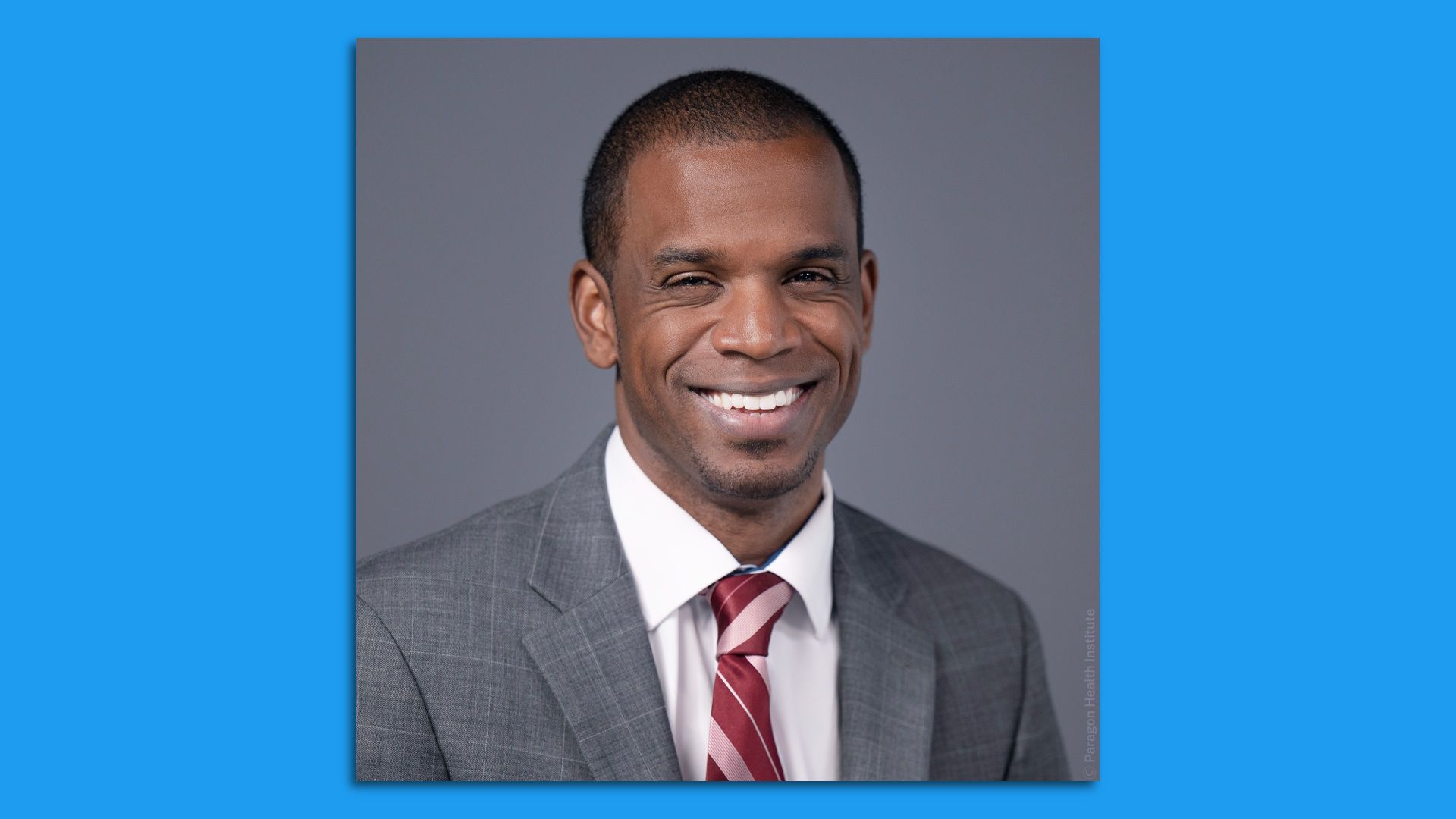
Photo: Courtesy Paragon Institute
House Speaker Mike Johnson's new health staffer, Drew Keyes, is returning to the Hill from a think tank position where he publicly opined on health policy — including, ironically enough, advice for the congressional staff tasked with creating it.
Why it matters: Keyes' recent work as a senior policy analyst at Paragon Health Institute offers insight into his thinking on some key health policy issues and how he'll likely approach his new job.
The big picture: Paragon was founded by Brian Blase, a former Trump administration official, and has embraced a relatively traditional center-right approach to health policy — including some positions that have become less popular in the current political era.
- "Drew is committed to reforming well-intentioned but broken programs, fixing government health agencies, empowering Americans with greater control over their health care decisions, and ensuring that American ingenuity and market-based competition are able to solve our most pressing problems," Blase wrote in a statement announcing Keyes' departure.
- Keyes, a former Republican Study Committee staffer, talked to Axios this past summer about the latest RSC budget, which included Medicare premium support — a risky move after all the political finger-pointing over Medicare cuts.
- "The question is, can you defend it as not being a cut? I think you can," Keyes told Axios at the time. "And then it comes down to that versus the status quo and the trajectory that we're on. You either believe in your principles and your policies or you don't."
State of play: Keyes' recent work at Paragon heavily featured public health policy, including a report on how to reform the CDC and recommendations for reauthorizing PAHPA.
- Familiarity with the PAHPA reauthorization debate will be particularly timely, given that Keyes is joining the speaker's office as the outlook for the program remains murky.
Between the lines: Keyes also wrote an eye-catching op-ed in Townhall this summer titled "Congress Should Not Do the Bidding of a Dying Trade Association." (Spoiler alert: The trade association is PhRMA.)
- The op-ed takes a pretty pro-PBM position and accuses PhRMA of "desperately point[ing] the finger away from themselves and toward PBMs."
- "Republicans and Democrats have to this point largely fallen for the Big Pharma narrative, moving to meddle in private contracts, remove businesses' choice, and ban spread pricing," Keyes wrote.
- This means Keyes' — and thus Johnson's — handling of the bipartisan, bicameral appetite for PBM reform will be something interesting to keep an eye on.
But the most iconic brief Keyes wrote may be the one titled "How to Keep Your Boss off Bad Policy, An Empathetic Approach."
- The paper aims to address questions relevant to Hill health staffers: "How do you balance the need for sustainable policy that benefits Americans in the long run with the potentially righteous, but often narrower, causes of specific constituents or interest groups?"
- "How do you respond to someone in the throes of real crisis and real pain beyond a simple no?"
- "How do you ensure that policies promoted as solutions don't have unintended consequences that undermine good health policy?"
Our thought bubble: We doubt that Keyes knew where he'd be headed shortly after he wrote this paper — particularly given how chaotic the process of choosing a new speaker was — but it's a pretty impressive feat for your past self to write such a relevant memo to your future self.
