
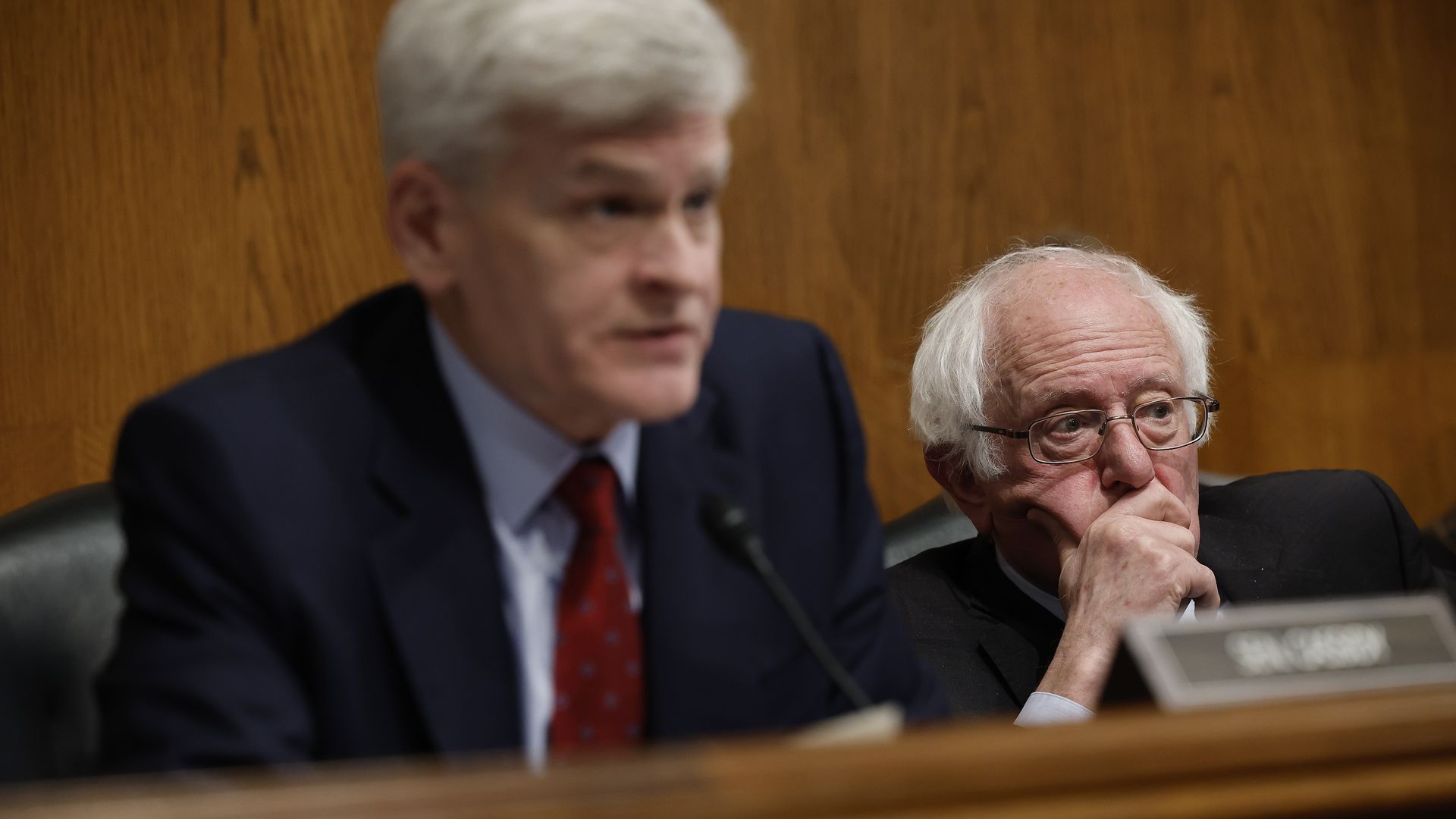
Sens. Bill Cassidy and Bernie Sanders at a hearing. Photo: Chip Somodevilla/Getty Images
The Senate health committee has shown recent interest in some of the most controversial hospital issues — but Chairman Bernie Sanders and Ranking Member Bill Cassidy aren't working together on those areas of interest.
Why it matters: Policy changes to hospitals' nonprofit status, the 340B program and facility fees could substantially impact hospitals' finances and patient affordability.
- But when the leaders of a committee are working on parallel but separate tracks, there are no guarantees of progress.
Driving the news: Sanders recently released an investigation into nonprofit hospitals, knocking them for what he described as paltry amounts of charity care compared to their revenue.
- That followed his championing aggressive hospital policies — including banning certain facility fees and "anticompetitive" terms in contracts with insurers — as part of a package strengthening primary care and the health care workforce.
- The measure passed out of committee in a bipartisan vote but without Cassidy's support.
- Last week, Sanders announced a field hearing in New Brunswick, New Jersey, where nurses at Robert Wood Johnson University Hospital have recently gone on strike. Cassidy has raised ethics concerns with the hearing.
Cassidy, meanwhile, has launched his own investigation into the 340B program, following "multiple reports of certain 340B recipients announcing record-setting profits with no transparency on if and how much of that profit benefits patients," per a press release.
- Cassidy's office said they invited Sanders to be part of the 340B investigation, but Sanders' office declined.
- Cassidy intriguingly has also shown interest in nonprofit hospitals — just not in partnership with Sanders. Instead, he signed onto a letter with Sens. Elizabeth Warren, Chuck Grassley and Raphael Warnock asking the Biden administration about nonprofit hospital oversight. Cassidy's office said they were not invited to be part of Sanders' investigation.
- Critics point out that tax issues like that are the Finance Committee's jurisdiction, not HELP's.
What they're saying: "From our view, the arbitrary cuts in Sen. Sanders' workforce bill are misguided, though at the same time, I think the examination of other issues related to hospitals is conventional oversight and nothing new," said Chip Kahn, president and CEO of the Federation of American Hospitals.
- They also dispute critics' arguments against them. The American Hospital Association recently released its own analysis on nonprofit hospitals' provision of charity care, which reached a very different conclusion than Sanders'.
The big picture: There's clearly bipartisan House and Senate interest in overhauling the way the hospitals get paid, although it's played out differently by chamber.
- The House's price transparency package, which includes a site-neutral payment measure, hasn't yet come to the floor amid clashes over government funding and electing a new speaker.
- And the Senate is still very far from having any kind of hospital payment reform legislation that is ready for floor action.
What we're watching: The optimistic take (unless you're a hospital ally) is that while hospital payment reform may not be on the immediate horizon, it's only a matter of time before Congress acts, considering the key players involved.
- The pessimistic take is that the disjointed process, differing points of view on varying topics of interest and fierce hospital opposition portend a lot of talk but no serious action.
