October 17, 2024


💕 Happy Thursday! Like us, we know you were up late catching up on "Love Is Blind" D.C., so we won't keep you too long.
🎶 Today's last song is from Natalie Enclade, executive director of BuildStrong America: "The Smallest Man Who Ever Lived" by Taylor Swift.
1 big thing: Congress' massive disaster task
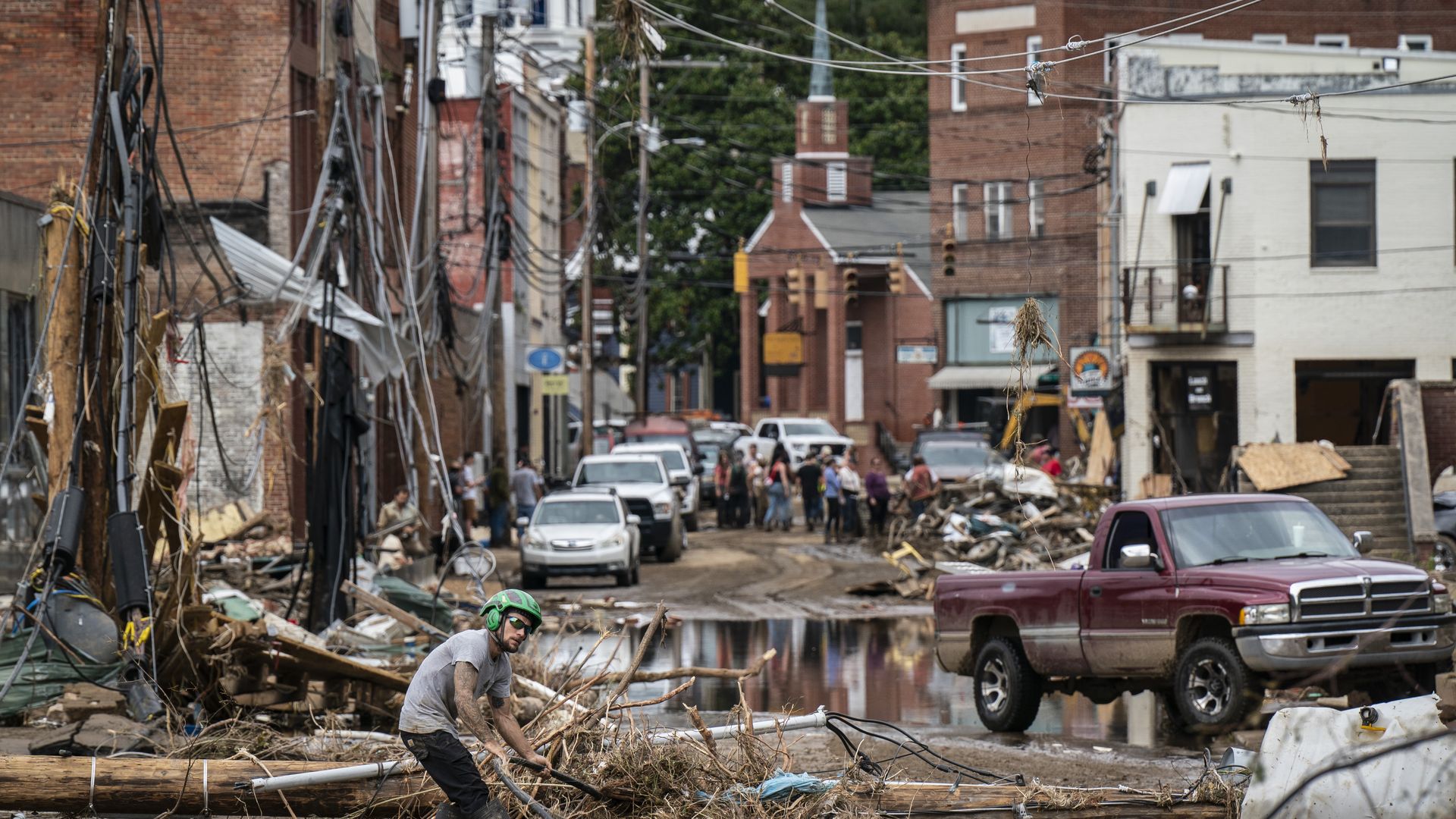
Hurricane season each year highlights an expensive problem: The disaster-response system is fundamentally broken, but Congress isn't thinking big, Nick writes.
Why it matters: Victims and communities often have to navigate a bureaucratic mess after a storm, and a combination of climate change and risky land use decisions are causing ever more expensive disasters.
- "We are really not quite yet grappling with how much our risk is changing and what that requires," said Carolyn Kousky, a climate risk expert at EDF.
- There is increasing bipartisan congressional interest in changing how the nation thinks about climate-fueled disasters in the long term.
Driving the news: For now, Congress will likely need to pass a supplemental funding package to deal with hurricanes Helene and Milton.
- Priority one after a disaster is drawing from FEMA's Disaster Relief Fund, which the agency believes will need more money this year.
- But relief also comes from a patchwork of agencies, like the Small Business Administration and HUD's Community Development Block Grant Disaster Recovery (CDBG-DR) money — a program that's never been permanently authorized.
- This can lead to a "valley of death" in the recovery process, in which households get some FEMA relief but face a long wait for Congress to appropriate more and for the bureaucracy to dole it out, said Carlos Martín, a program director at Harvard's Joint Center For Housing Studies.
Zoom in: Congress in 2018 updated the Stafford Act — the primary law governing relief efforts — in the Disaster Recovery Reform Act.
- The law created the Building Resilient Infrastructure and Communities (BRIC) grant program, allowing FEMA to set aside a chunk of the Disaster Relief Fund for mitigation and climate resilience projects.
- The bipartisan infrastructure law sent billions of dollars to climate resilience projects around the country.
Yes, but: Experts think Congress needs to do more than tinker with the Stafford Act.
- BRIC, for instance, has struggled to get money out the door and has allocated relatively little to Gulf Coast states that are often in the path of hurricanes.
What's next: Martín proposes making FEMA an independent Cabinet agency and formally authorizing HUD's CDBG-DR program (both bipartisan ideas).
- Sen. Chris Coons also has a bipartisan bill to create a national climate adaptation strategy and appoint a chief resilience officer at the White House. Its eight cosponsors are split between the parties.
Our thought bubble: None of these proposals has seen much action.
- The politics are a little funky in light of the conspiracy theories about FEMA that former President Trump and his allies are spreading.
- Still, while Republicans don't openly talk about climate change making hurricanes more intense, they're often open to the argument that resilience investments save money over the long term.
2. FERC's Rosner eager to see permitting package
New FERC commissioner David Rosner said he's focused on lowering barriers to transmission projects, Daniel writes.
Why it matters: The former FERC detailee to Senate ENR was confirmed to the commission this year and could be a key swing vote on major rulemakings.
- Rosner worked on the Senate permitting reform proposal and advised Sen. Joe Manchin on FERC, electricity and electric transmission.
Rosner, in his new role, declined to comment directly on the bill and its prospects in an interview on the sidelines of last week's ACORE Grid Forum.
- "It takes too long to build things — full stop," Rosner said. "But I defer to Congress on a solution. If they come up with one, I'll be really excited and work really hard to implement it."
Rosner, a Democrat, said he wants to "turn down the political temperature" on FERC's transmission planning rule in May that drew criticism from Republican lawmakers and legal challenges from GOP states.
- "Load growth is economic growth, and I think that has broad bipartisan appeal," Rosner said. "We have to find ways to build needed transmission."
The latest: Rosner and the rest of FERC unanimously voted today to back a separate transmission rule it finalized in May.
- The rule opened a pathway to federal permitting of transmission lines deemed by the Energy Department to be in the national interest.
- Today's order changes the rule to require transmission developers to describe in advance how they will engage with tribal nations to obtain permission to use land held in the trust of a tribe.
3. FERC bonus: Chair praises nuke deals amid grid fears
/2024/10/17/1729178193239.gif?w=3840)
FERC Chairman Willie Phillips said recent tech industry deals to invest in nuclear power signaled "great hope and optimism" for small modular reactors to supply growing demand, Daniel writes.
Why it matters: FERC has been confronting grid reliability challenges with a rise in energy demand, the loss of coal and nuclear plants, and extreme weather.
- Rising interest in nuclear as a way to shore up energy shortfalls dominated the conversation during FERC's joint meeting with the Nuclear Regulatory Commission in January.
Threat level: Phillips told reporters after today's open meeting that the commission has been addressing supply chain risks, rolling out reliability standards for wind and solar resources, and publishing action reports on extreme weather events.
- But recent hurricanes that left more than 3 million customers without power shows a need for FERC to be "ever vigilant" in enforcing reliability standards, he said.
What they're saying: "I don't talk about climate change a lot from this podium," Phillips said. "But I can tell you this: From what we've seen in the activity in devastating hurricanes that we've seen over the past few weeks ... we have to take seriously our obligations and responsibility to ensure reliability and resilience of our power system."
What we're watching: FERC is likely to address the need for additional grid reliability following a technical conference yesterday to discuss current risks to the system.
4. Catch me up: SCOTUS reax, plastics, Pentagon
🏭 1. Power up: Hill Republicans are mad — but not too mad — that SCOTUS declined to stay EPA's power plant emissions rule.
- "I am disappointed with the decision by the Supreme Court and trust that the D.C. Circuit Court of Appeals will uphold the Constitution and strike down this illegal rule," Western Caucus Chair Dan Newhouse said in a statement.
✏️ 2. State (Department) of play: Rep. Dan Crenshaw and other Republicans sent a letter this week to the State Department criticizing the administration's support for a U.N. treaty to limit plastic production.
🪖 3. Defense of climate tech: Military spending on resources such as batteries, low-carbon fuels, on-site power and electric vehicles has become a vital source of capital for certain climate tech companies, our colleague Alan Neuhauser writes in Axios Pro: Climate Deals.
- Read his deep dive here, and click here to subscribe to Climate Deals.
✅ Thank you for reading Axios Pro Policy, and thanks to editors Chuck McCutcheon and David Nather and copy editor Amy Stern.
✏️ Do you know someone who needs this newsletter? Have them sign up here.
View archive