
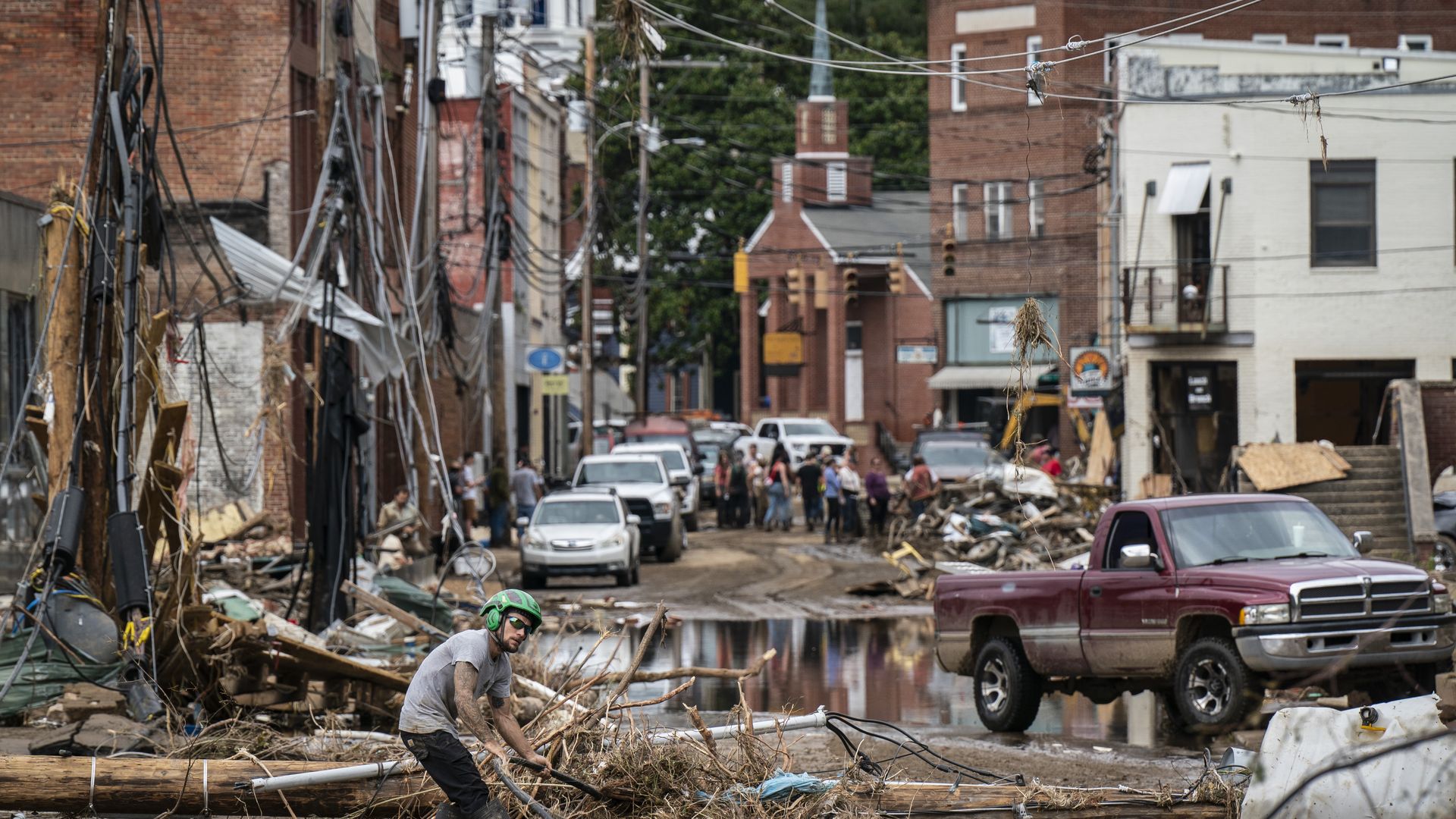
Hurricane season each year highlights an expensive problem: The disaster-response system is fundamentally broken, but Congress isn't thinking big.
Why it matters: Victims and communities often have to navigate a bureaucratic mess after a storm, and a combination of climate change and risky land use decisions are causing ever more expensive disasters.
- "We are really not quite yet grappling with how much our risk is changing and what that requires," said Carolyn Kousky, a climate risk expert at EDF.
- There is increasing bipartisan congressional interest in changing how the nation thinks about climate-fueled disasters in the long term.
Driving the news: For now, Congress will likely need to pass a supplemental funding package to deal with hurricanes Helene and Milton.
- Priority one after a disaster is drawing from FEMA's Disaster Relief Fund, which the agency believes will need more money this year.
- But relief also comes from a patchwork of agencies, like the Small Business Administration and HUD's Community Development Block Grant Disaster Recovery (CDBG-DR) money — a program that's never been permanently authorized.
- This can lead to a "valley of death" in the recovery process, in which households get some FEMA relief but face a long wait for Congress to appropriate more and for the bureaucracy to dole it out, said Carlos Martín, a program director at Harvard's Joint Center For Housing Studies.
Zoom in: Congress in 2018 updated the Stafford Act — the primary law governing relief efforts — in the Disaster Recovery Reform Act.
- The bipartisan infrastructure law sent billions of dollars to climate resilience projects around the country. And FEMA, thanks to a separate 2022 law, has new ways of mapping where that kind of money is needed.
- The Biden administration has also made some "really important" changes to make the distribution of FEMA assistance more equitable, Kousky said.
- That includes the new $750 "serious needs" assistance — intended to just get cash in victims' hands immediately — that's been the subject of conspiracy theories after the recent storms.
Yes, but: Experts think Congress needs to do more than tinker with the Stafford Act.
- BRIC, for instance, has struggled to get money out the door and has allocated relatively little to Gulf Coast states that are often in the path of hurricanes.
- Then there's the National Flood Insurance Program, which has updated its system for pricing flood risk under the Biden administration — to much criticism and acclaim — but was last reauthorized on a long-term basis in 2012.
What's next: Martín proposes making FEMA an independent Cabinet agency and formally authorizing HUD's CDBG-DR program (both bipartisan ideas).
- Sen. Chris Coons also has a bipartisan bill to create a national climate adaptation strategy and appoint a chief resilience officer at the White House. Its eight cosponsors are split between the parties.
That is a "pressing need," said Forbes Tompkins, a senior officer at Pew who worked on climate adaptation in the Biden White House.
- "We've made a lot of progress as far as historic investment in resilience, but we need to make sure that across the federal government, when there's at least 17 federal agencies responsible for disaster recovery and preparedness funding, that they're doing it in a coordinated and efficient way."
Our thought bubble: None of these proposals has seen much action.
- The politics are a little funky in light of the conspiracy theories about FEMA that former President Trump and his allies are spreading.
- Still, while Republicans don't openly talk about climate change making hurricanes more intense, they're often open to the argument that resilience investments save money over the long term.
The bottom line: Political reckoning is tough to predict these days, but the impacts of climate change may eventually throw the nation into environmental and fiscal disaster.
- "The way that we fund disaster relief in the country is not sustainable," said Natalie Enclade, executive director of BuildStrong America.
