February 28, 2024

😅 Quite a day, huh? Can't imagine anything interesting happened.
⚡️ Join Axios Pro Policy for an exclusive conversation with Rep. Cathy McMorris Rodgers on Thursday, March 7. Register here.
- You're also invited to join Axios Pro's Maria Curi and Ashley Gold tonight at 6:30 ET in D.C. for an event on AI with Sens. Mike Rounds and Cory Booker as well as NTIA administrator Alan Davidson.
🎼 Today's last tune is dedicated to Mitch McConnell: "My Old Kentucky Home, Goodnight" by John Prine. ("Everybody likes John Prine — or should," says our editor Chuck.)
1 big thing: What McConnell's exit means for energy
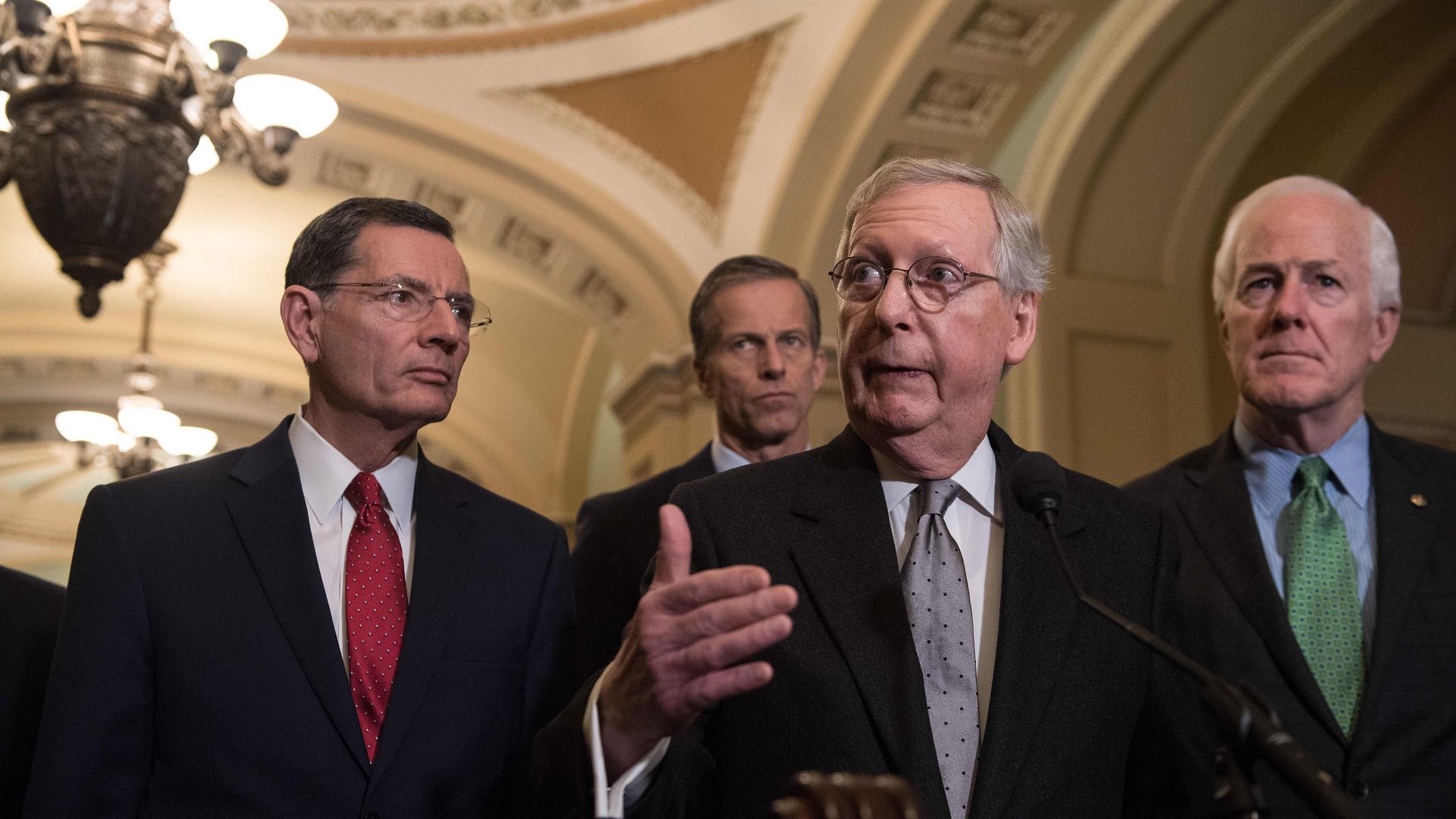
Barrasso, Thune, McConnell and Cornyn in 2018. Photo: Nicholas Kamm/AFP via Getty Images
Mitch McConnell's leaving. Brace yourself for the "war of the Johns," Jael and Nick write.
Why it matters: The Senate Republican leader race could shape future energy and climate policy in Congress for years — maybe decades.
Driving the news: McConnell's most likely successor: John Thune, John Barrasso or John Cornyn.
Between the lines: Each candidate recites GOP boilerplate on energy issues — "all of the above" with a dash of renewables bashing. But a few factoids stand out.
- Thune's state of South Dakota is a big ethanol producer but also has a burgeoning wind and hydropower contingent.
- He's also a biofuels backer and has teamed up with Democrats to try to shape the rollout of the IRA's sustainable aviation fuel credit.
Then there's Barrasso of Wyoming, a coal and nuclear state. He is perhaps most experienced on our issues as a former EPW chair and current ranking member on ENR.
- He's got a soft spot for the 45Q carbon capture tax credit and has helped lead the fight to get uranium import restrictions into law.
- He's a fierce partisan but no stranger to bipartisan deals. As EPW chair, he struck a deal with Tom Carper on legislation to phase down the use of hydrofluorocarbons.
John Cornyn is more of a wild card. There's no doubt he's an oil and gas guy, but he's also joined bipartisan efforts to bolster hydrogen.
- Interesting tidbit: Cornyn's working with Chris Coons to fix a budgetary issue holding back overseas investments in a minerals supply chain to counter China.
Here's a good ideological proxy: All three voted against the bipartisan infrastructure law — a bill that McConnell championed.
Flashback: McConnell helped kill cap-and-trade as minority leader and led the GOP's vociferous opposition to Obama-era climate rules.
- He was generally a trendsetter over his term in leadership in how the GOP messaged through the decline of coal.
Our thought bubble: We might see even more of a vocal emphasis on energy policy from the likes of Barrasso, Thune or Cornyn.
2: Hill hydrogen hubbub

Illustration: Tiffany Herring/Axios
The fight over hydrogen tax credits is reaching a climax on the Hill and in the federal comment docket, Nick writes.
Why it matters: Monday marked the end of the public comment period for Treasury's proposed rules on the 45V hydrogen incentive. Companies and green groups are scrambling to spell out their version of congressional intent.
State of play: A bevy of comments scooted in under the deadline, illustrating how some in the industry are in a panic about Treasury's guidance.
- The U.S. Chamber of Commerce, American Council on Renewable Energy and Edison Electric Institute have all written comment letters seeking changes to the initial guidance.
- "The three pillars as contemplated under the proposed regulations are a flawed proxy for the incentive Congress enacted and could significantly limit a domestic clean hydrogen market that has yet to take its first steps," ACORE wrote.
What they're saying: "What I'm trying to do as the author of this is to try to find the balance we talked about in committee," Senate Finance Chair Ron Wyden told Nick.
- He largely declined to get into specifics but said there's "more work to do" on the credit.
- "I'm really hopeful that they'll pay attention to striking the right balance," said Sen. Chris Coons. "We could have a generational global leadership … but not if those tax interpretations come out all the way at one end of the spectrum."
- On the GOP side, Sen. Shelley Moore Capito wrote to Treasury last week arguing that the three pillar approach is "not established in statute and will undermine bipartisan efforts to spur a hydrogen economy."
Context: The Treasury Department's proposed rulemaking included the three-pronged guardrails that climate activists wanted.
- To qualify, hydrogen projects would have to be connected to new low-carbon power, be produced in the same region as that power, and be matched on an hourly basis by "clean" energy by 2028.
Zoom in: Along with its own written comments, the American Clean Power Association unveiled a study Monday declaring Treasury's proposed time matching requirements as unfriendly for "green" hydrogen (that is, produced via renewables).
The other side: Environmental groups — and some hydrogen companies — push back on the idea that Treasury's proposed guidance would devastate the industry.
- "[Congress] wanted to promote low-carbon hydrogen that would reduce overall greenhouse gas emissions," the Clean Air Task Force wrote in its comment.
3. EV world tries to kill the AM radio star

Illustration: Sarah Grillo/Axios
EV supporters are trying to snuff out the bipartisan AM radio bill before it can get into any must-pass legislative package, Jael writes.
Why it matters: Carmakers say the AM radio mandate proposal, backed by broadcasters, would particularly affect EVs because their frequencies interact with other parts of the vehicles.
Driving the news: Washington allies of the EV industry are redoubling their efforts on the bill, placing Beltway ads and circulating fresh literature on Capitol Hill.
- The Consumer Technology Association, which represents EV startups Tesla, Rivian and Lucid, has been running ads on the Punchbowl daily podcast this week opposing the legislation.
- CTA has also begun circulating a joint one-pager on the Hill with the Alliance for Automotive Innovation and ZETA, which represents companies up and down the EV supply chain.
- "Mandating analog AM radios in every vehicle stretches the traditional approach to vehicle safety, affects innovation and undermines the expansion of safer and cleaner transportation," reads the one-pager, which Axios obtained today.
What they're saying: This new offensive is aimed at preempting any effort to stick the AM radio bill into an omnibus package to fund the government or enact other must-pass bills this year, said CTA's India Herdman.
- "The ads are necessary, because as long as the broadcasters are pushing this bill, we're going to have to fight back," Herdman told Jael.
4. Catch me up: Nuclear bill, DOE money

Illustration: Shoshana Gordon/Axios
💌 1. GOP waiver war: Capito and House E&C chair Cathy McMorris Rodgers are sending a letter this afternoon to the EPA opposing the waiver for California's auto emissions standards, Jael has learned.
- The letter, provided exclusively to Axios ahead of public release, says California's standards make "unrealistically stringent requirements on manufacturers."
- Sen. Markwayne Mullin and Rep. John Joyce also signed it.
☢️ 2. WIPPed clean: DOE put out a request for information yesterday about developing carbon-free power projects at New Mexico's Waste Isolation Pilot Plant, which celebrates its 25th anniversary as the nation's nuclear garbage dump.
⚡️ 3. Efficient distribution: DOE also announced today a fresh $17 million round of bipartisan infrastructure law funding for energy efficiency projects.
✅ Thank you for reading Axios Pro Policy, and thanks to editors Chuck McCutcheo and David Nather and copy editor Brad Bonhall.
View archive