February 07, 2024

🐪 Something-something hump day. Now on to the news!
🚨 Situational awareness: The House has teed up a major water permitting bill for a vote next week, along with two bills that target forced labor in China.
- The schedule remains in flux, so if bills are added, we'll let you know!
🎼 Today's last tune is from Rep. Scott Peters: "I Wish" by Skee-Lo. (We don't know if Peters can get any taller, but a wish is a wish ...)
1 big thing: Energy transition alarm bells
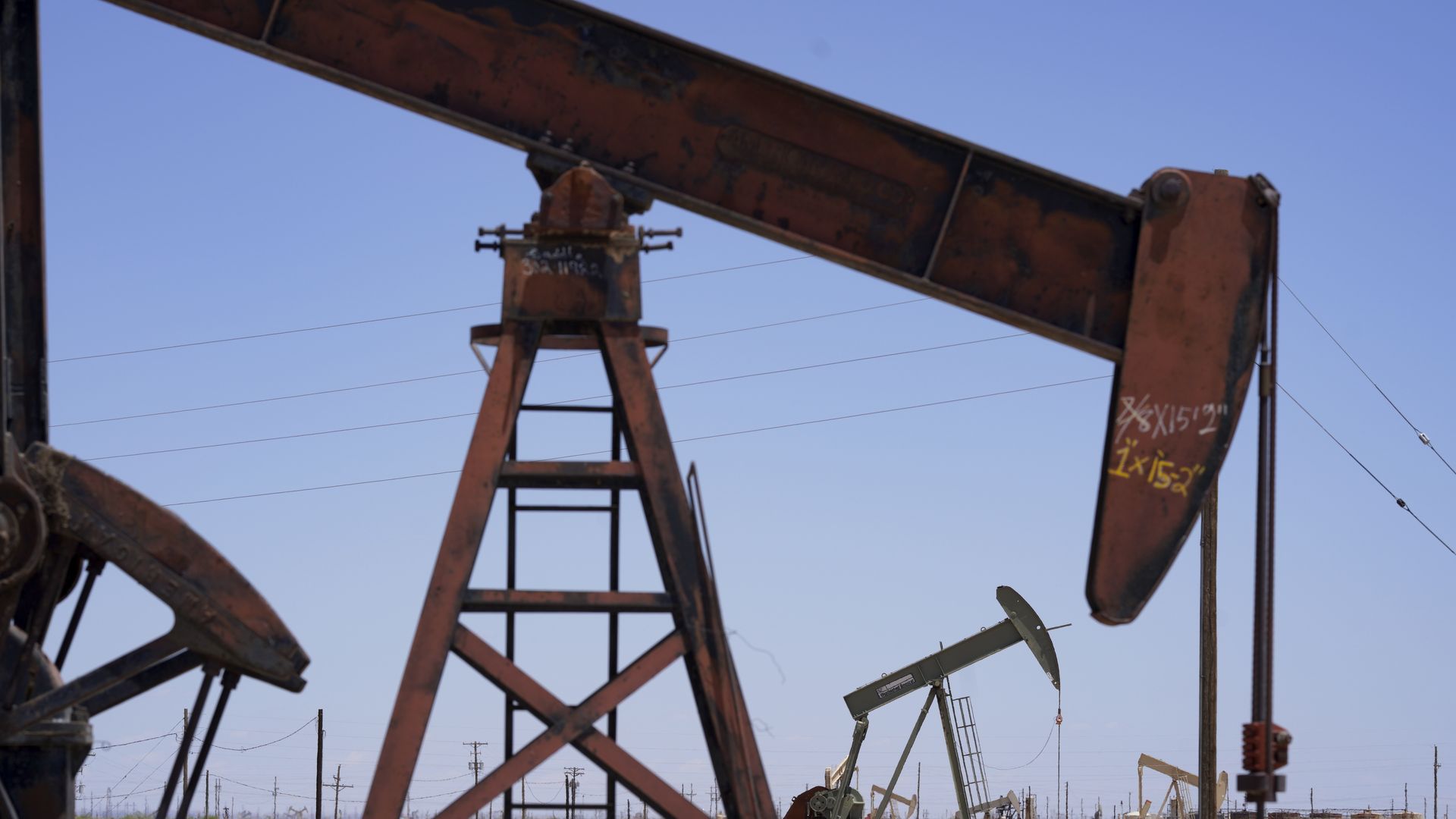
Pumpjacks outside Artesia, N.M. Photo: Bonnie Jo Mount/The Washington Post via Getty Images
Fossil fuel communities stand to lose billions in tax and royalty revenue in the energy transition — an issue Congress has barely started to address, Nick writes.
Why it matters: The decline of coal has already had huge impacts on employment and tax bases in localities around the country. Some lawmakers want to address that — and ensure that oil and gas communities avoid a similar fate.
- "We're trying to figure out how to get people talking about this transition more," Sen. Martin Heinrich told Nick. "It's a disservice not to have this conversation, because this is going to have a lot of impacts on people's lives."
By the numbers: New Mexico gets roughly 40% of its revenue, including taxes and federal royalties, from oil and gas production.
- Elsewhere, some counties derive more than 90% of their property tax revenue from oil, gas or coal, according to a recent report from Resources for the Future.
- "If there is going to be a rapid transition to net zero, there is going to need to be financial transfers from the federal government to states and localities" if they want to maintain their level of services for schools, roads and safety, said Daniel Raimi, the report's author.
Flashback: After the decline of the timber industry, Congress did just that via the 2000 Secure Rural Schools Program, which funds former timber communities' roads as well as schools.
- But it was repeatedly renewed — and lapsed at times — as those communities struggled to attract new development.
- "Replicating something like Secure Rural Schools, I think, is a bad idea," said Mark Haggerty, senior fellow on energy and environment at the Center for American Progress.
Between the lines: A lot of money is on the table from the IRA and infrastructure law for advanced manufacturing and renewables projects in these communities.
- But experts say those kinds of projects are unlikely to fully replace revenue lost from fossil fuels.
- The IRA includes a bonus tax credit for renewables projects that go into an "energy community," but the Biden administration's guidance made huge swaths of the country eligible for the incentive.
- "That makes me skeptical that provision is going to be very effective in steering a disproportionate amount of investment to the most fossil-dependent communities," Raimi said.
What we're watching: Heinrich introduced a bill in 2021 that would create "energy transition payments" to help states and localities make up for lost royalty revenue.
- Henirich said he's not sure when he'll reintroduce it because he wants to find the best way to "force this conversation."
- Sen. Michael Bennet also has a proposal to create a federally chartered nonprofit to send support to transitioning communities. His office said he's seeking a Republican cosponsor.
The other side: To Sen. Bill Cassidy, "the impending death of natural gas and oil is greatly exaggerated."
- "Now, should they diversify?" he told Nick. "Every economy should diversify a little bit."
- Sen. Kevin Cramer acknowledged that "there's going to have to be a replacement" for these revenues — but said it's an argument against climate policies that force a quick transition.
Our thought bubble: Even if oil and gas production were to go on forever, the industry's ebbs and flows create some uncertainty for states and communities reliant on it.
- Congress won't act this year, but the fate of the timber and coal industries should set off alarm bells.
2. A new fusion caucus

Illustration: Natalie Peeples/Axios
The Senate is getting its own fusion energy caucus, Nick writes.
Why it matters: It could boost support for the big federal funding that the industry wants to help it commercialize its technologies over the next decade.
Driving the news: Heinrich will lead the caucus with a yet-to-be-determined Republican co-chair.
- Initial members include Todd Young, Kirsten Gillibrand and Angus King.
- Heinrich held an early launch event last week with a few other Senate Democrats and members of the House Fusion Caucus.
- "What our role should be is in thinking through how DOE can accelerate, shorten timelines, be a good partner to private-sector industry," Heinrich told Nick as he sat in his antler-lined Hart office.
Zoom in: The fusion industry wants Congress to focus more on commercialization funding and materials science for fusion.
- Part of the conversation on the Hill, Heinrich said, is about how to make that shift, with many existing programs at DOE focused on earlier-stage science.
- "When you look at the capital that's moved into fusion as a business model, you can tell that we're starting to make that transition from physics to engineering," he said.
Of note: The Nuclear Regulatory Commission last year voted to regulate fusion differently than that for conventional fission reactors, which could enable fusion projects to get licensed much more quickly.
- Members of the House caucus have a bill to codify that decision, and Heinrich said he's "looking at" a potential Senate companion.
- "I think we should put that decision into permanent law," he said.
3. EPA's super soot salvo
Illustration: Aïda Amer/Axios
The EPA is tightening standards for soot, prompting loud cries from corporate America.
Why it matters: This form of air pollution is linked to asthma, irregular heartbeats, bronchitis and premature death.
State of play: The agency is imposing a new annualized exposure mandate for fine particulates of 9 micrograms per cubic meter (µg/m3), down from the current 12 µg/m3 requirement, Axios Generate's Ben Geman writes.
What they're saying: Environmental groups — a key Democratic political constituency — called it an important public health move.
- But business groups, citing steady improvements in air quality, say ratcheting down requirements again would throttle development and job growth.
To read the full story, subscribe to Axios Generate.
4. Catch me up: CRAs aplenty, DOE grid request

Illustration: Tiffany Herring/Axios
🚫 1. Disapproving GHG plans: Senate EPW Ranking Member Shelley Moore Capito introduced a Congressional Review Act resolution to disapprove of the Transportation Department's efforts to get states to set greenhouse gas plans.
- The legislation is backed by a large gang of congressional Republicans and (surprise!) Senate ENR Chair Joe Manchin.
- Meanwhile, Rep. Jared Huffman today reintroduced his bill to require transportation planners to account for climate impacts.
🔌 2. Transmissions from gridland: The Energy Department put an RFP out yesterday for fresh candidates to receive bipartisan infrastructure law grid money.
- Through the RFP, officials said, they expect to release up to $1.2 billion for transmission projects through capacity contracts.
⛏️ 3. Mining matters: The Natural Resources Committee yesterday advanced a bipartisan (and controversial) bill that would allow mining companies to store waste and process materials on public land that doesn't have known mineral deposits.
✅ Thank you for reading Axios Pro Policy, and thanks to editors Chuck McCutcheon and David Nather and copy editor Brad Bonhall.
View archive