Axios World

June 29, 2023
Welcome back to Axios World.
- We start tonight (1,948 words, 7 minutes) with the unrest in France, take a deep dive into the U.S.-China race on AI, check in with the latest from Putin and Prigozhin, and end by asking... what's my age again?
Situational awareness: U.S. envoy for Iran Rob Malley told Axios' Barak Ravid he is on leave because of an investigation that has affected his security clearance.
1 big thing: Protests and unrest grip France after police shooting

Mounia, the mother of Nahel, a teenage driver shot dead by a policeman, at a demonstration today. Photo: Antoine Gyori/Corbis via Getty
Protests and unrest are rocking parts of France after the deadly police shooting of a 17-year-old driver of Algerian and Moroccan descent during a traffic stop in a Paris suburb on Tuesday, Axios' Laurin-Whitney Gottbrath writes.
Driving the news: Authorities said 40,000 police officers were being deployed today to help quell the unrest after demonstrators set cars and public buildings on fire to protest police brutality and systemic racism. At least 180 people have been arrested so far.
- A prosecutor announced that the officer who shot and killed the teenager, identified as Nahel M, will be formally investigated for voluntary homicide.
- French President Emmanuel Macron yesterday called the killing "inexplicable" and "unforgivable." After the violence overnight, he tweeted that "violence against police stations, schools, town halls, against the Republic, is unjustifiable."
- Thousands marched today with Nahel's mother through Nanterre, the Paris suburb where the teen was killed, to call for justice. She told France 5 she didn't blame the police as a whole but believed the officer who killed her son, "saw the face of an Arab, of a little kid, he wanted to take his life."

Zoom out: There have also been demonstrations and arrests in other French cities, including Marseille and Toulouse, and even in Brussels.
- The unrest echoes three weeks of protests and riots that erupted in France following the 2005 deaths of 15-year-old Bouna Traoré and 17-year-old Zyed Benna, who were electrocuted after hiding in a power substation as police chased them.
- Two officers involved were cleared of wrongdoing 10 years later.
What happened: The French prosecutor said Nahel drove through a red light to avoid police, who were attempting to pull him over for several traffic violations.
- The teen was known to authorities for previously violating traffic stop orders, the prosecutor added. The officer who shot Nahel said he feared for his and the public's safety.
- But a video of the shooting shows the officer firing his weapon as Nahel drives away — contradicting earlier reports by French media, citing police sources, that the teen had driven his vehicle into the officers.
- The prosecutor said his initial investigation concluded “the conditions for the legal use of the weapon were not met."

Lawyers for Nahel's family welcomed the news that the officer who killed Nahel was being investigated, but also called for investigations into a second officer for alleged complicity and another for allegedly lying about the shooting, per the NYT.
What they're saying: "The situation for French people of Arab origin, for French Black people as well, has only gotten worse with regards to police violence," Crystal Fleming, a professor of sociology and Africana studies at Stony Brook University, told France24.
- She said that while French politicians decry police brutality and racism in the U.S., they often refuse to do so when similar incidents happen in France.
- "I really wonder how many more people have to experience this level of brutality before there is an acknowledgment that systemic racism in France is real and needs to be addressed," she said.
2. How the U.S. is trying to stay ahead of China in the AI race

Illustration: Sarah Grillo/Axios
The U.S. has a key advantage over China as the two superpowers compete for supremacy in artificial intelligence: The most advanced chips used to train AI are designed in the U.S. and built with tools from allied countries.
Driving the news: The Biden administration is poised to expand its efforts to keep those highly advanced chips out of China, and thus keep Chinese AI firms behind the curve.
- Last October, the U.S. moved to block exports to China of certain top-of-the-line chips — including Nvidia's A100 — as well as chipmaking tools needed to make them.
- The Biden administration is considering broadening the restrictions as early as next month to include chips like Nvidia's A800, which was designed to comply with the October regulations, and restrict Chinese firms' ability to use powerful chips hosted overseas, the WSJ reports.
- The Commerce Department declined to comment.
Between the lines: The Biden administration is worried that AI developed by private Chinese firms will ultimately have military, intelligence and surveillance utility for Beijing.
- But it has to balance its response with concerns that cutting China off will hamper the tech giants that have powered U.S. advances in AI — particularly Nvidia, which recently became the seventh company to hit a $1 trillion market cap.
- As the WSJ report drove Nvidia's share price down, CFO Colette Kress warned the regulations could lead to "a permanent loss of opportunities for the U.S. industry to compete and lead in one of the world’s largest markets."
- For now, though, demand for advanced chips so far outstrips supply that Nvidia's bottom line won't be affected, she said.
The big picture: Advanced AI models are differentiated by three main inputs: algorithms, data, and chips, according to Paul Scharre, director of studies at CNAS and author of "Four Battlegrounds: Power in the Age of Artificial Intelligence."
- The biggest chokepoint for AI developers at the moment is access to the most advanced chips, which are mostly designed by American firms (particularly Nvidia) and manufactured in Taiwan using U.S. software and chipmaking tools made by Dutch and Japanese firms.
- The Biden administration not only restricted exports of top-of-the-line chips to China, but it also got the Netherlands and Japan to agree to restrict exports of the tools used to make them.
- If the policy works as intended, Chinese AI developers will remain boxed out of that supply chain, working with less powerful chips, and thus a year or two behind the cutting edge as AI continues its rapid advance, Scharre says.
3. China's path to catching up
Illustration: Sarah Grillo/Axios
Chinese firms have a few options to counter the U.S. efforts to leave them behind.
- There's already a black market for Nvidia’s A100 chips in China, Reuters reports, suggesting some suppliers are using work-arounds to get them into the country.
- Firms can also use a greater number of less powerful chips to approximate the same performance.
As the regulations currently stand, Chinese companies can also effectively lease access to top-of-the-line chips from cloud computing centers overseas.
- The Biden administration is also considering restricting that access, according to the WSJ.
- That would have major implications not only for the AI race, but also for the cloud services space, which U.S. firms like Amazon and Microsoft currently dominate, according to Christopher Miller, an associate professor at Tufts University and author of "Chip War."
In the longer term, Beijing is intent on catching and surpassing its foreign competitors in both the design and fabrication of advanced chips.
- China has been spending “one CHIPS Act per year” for the past decade on semiconductor R&D, Miller says, referring to the $280 billion law the U.S. passed last year to boost domestic chip production.
- For now, the U.S. continues to produce the world's "most innovative and important chip companies," like Nvidia, while China hasn't been able to muscle its way into the high-end supply chain, Miller says.
- A spokesperson for China's embassy in Washington hit out at U.S. efforts to obstruct "China's scientific and technological advancements" in a press briefing on Wednesday, without referring directly to the potential new step.
- In a signal that it can hit back — and a possible attempt to divide Washington and Seoul — Beijing last month announced a partial ban on Micron memory chips, officially for security reasons. The Biden administration is urging Micron's South Korean competitors not to fill the void.
What to watch: While Chinese companies are making strides on AI and semiconductors, the Biden administration seems to be betting that its regulations and investments will keep U.S. firms just ahead.
- Miller thinks the U.S. and its allies are well-positioned in that race. "If you asked me would I rather be in a camp that involves all of the world's most advanced economies that are at the cutting edge, or would I rather be in a camp that only involves China and is several generations behind the cutting edge, I think that's an easy question to answer."
- Other experts think China might be well-positioned in the longer-term, particularly if it continues to narrow the "talent gap" with the U.S. by investing in education and research and convincing more talented AI researchers to stay in China.
Bonus: Where in the World?
"I didn't make the quiz?" Photo: David Hume Kennerly/Getty Images
In today’s quiz, we’re talkin’ bout a revolution — several in fact.
Can you name the modern-day country in which the following famous revolutionaries were born? There are one or two trick questions in here.
- Vladimir Lenin
- Karl Marx
- Mahatma Gandhi
- Maximilien Robespierre
- Sun Yat-sen
- Che Guevara
- Simón Bolívar
- Manuela Sáenz
- Patrick Pearse
- Toussaint L'Ouverture
- Alexander Hamilton
- Muammar Gaddafi
- Emiliano Zapata
- Giuseppe Garibaldi
- Thomas Sankara
Scroll to the bottom for answers.
4. The latest from Putin and Prigozhin
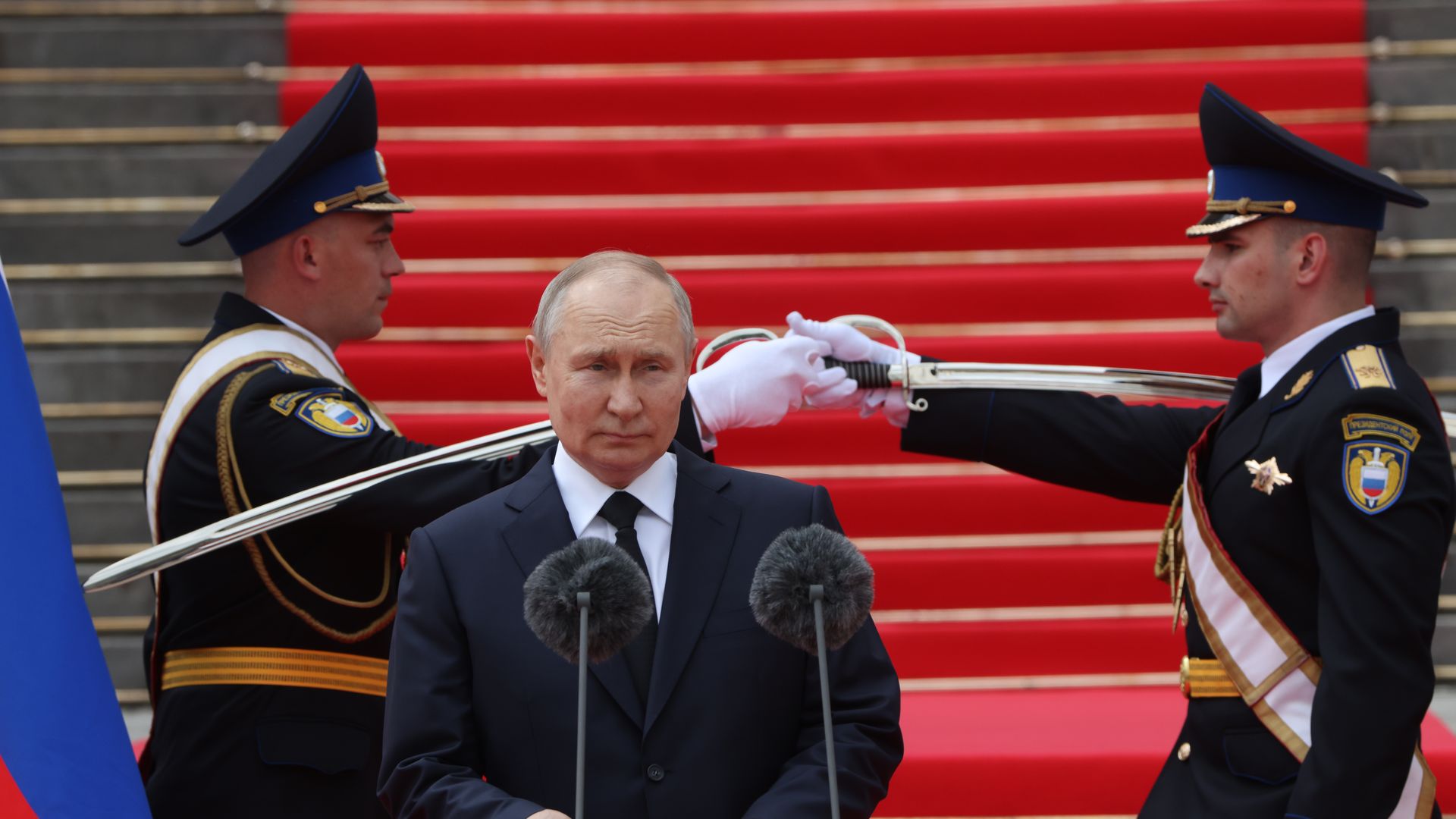
President Vladimir Putin speaks Tuesday on the rebellion, while soldiers do something kind of confusing with their swords. Photo: Getty Images
Here's a quick look at the ripples from the rebellion in Russia.
In Moscow, a top Russian general has reportedly been detained, and other senior figures are being scrutinized for potential links to Wagner Group leader Yevgeny Prigozhin’s rebellion.
- In Dagestan, President Vladimir Putin showed unusual warmth as he mingled with crowds on a visit apparently designed to demonstrate his enduring public support.
- In Belarus, rapid construction is taking place at a military base, the NYT reports, possibly to house Wagner fighters who follow their leader into exile. President Aleksandr Lukasheno said Tuesday that Prigozhin was in Belarus, but his current whereabouts are unconfirmed.
- In Syria, a senior Russian official arrived to inform President Bashar al-Assad that Wagner would no longer operate there independently from the Russian state, per the WSJ.
- In the Central African Republic and Mali, officials received reassuring calls from Moscow that Wagner’s operations there would continue, the Journal reports, noting that Russia doesn’t want to lose the influence and cash flow it derives from Wagner's presence in the Middle East and Africa.
- In Beijing, the rebellion may be sowing doubts that Russia is the stable, reliable partner China needs to achieve its ambitions, Axios China's Bethany Allen-Ebrahimian writes.
More global headlines
- A U.K. appeals court ruled that the government's plan to send asylum-seekers to Rwanda is illegal. The government has a week to appeal.
- With unpopular incumbent President Alberto Fernández and powerful VP Cristina Fernández de Kirchner not running, Argentina's Peronists have selected economy minister Sergio Massa as their candidate in October's elections. They're currently trailing the conservatives.
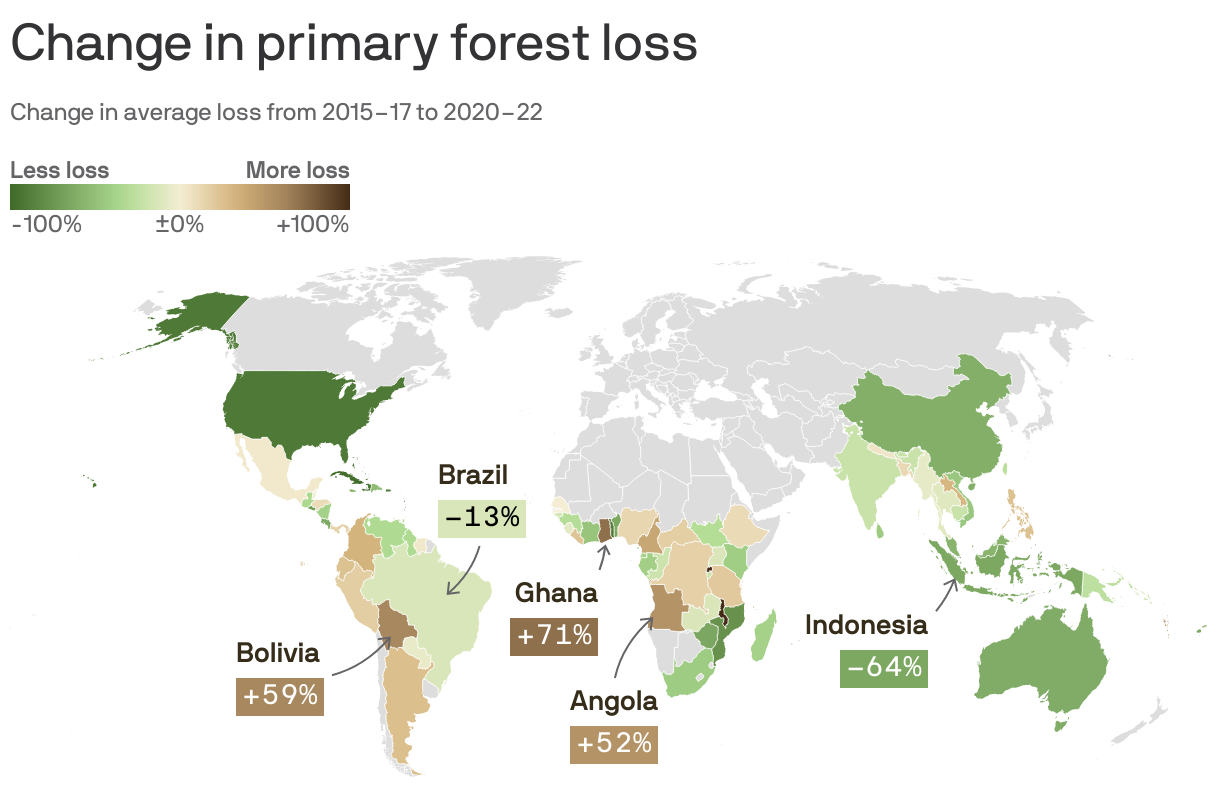
- Despite global commitments to halt the loss of tropical forests, the world lost 10% more primary rainforest in 2022 than it did the year before, Axios' Andrew Freedman writes.
5. Data du jour: Countries increasingly see U.S. as top economic power


In countries around the world, people are now more likely to name the U.S. as the world's leading economic power, rather than China, according to a new Pew report published Tuesday.
- The share of people who rate the U.S. as the world's leading economy has increased markedly among U.S. allies like Germany, Japan and France since 2020, Axios' Ivana Saric writes.
6. One fun thing: South Koreans wake up younger

People lounge in Seoul Plaza in Seoul, South Korea on April 23. Photo: Wang Yiliang/Xinhua via Getty Images
South Koreans woke up yesterday a year or two younger as the country replaced its own age-counting methods with the international standard, Ivana writes.
- Under the traditional method, people were one year old at the time of birth, with an additional year added every Jan. 1. A baby born on Dec. 31 would be considered 2 years old just 24 hours later.
- But the international standard method was used for medical and legal documents. The new standardization is expected to reduce the confusion.
7. Stories we're watching
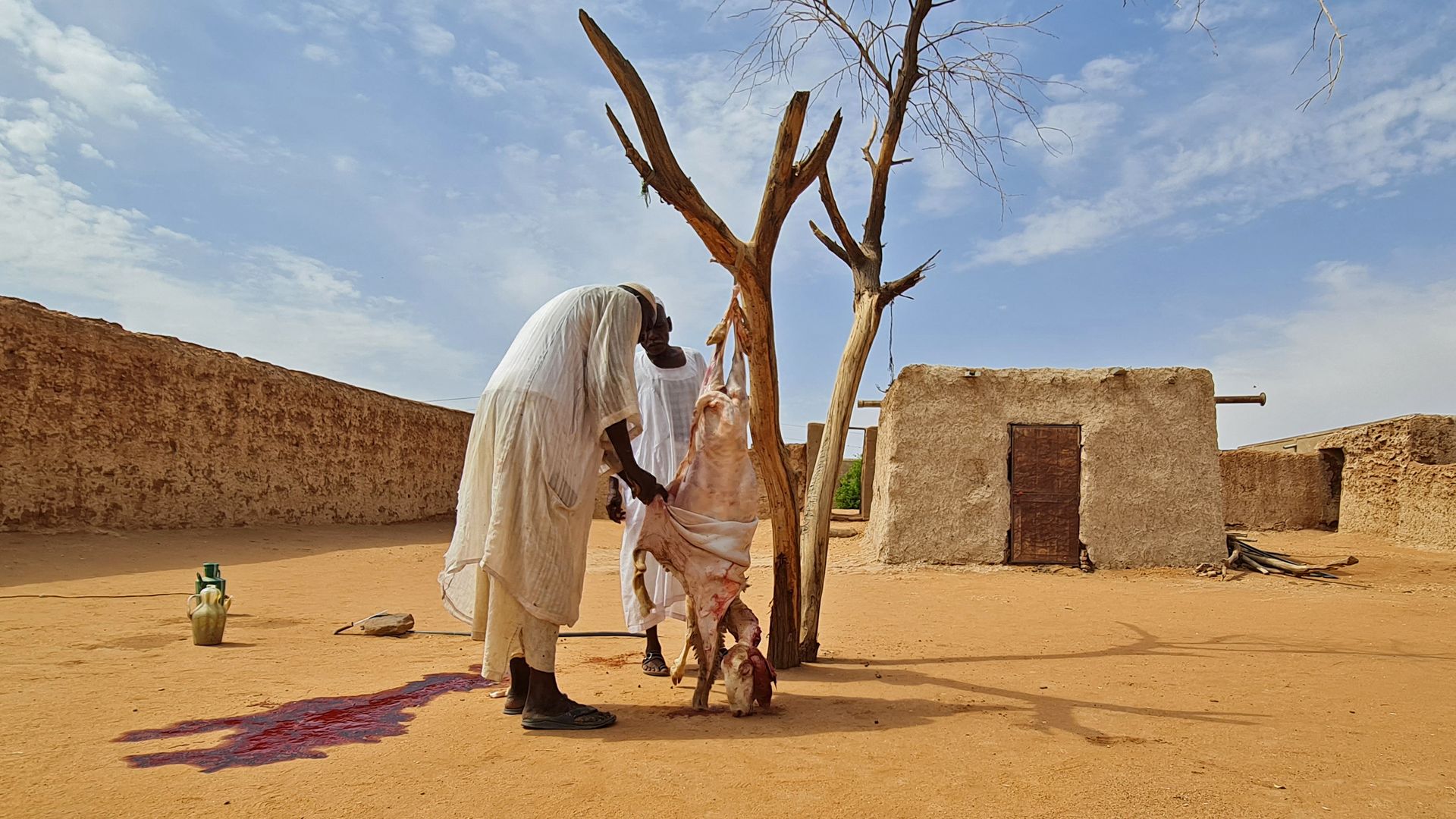
Preparing a sheep for Eid al-Adha in Wad Hamid, Sudan. Photo: AFP via Getty Images
- Canada wildfires now worst on record
- China tries to slow its currency slump
- WH concerned Israel is leaking on Iran talks
- UN: U.S. should apologize for "cruel" treatment at Guantánamo Bay
- White House condemns harassment of reporter who questioned Modi
- Mexican beer makers use bugs to supplement barley
- Shohei Ohtani continues to astound
Quoted:
"Park Jeong-yeon... an office worker, is delighted she will soon age backward to 28, from 30 years old. That buys her more time to meet her parents’ goal that she marries by her mid-30s."— Excerpt from the WSJ.
Answers: 1. Russia; 2. Germany; 3. India; 4. France; 5. China; 6. Argentina; 7. Venezuela; 8. Ecuador; 9. Ireland; 10. Haiti; 11. St. Kitts and Nevis; 12. Libya; 13. Mexico; 14. France (he was from Nice, this one was kind of mean); 15. Burkina Faso
Key: 1. Lenin; 2. Marx; 3. Gandhi; 4. Robespierre; 5. Sun; 6. Guevara; 7. Bolívar; 8. Sáenz; 9. Pearse; 10. L'Ouverture; 11. Hamilton; 12. Gaddafi; 13. Zapata; 14. Garibaldi; 15. Sankara
Sign up for Axios World

Take a tour of the most important stories shaping our world