Axios World

June 26, 2023

Welcome back to Axios World.
- Tonight's edition (1,772 words, 6½ minutes) focuses on the events over the weekend in Russia, before making stops in Sierra Leone, South Korea and an undersea volcano.
1 big thing: What the rebellion inside Russia means for Ukraine
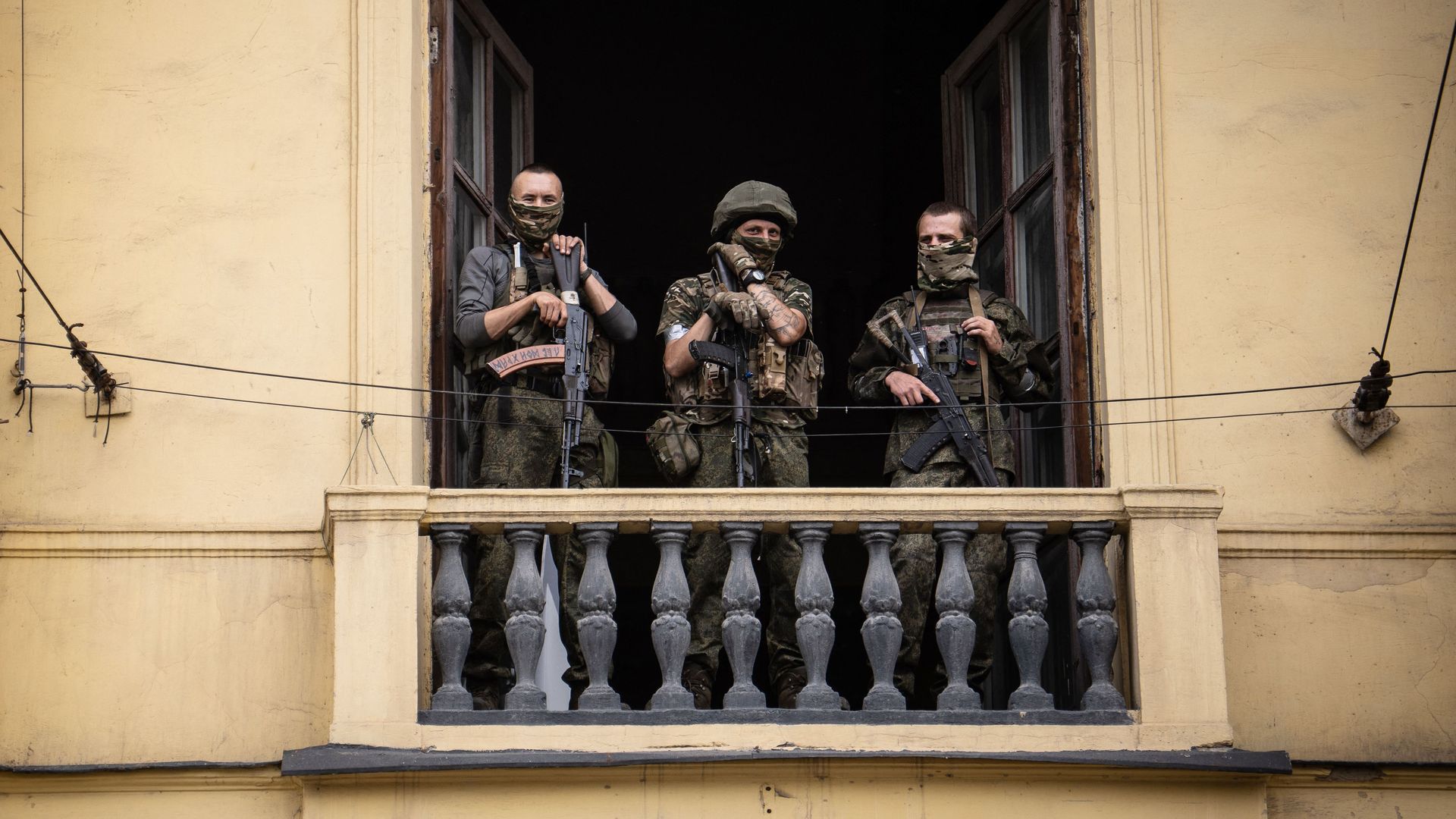
Wagner fighters on a balcony in Rostov-on-Don. Photo: Roman Romokhov/AFP via Getty Images
Wagner boss Yevgeny Prigozhin's unexpected offensive into the Russian interior may breathe new life into the counteroffensive across the border in Ukraine.
The big picture: Ukraine's forces have made only gradual progress so far in attacking well-defended Russian positions in the south and east of Ukraine. Wagner mercenaries, meanwhile, took control of the major Russian city of Rostov-on-Don and seemed to face little resistance as they covered three-quarters of the roughly 600 miles from there to Moscow.
On the one hand: The short-lived uprising in Russia doesn't appear to have left any major gaps for Ukraine to exploit. Wagner forces were not playing a major role in Russia's defenses, and the mutiny appears to have ended without Russian units being pulled out of Ukraine to help repel it, analysts say.
- Wagner did play a central role in the long and bloody battle for Bakhmut, but moved out after declaring victory there as Prigozhin feuded with the Ministry of Defense over plans to integrate his fighters into the conventional military.
- "[Wagner] units were not pulled off the line, hence Russian defense (especially in the south) is unlikely to suffer immediately from their absence," notes Michael Kofman, a top analyst of Russia's military at CNA.
- According to the Kremlin, Wagner fighters who did not take part in the mutiny will still be allowed to sign contracts with the defense ministry.
- "The fact that Wagner is returning to their training camps with military equipment indicates that the Kremlin intends to maintain at least certain elements of Wagner’s manpower rather than seek to immediately demobilize them," Kateryna Stepanenko, a Russia analyst at the Institute for the Study of War, tells Axios.
On the other hand: It's unclear whether Moscow will be able to effectively integrate Wagner's forces, which include some of Russia's most battle-hardened fighters, after such a public fracture.
- Wagner units reportedly shot down seven Russian aircraft and killed 13 airmen during the push toward Moscow.
Then there's the psychological blow for civilian leaders and front-line soldiers alike.
- Prigozhin challenged President Vladimir Putin's narrative around the Ukraine invasion — claiming it was launched not to defend Russia but to enrich an "oligarchic clan" — and seemed to challenge the president's very hold on power.
- More than a year after Russian tanks first rolled toward Kyiv, Russian authorities were blocking roads and bridges to defend their own capital against a potential coup.
- "Prigozhin’s rebellion has illustrated that Russian forces lack reserves in many rear areas and almost certainly will degrade the morale of Russian personnel in Ukraine," Stepanenko says, noting that Kyiv might try to use that information to its advantage.
Putin, meanwhile, "must be wondering whether it is a good idea to have so much of his army committed to the fight in Ukraine," writes Lawrence Freedman, a professor of war studies at King's College London.
- Angela Stent, a Russia expert at Brookings, tells Axios the weekend's events may not have much direct impact on Putin's war plans or his hold on power, but they will have planted seeds of doubt within the Russian elite that could bloom in unpredictable ways.
- Russian Defense Minister Sergey Shoigu made a public appearance today, and Putin is also likely to retain his top general, Valery Gerasimov, lest it appear he's giving into Prigozhin's demands to fire them, says Stent.
Part II: What Putin and Prigozhin are saying
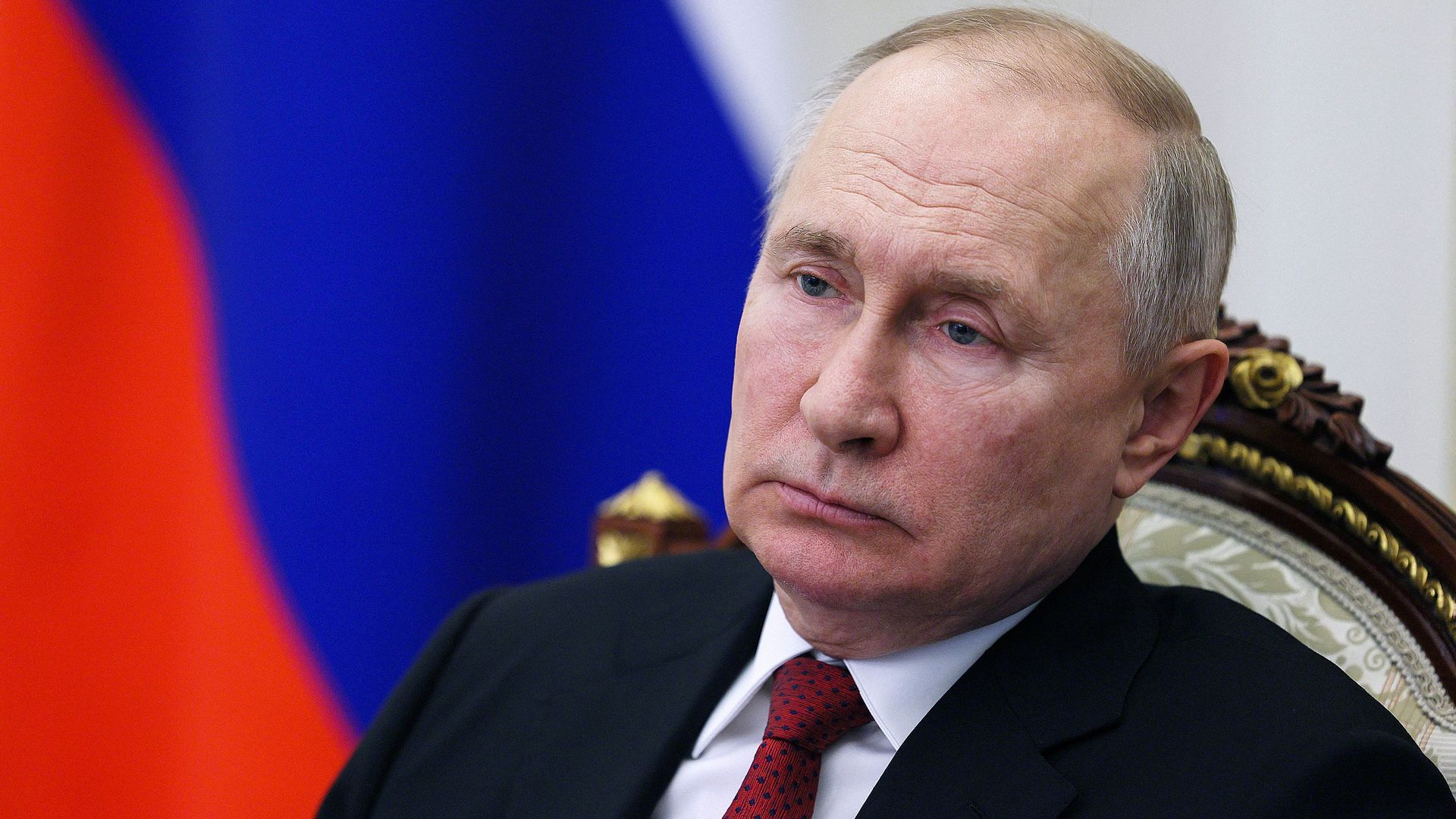
Russian President Vladimir Putin. Photo: Gavriil Grigorov/Sputnik/AFP
Putin and Prigozhin both broke their silence today about the deal that was struck to avert a direct clash between them.
- Putin declared that the organizers of the "rebellion" would be "brought to justice," though he did not name Prigozhin directly.
What he's saying: "This is criminal activity, which is aimed at weakening the country, and this was a colossal threat to us," Putin said.
- "Any kind of blackmail is doomed to failure," he added, calling the rebellion an act of "suicide" that played into the hands of Ukraine and its Western backers.
- The vow to punish the culprits contrasts with an earlier Kremlin claim that Prigozhin would be allowed to go into exile in neighboring Belarus as part of the deal.
- Putin reiterated another promise, that Wagner fighters — the majority of whom, he claimed, remained loyal or pushed for the convoy to turn back — will still be allowed to sign contracts to join the conventional military, move to Belarus, or "go back to your homes."
Between the lines: Putin claimed Russian society and, in particular, the security services, had "saved Russia" through their loyalty and patriotism.
- In fact, there were few public displays of support for Putin from officials or ordinary citizens, notes Stent. "Everyone was waiting to see which way the wind was blowing."
The other side: Prigozhin insisted that he never intended to overthrow the Russian government, but launched his "march of justice" to prevent the destruction of Wagner and protest against the way the war in Ukraine is being prosecuted.
Part III: Wagner after Prigozhin?
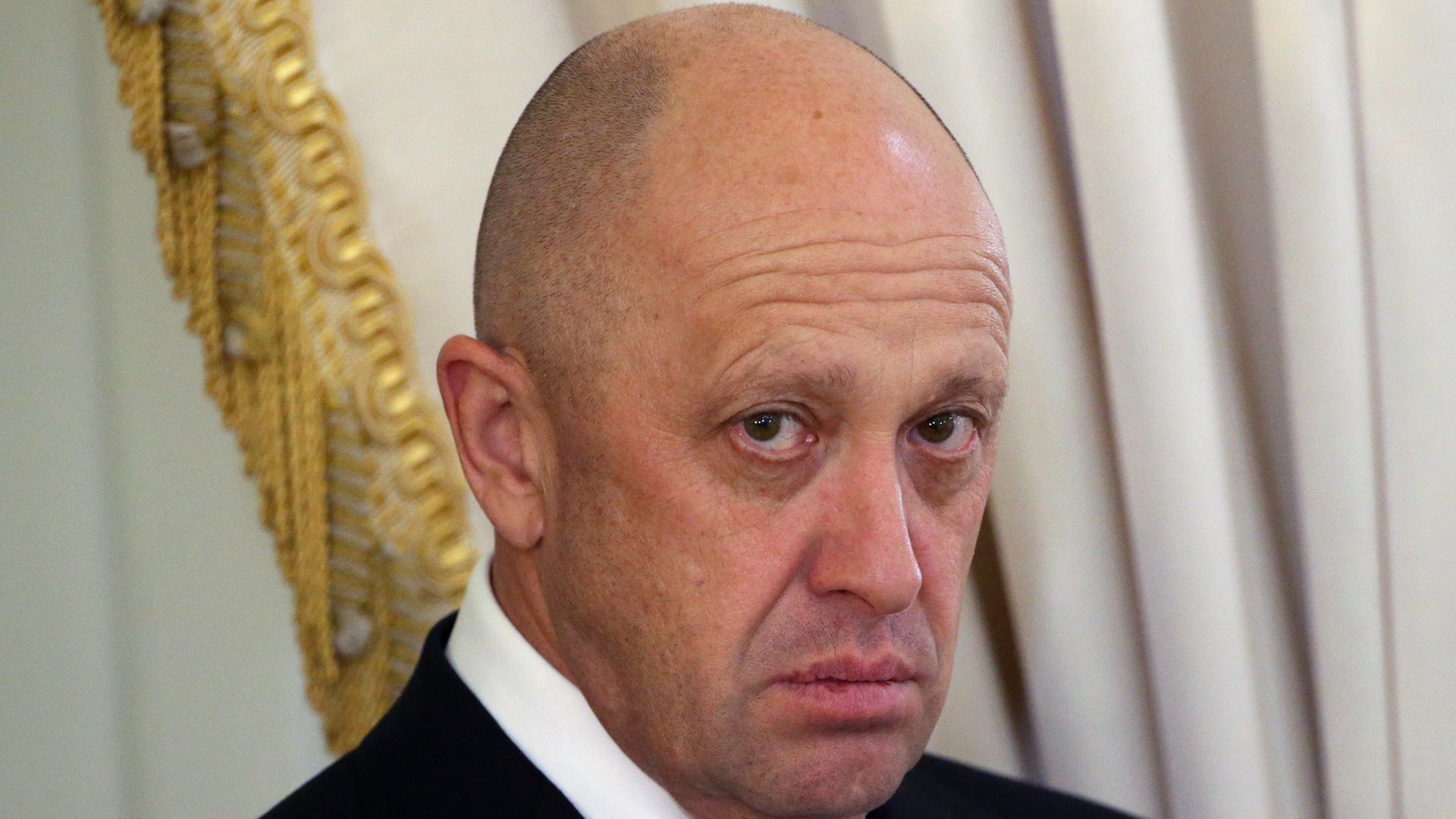
Yevgeny Prigozhin in St. Petersburg in 2016. Photo: Mikhail Svetlov/Getty Images
Russian Foreign Minister Sergey Lavrov promised that Wagner would continue its work in the Central African Republic and Mali, training soldiers and protecting those countries' leaders.
The big picture: For a decade, Wagner has operated in unstable countries like CAR, Mali, Syria and Libya, securing natural resources and furthering Putin's global aims along the way.
- Analysts have long believed the group could not have been formed and deployed all over the world without Putin's blessing.
- A presidential adviser in CAR told AFP today that its security deal is with Moscow, which had then subcontracted to Wagner but can "send us a new contingent" if it so chooses.
"Wagner is very important in terms of projecting Russian influence in Africa and the Middle East, and making a lot of money for the Kremlin and for Wagner, and so I would be very surprised if it were dissolved," Stent says.
- Prigozhin is the group's leader and spokesman, and played a particularly visible role in recruiting Russian prisoners to fight in Ukraine, says Stent.
- But operations elsewhere have their own commanders who likely already operated with autonomy while Prigozhin was focused on Ukraine, she says. "I think the organization itself can continue in some form in these parts of the global south where they're operating now."
What to watch: They may have to continue without Prigozhin.
- A former convict, Prigozhin has known Putin since the 1990s in St. Petersburg, when he was running a restaurant and Putin was a rising politician.
- After Putin took power, Prigozhin won so many government contracts that he was nicknamed “Putin’s chef."
- His interests soon stretched far beyond catering. He was indicted in the U.S. in 2018 for his role in running the Internet Research Agency, which spread disinformation online during the 2016 election campaign.
- Prigozhin long denied any links to Wagner before becoming the group's public face and the biggest threat to his former patron in the Kremlin.
Go deeper: What to know about Prigozhin and Wagner
4. Global elections roundup
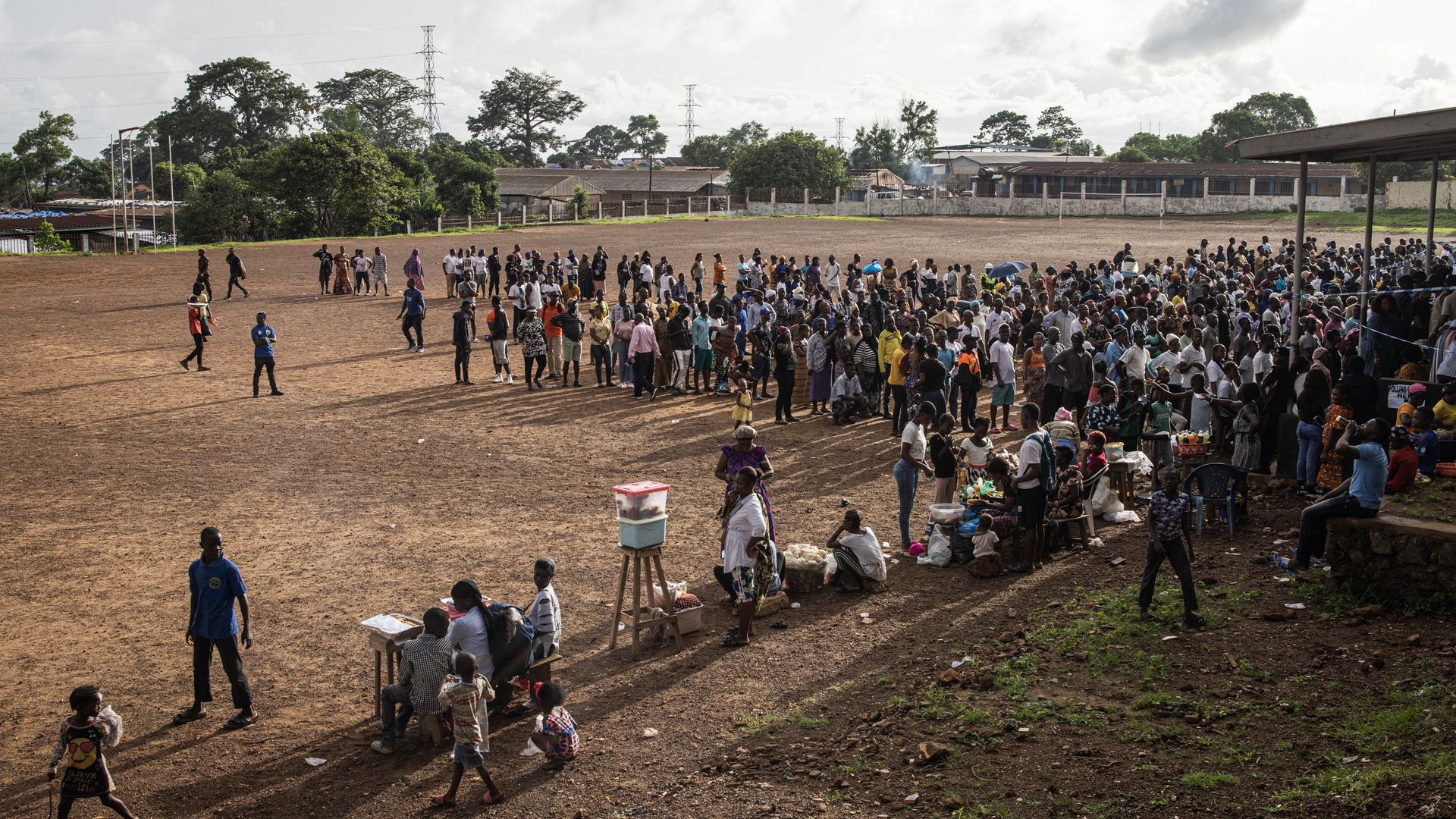
Lining up to vote in Freetown, Sierra Leone. Photo: John Wessels/AFP via Getty Images
1. Incumbent President Julius Maada Bio is ahead with 60% of the results in from Sierra Leone’s election, which was marred by violence against opposition supporters over the weekend.
2. Greek Prime Minister Kyriakos Mitsotakis won a thumping victory on Sunday. He’s promising “major reforms” to the Greek economy, which is now on a stronger footing a decade on from the financial crisis.
- The vote was held in the wake of a tragedy on the Mediterranean. A boat packed with hundreds of migrants sank, killing at least 82 people and likely many more. The fallout didn’t seem to harm Mitsotakis, who has taken a hard-line approach to migration.
3. A center-left, anti-corruption candidate in Guatemala's presidential election defied expectations this weekend by claiming a spot in the runoff, Axios Latino’s Marina E. Franco writes.
- Bernardo Arévalo, a former diplomat and member of Congress, beat out a far-right candidate to claim a spot in the Aug. 20 runoff against former first lady Sandra Torres.
4. Voters in Mali overwhelmingly backed constitutional reforms to expand representation and strengthen the presidency, according to official results, though irregularities were reported, including the kidnapping of electoral agents.
- Some in civil society opposed the idea of giving the military junta a mandate to oversee such sweeping changes. President Assimi Goita, who led a 2021 coup, claims he’ll hand over power after elections next year.
- What to watch: Shortly before the vote, the junta demanded that UN peacekeepers leave the country. Mali has looked to Russia and Wagner for help in restoring security.
5. South Korea to crack down on "cram schools"
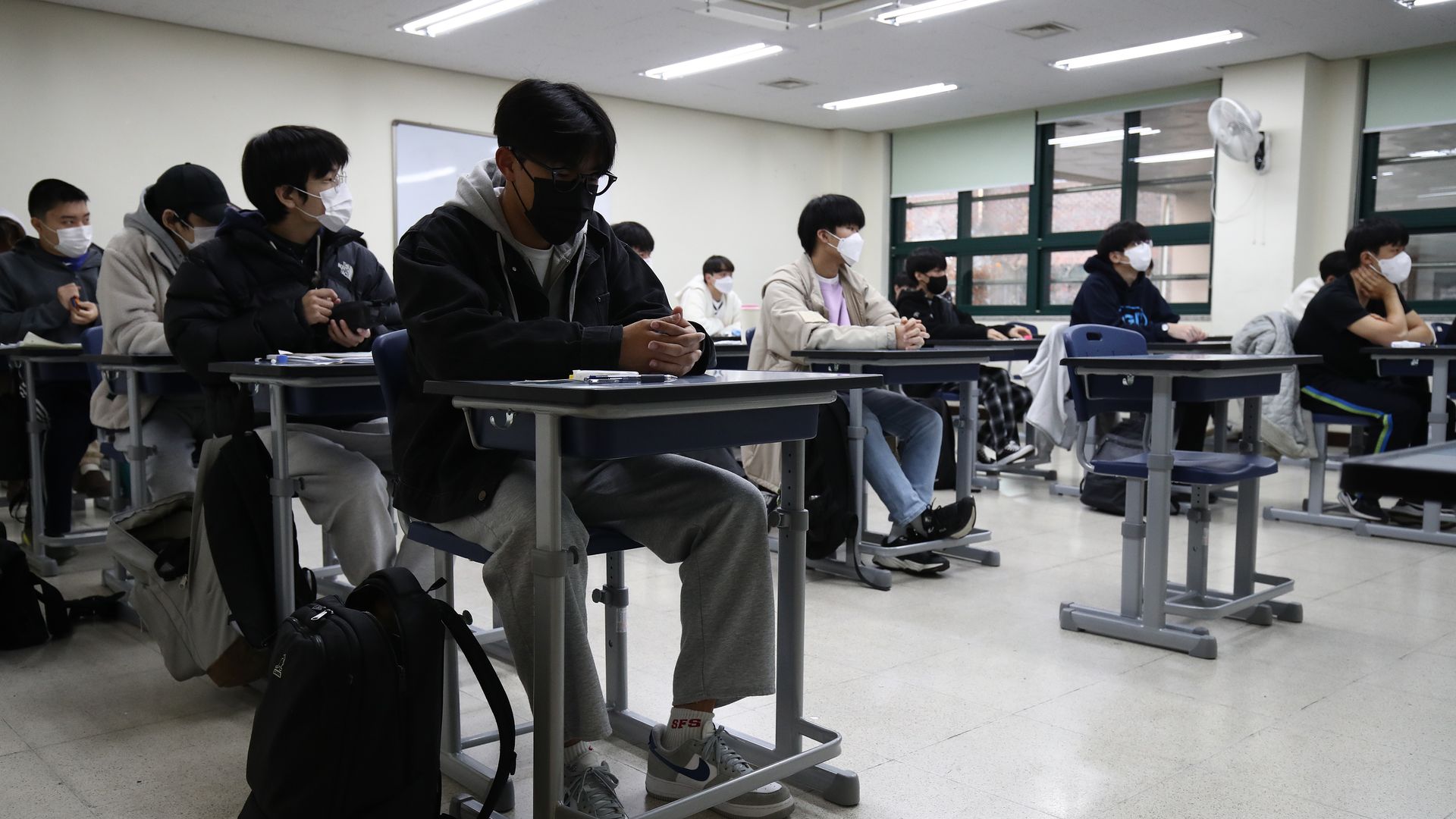
Students in Seoul take their college entrance exams. Photo: Chung Sung-Jun/Getty Images
South Korea’s government today announced plans to reform college entrance exams and crack down on private education "cartels,” Reuters reports.
Why it matters: Nearly 80% of South Korean children attend private supplemental education, known as “cram schools," in part because the country's high-stakes exams often include "killer questions" on material not covered in public school curricula.
- "We will cut the vicious cycle of killer questions in exams, which leads to excessive competition among students and parents in private education," education minister Lee Ju-ho said.
- South Korean parents spent $20 billion on private education last year. That's contributing to a sense that having a child is simply unaffordable, and may be part of the reason South Korea has the lowest birth rate in the world.
The big picture: South Korean students perform very well in math and reading relative to their counterparts in other wealthy countries, but some parents worry students face too much competition and pressure to perform well on exams.
6. Out of this World: Most intense lightning ever recorded

An umbrella cloud generated by the underwater eruption of the Hunga Tonga-Hunga Ha’apai volcano on Jan. 15, 2022. Credits: NASA Earth Observatory image by Joshua Stevens using GOES imagery courtesy of NOAA and NESDIS
An underwater volcanic eruption in the south Pacific last year generated a supercharged storm — and the most intense lighting event on record, Axios' Alison Snyder writes.
- The underwater eruption created a plume of ash, water and volcanic gas that reached about 36 miles above sea level and into the stratosphere.
- It then expanded as an umbrella cloud and created powerful gravity waves that rippled outward from the plume, followed by flashes of lightning in a similar ring-shaped pattern.
- The storm lasted 11 hours and generated more than 2,600 lightning flashes per minute at its peak intensity, "an astonishing rate of volcanic lightning" and "the most intense lightning rates ever documented in Earth's atmosphere," researchers reported in Geophysical Research Letters.
7. Stories we're watching
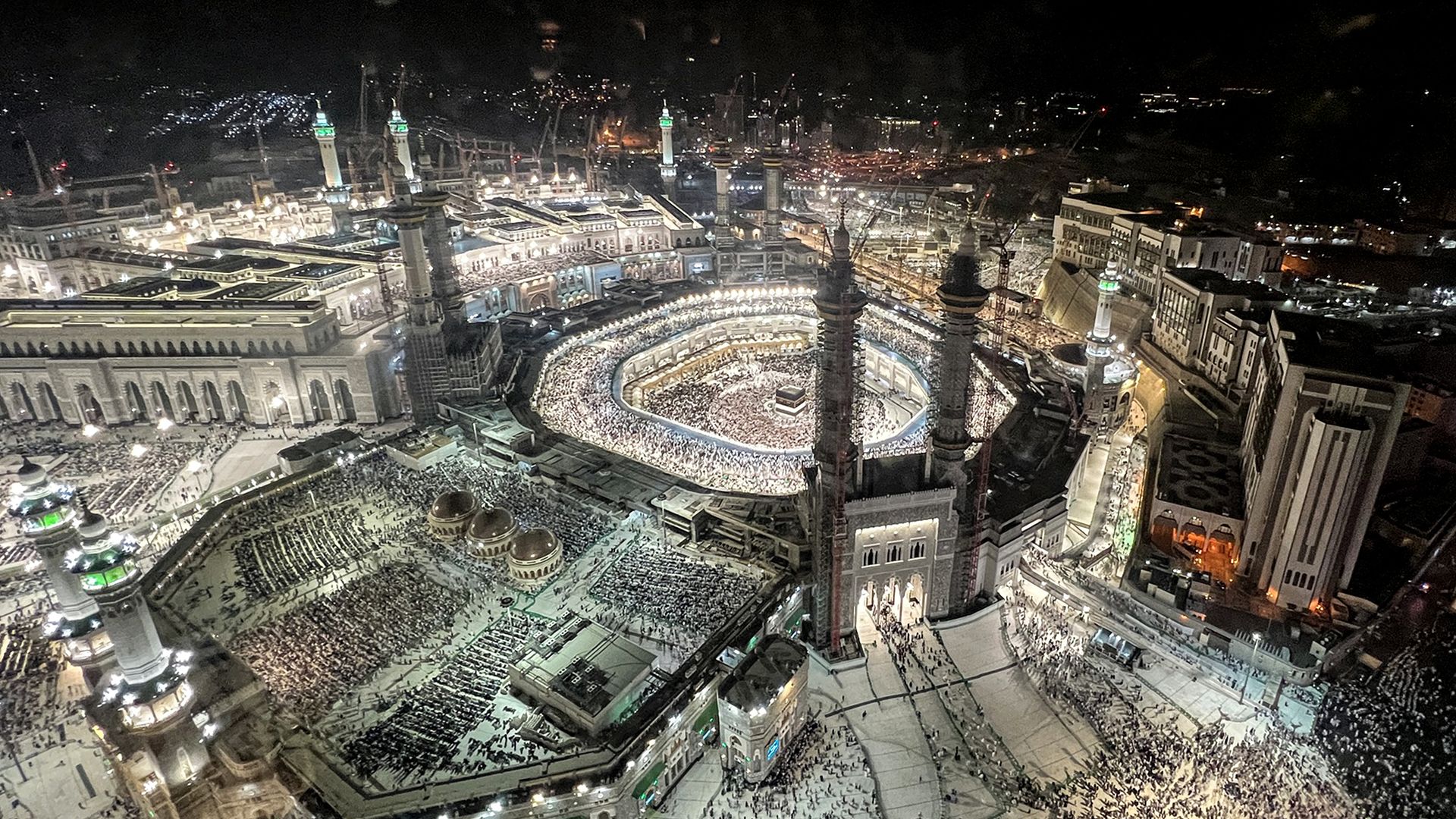
Worshippers gather around the Kaaba as they arrive for the Hajj in Mecca. Photo: Rania Sanjar/AFP via Getty Images
- Largest Hajj pilgrimage in history
- Zambia gets a debt deal
- The case for printing $2 trillion to save the planet
- Paris climate finance summit unlocks billions
- Japan buys big chipmaker
- Biden shifts settlements policy
- Qatar to buy a piece of Washington Wizards
Quoted:
“The whole U.S. mainland is within our shooting range.”— One of the many hawkish messages seen on placards at a rally in Pyongyang this weekend to mark the 73rd anniversary of the outbreak of the Korean War
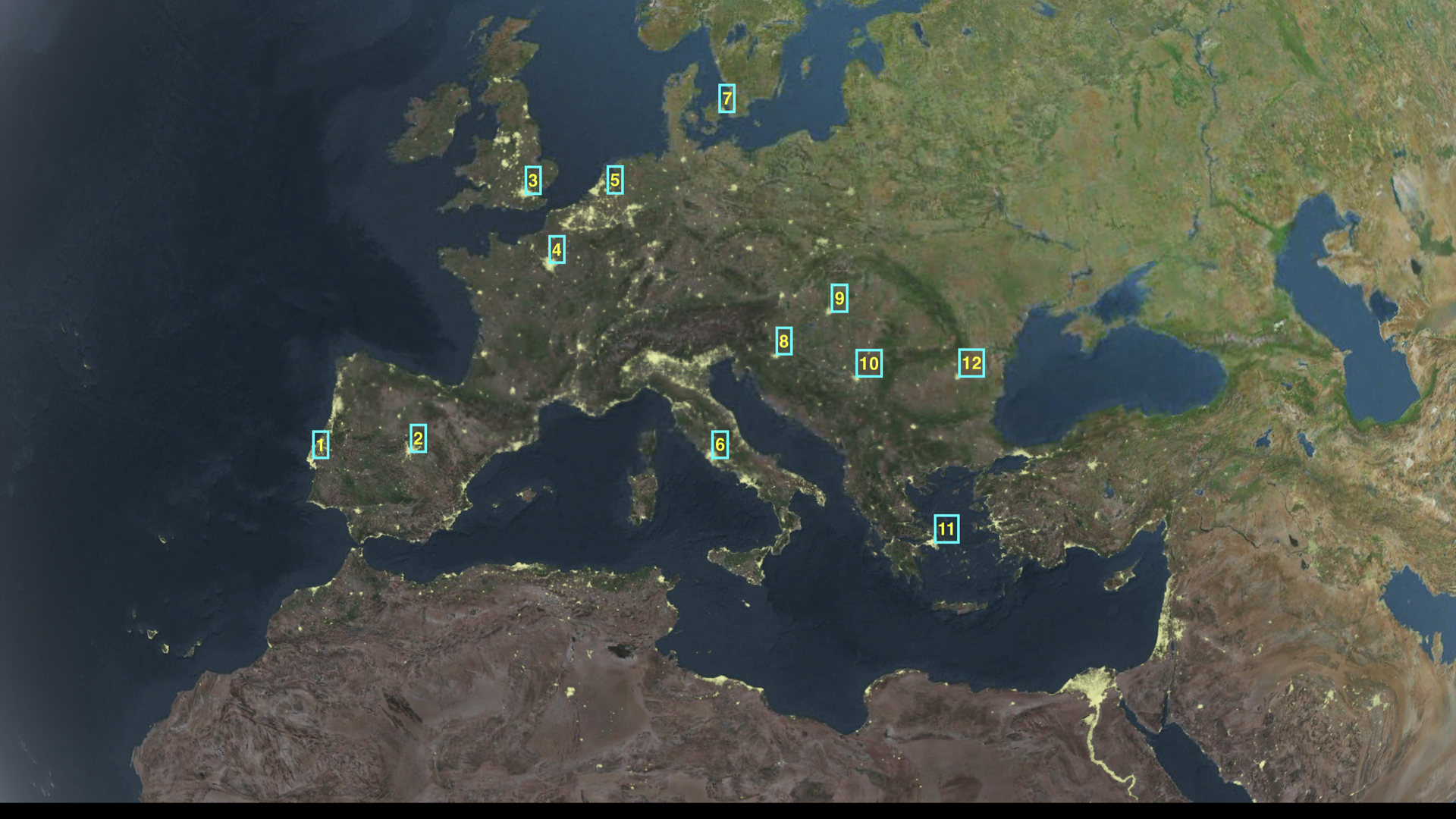
Answers: 1. Lisbon; 2. Madrid; 3. London; 4. Paris; 5. Amsterdam; 6. Rome; 7. Copenhagen; 8. Zagreb; 9. Budapest; 10. Belgrade; 11. Athens; 12. Bucharest