
Axios What's Next

June 14, 2023
Weather conducive to wildfires is growing more common across the U.S., and human-induced climate change is to blame, our colleagues Andrew Freedman and Kavya Beheraj write today.
Editor's note: This newsletter was sent to you by accident yesterday afternoon β oops! βbut we decided to send it again at its usual time for the people who count on it in the morning. We regret the error.
Today's newsletter is 993 words ... 4 minutes.
1 big thing: "Fire weather" grows more common across the Lower 48
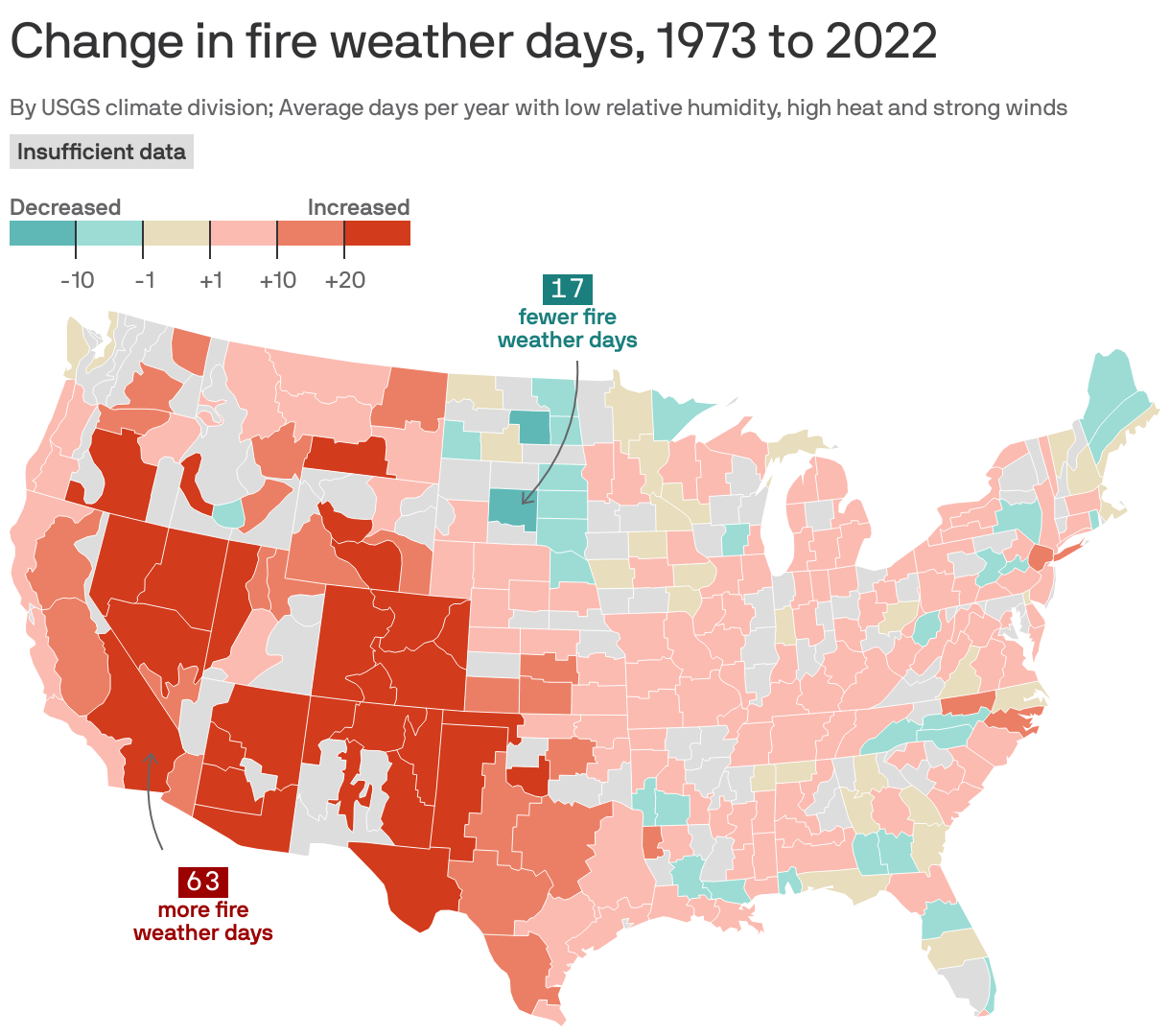
Fire weather days β featuring a volatile mix of low humidity, strong winds and high temperatures β have increased in number across much of the Lower 48 states during the past 50 years, a new analysis shows.
The big picture: An analysis from Climate Central, a nonprofit climate science research organization, found that wildfire seasons are getting longer and more intense, especially in the West.
- Many parts of the East have also seen increases in fire weather days, the report finds.
Why it matters: The trend in fire weather days demonstrates how climate change is altering risk levels at the local and regional levels, with much of the phenomenon tied to human-caused climate change, per Climate Central.
- As average temperatures increase, extreme heat accompanied by dry conditions becomes more common, which is leading to more frequent and larger fires that are more difficult to control.
Zoom in: The report uses weather data from 476 recording sites across the country during the years 1973-2022.
- It finds that Southern California, Texas and New Mexico have experienced some of the greatest increases in fire weather days each year, with some areas now seeing around two more months of fire weather compared with a half century ago.
Yes, but: The Climate Central analysis has not been peer reviewed, though the data and method it relies on are widely used in the scientific literature. It also matches findings from peer-reviewed research.
- For example, a study published this week in the journal Proceedings of the National Academy of Sciences found that "nearly all" of the increase in burned area across California during the past half-century is tied to human-caused climate change.
The bottom line: Climate change is ratcheting up wildfire risks across much of the country. With more people than ever living in areas prone to fires, managing such risks is going to be more of a challenge.
2. Generative AI is making voice scams easier to believe

Illustration: Sarah Grillo/Axios
Generative AI has already lowered the bar for cybercriminals looking to clone someone's voice and use it in their schemes, writes Sam Sabin, author of Axios Codebook.
Why it matters: Cybercriminals now need as little as three seconds of someone's voice to clone it and make it usable in a scam call, researchers at McAfee have found.
- People are already losing money from these incidents: In a recent McAfee survey, 77% of victims in AI-enabled scam calls said they lost money.
- More than a third lost more than $1,000.
How it works: Scam phone calls have usually taken the form of mass robocalls pretending to be a health care provider, the Internal Revenue Service or a company looking to extend someone's auto warranty.
- But now, using generative AI, scammers can make the calls seem like they're coming from a loved one β your child or another relative.
- Legitimate tools let the scammer respond to their victims in real time as they type out sentences in voice-cloning apps.
- Some fraudsters go as far as to research personal information about the victim's relative to make the call more believable.
Be smart: Experts suggest people adopt code words to use with loved ones during calls of distress to ensure that they're legitimate.
- Another easy way to validate the identity of the person on the other end of the line is to hang up and immediately call them back.
3. Toyota says it'll double the range of current electric vehicles
Illustration: Gabriella Turrisi/Axios
Toyota says it's planning electric vehicles that would double the range of models currently on the road, Joann writes with Nathan Bomey of Axios Closer.
- The company confirmed Tuesday that it plans to begin selling "next-generation" EVs in 2026.
Driving the news: Takero Kato, president of Toyota's newly created BEV Factory, said the company is targeting battery-powered vehicles with a range of 1,000 kilometers β about 620 miles β arriving in 2026.
- "That is stunning," Cox Automotive executive analyst Michelle Krebs tells Axios, noting that range fear is one of the three top obstacles to EV adoption.
Why it matters: When the world's largest automaker takes a step, the earth shakes in the automotive industry.
- The eye-popping range goal illustrates the automaker's intention to compete for EV supremacy despite its previous hesitancy to invest heavily in the space.
4. Solar panels on a historic home: Unsightly or economical?
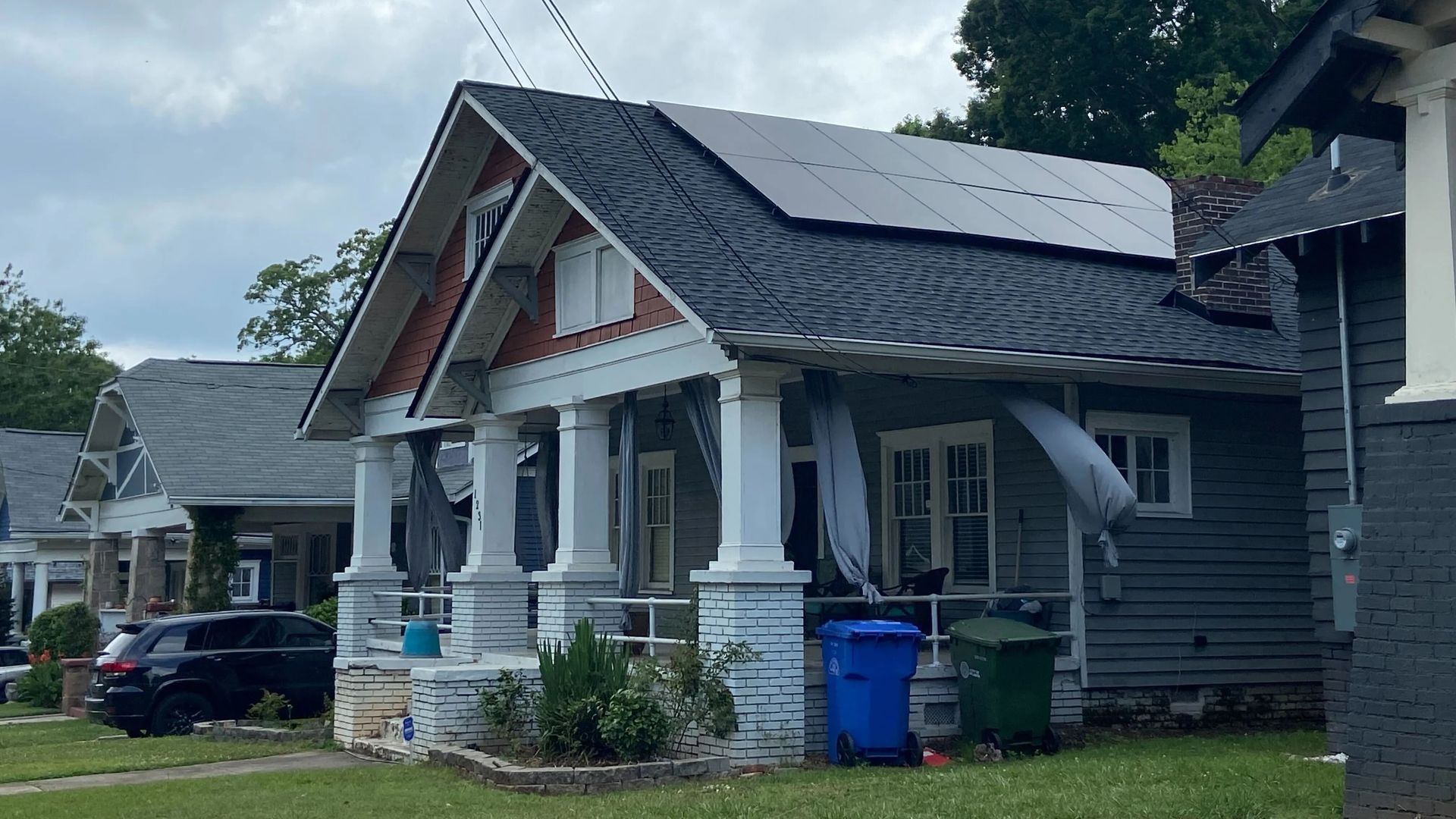
This home in Atlanta's historic West End is the subject of controversy. Photo: Thomas Wheatley/Axios
A decision by the city of Atlanta to allow solar panels on a home in the West End Historic District has ignited debate about balancing property rights with historic preservation, Kristal Dixon writes for Axios Atlanta.
Why it matters: Situations like this βΒ in which efforts to retain the charm of an older neighborhood bump up against the use of modern technology β are growing more commonplace.
Context: In January, Atlanta's Urban Design Commission approved a variance to allow the owners of the West End home to install solar panels, despite the West End Historic District's regulations prohibiting them if they are visible from the roadway.
- The panels are visible from the front and back of the home, which was built in 1920, city documents indicate.
What they're saying: "These historic neighborhoods are what gives Atlanta its character, its identity," said David Mitchell, executive director of the Atlanta Preservation Center.
- "And when you start throwing up these solar panels like this, what's the point of having rules?"
The other side: Jesse Melton, one of the homeowners, told Axios that installing solar panels on his home was a "smart move for the environment."
- "It's 2023, and I'm trying to get with the times and save some money," he said.
The big picture: Mitchell told Axios that the decision to allow the panels could create contention between longtime residents who want to see the standards upheld and new neighbors who move into historic districts and do "whatever the hell they want."
- "This is something that's really going to become more and more of a challenge," he said.
The bottom line: Jervonia Melton, who also owns the property, told Axios she isn't bothered by the controversy.
- "The historic preservationists got mad, but my energy bill isn't mad."
A solar-powered "thank you" to What's Next copy editor Amy Stern.
Was this email forwarded to you? Get your daily dose of What's Next by signing up here for our free newsletter.
Sign up for Axios What's Next

The next decade of big, sweeping changes will unfold in cities and communities where new technologies like 5G, AI and drones are transforming how we work, live and play together. Whatβs Next will guide you through the revolution.


