Axios What's Next

August 13, 2021
You know what we dislike? When newsletter writers open with stuff like, "Happy Friday!"
So instead, I'm going to ask you to send us more "What's Next" photos β images that say something about the way we live, work and play in 2021 and beyond. The ones you've submitted so far are great. See today's latest examples at the bottom.
- 1 scoldy thing: Please don't send us cool pictures you pulled off the internet. Our lawyers don't like us violating copyrights, etc.
- Send us a picture you took yourself! Email us at [email protected].
Today's Smart Brevity count: 962 words ... 3.5 minutes.
1 big thing: The great American dog shortage
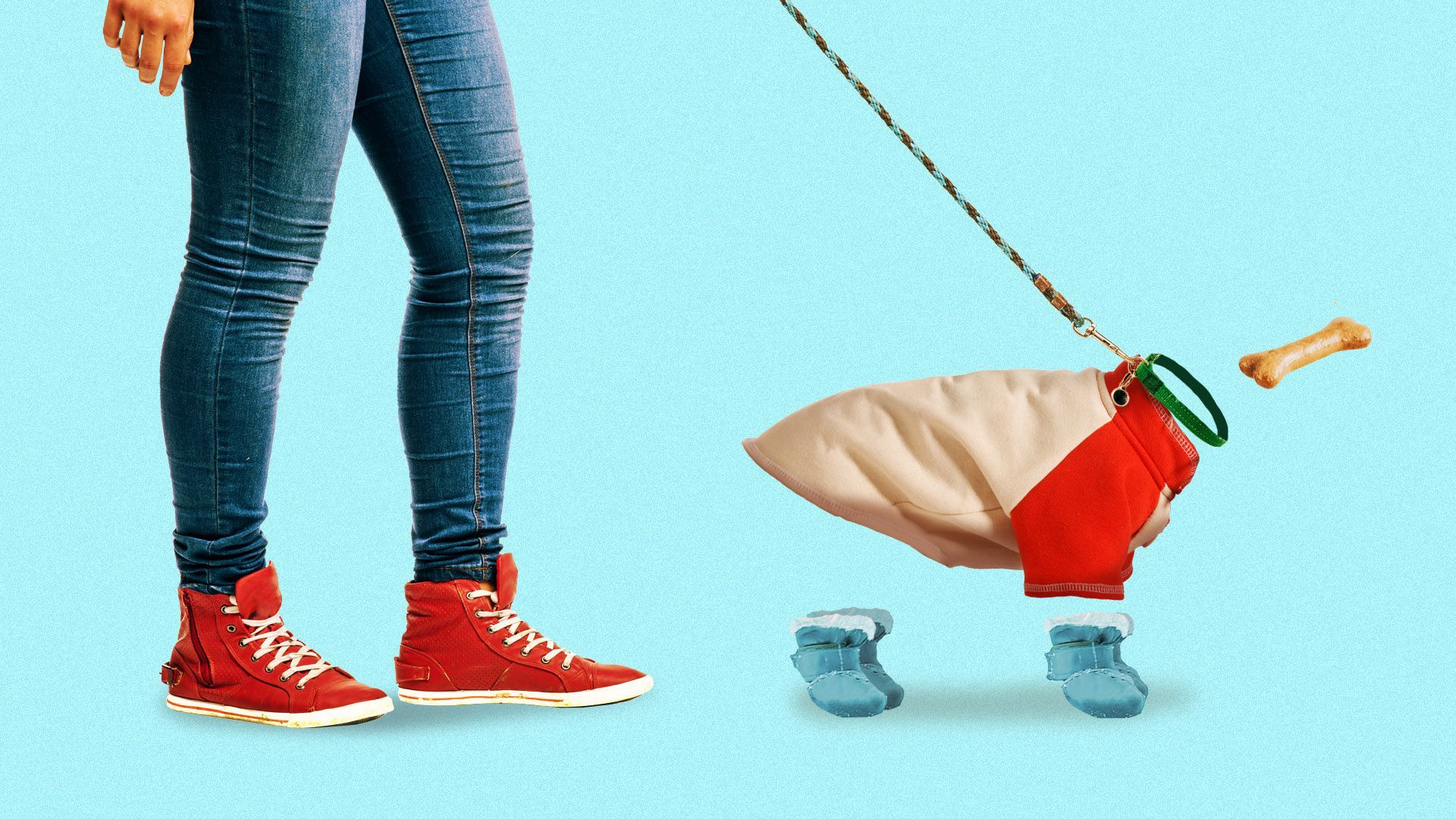
Illustration: Sarah Grillo/Axios
Demand for pet dogs is far outstripping supply, and the imbalance is expected to worsen as young adults consider dog ownership a normal stage of life (before kids), dog breeders face increasing regulation and the U.S. cracks down on illegal dog imports, Jennifer A. Kingson writes.
Why it matters: Rabies and other diseases that can jump from dogs to humans are cropping up in places where they were all but eradicated, a result of unscrupulous imports from countries with looser hygiene laws and health oversight.
Driving the news: On June 14, the CDC issued a temporary suspension of the importation of dogs from more than 100 countries deemed at high risk for rabies, including Egypt, India, China, Russia and Ukraine.
- At the same time, the Healthy Dog Importation Act β a bipartisan bill recently introduced in the House and the Senate β would require that every dog coming to the U.S. have a health certificate with proof of vaccinations issued by a properly licensed veterinarian.
By the numbers: While the U.S. imports more than 1 million dogs a year, the annual demand for dogs β imported or notβ is 8 million.
- The American Pet Products Association released its biennial pet owners' survey in June, showing that "pet ownership has increased from an estimated 67% of U.S. households that own a pet to an estimated 70%" over the prior survey.
- Millennials were the largest cohort of pet owners, at 32%, followed by Boomers at 27% and Gen X at 24%.
What they're saying: "People are shocked when they hear the number of dogs that have been imported to the U.S.," Sheila Goffe, vice president of government relations for the American Kennel Club, tells Axios.
- "Some are going to pet stores, some are going to shelters, a lot are being sold online."
- Goffe says the USDA and U.S. Border Patrol are ill-equipped to police big batches of dogs that arrive in the U.S. in groups as big as 40 or 50, with fake health certificates that have been photocopied.
Context: The number of dogs going to shelters and being euthanized has plummeted over the last 50 years, thanks to the success of spay-and-neuter programs and the rise of "responsible dog ownership," in which people commit to keeping a dog for life.
2. America' s second botched summer
Illustration: Sarah Grillo/Axios
The pandemic has stretched into the 2021 summer β and case counts are rising due to the Delta variant β so Americans are still working instead of going on vacation, Erica Pandey writes.
What's happening: The share of employed adults who are vacationing typically peaks in July at around 3%, notes Nick Bunker, an economist at the jobs site Indeed. And while the 2021 rate is higher than that in 2020, it's still well below normal, at under 2%.
The big picture: Americans are historically bad at taking time off. In 2019, U.S. workers earned 23.7 days of paid time off, but used only 17.2, per U.S. Travel Association data.
- It's gotten even worse during the pandemic, as many workers are delaying time off until they feel safer traveling or until vacation sites are fully open.
Why it matters: Underusing time off is exacerbating burnout across the U.S. workforce. 52% of workers said they're experiencing burnout in 2021, per a recent Indeed survey. That could push employees to quit at an even faster clip than they are now.
3. Touchless Taco Bell could be the future of drive-thrus
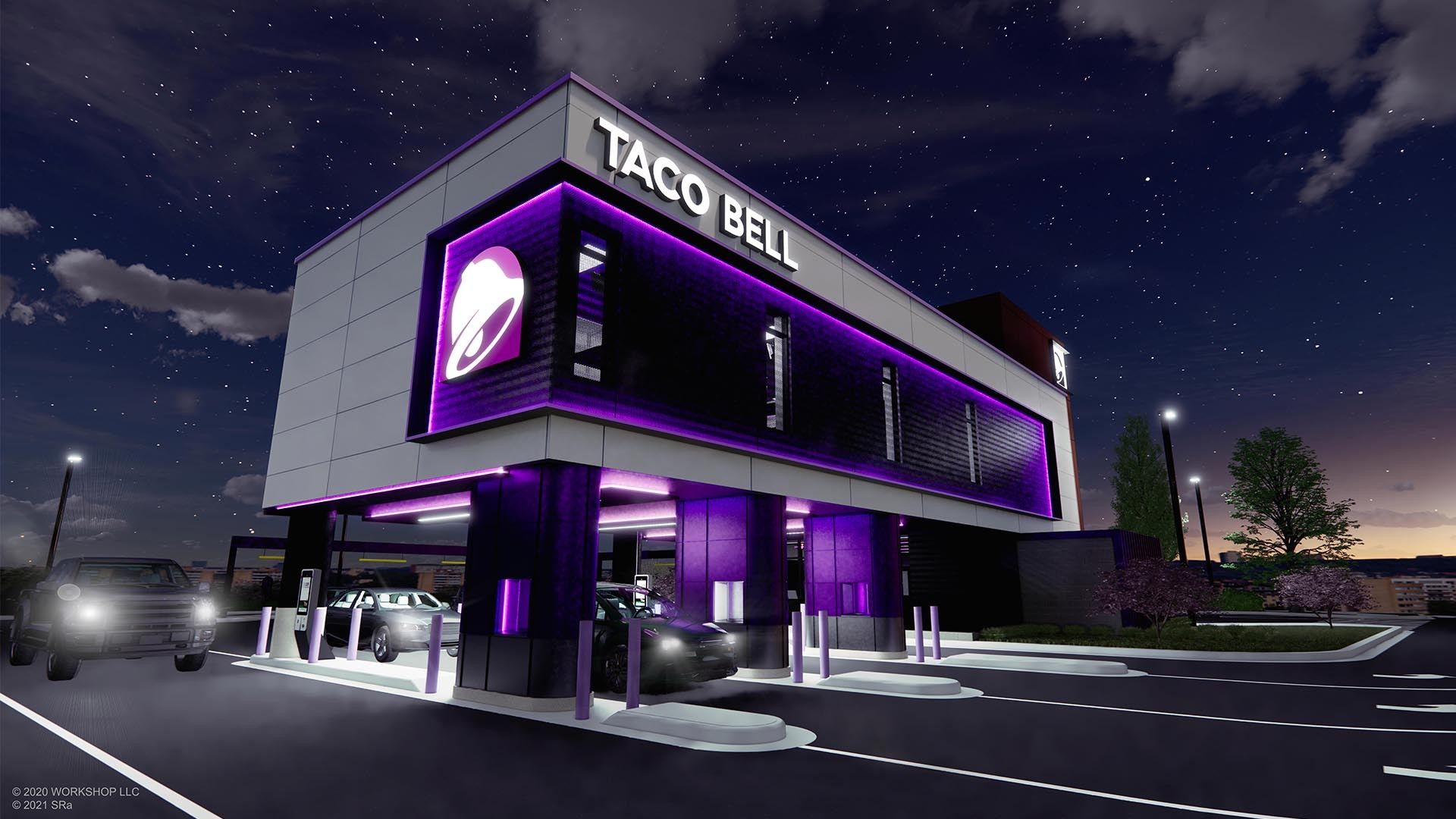
Rendering of a Taco Bell Defy restaurant coming in Brooklyn Park, Minnesota. Photo: Taco Bell
Late-night munchies will be a little easier to satisfy for mobile customers at Taco Bell's new touchless drive-thru restaurant coming to Brooklyn Park, Minnesota, Joann Muller writes.
Why it matters: When you're hungry, you want your food NOW.
Flashback: Axios' crack local reporters in Minneapolis-St. Paul already flagged plans for this prototype fast-food joint back in February, pointing out its odd resemblance to a bank branch.
Details: The "Taco Bell Defy" restaurant will open in the summer of 2022.
- There are four drive-thru lanes, three of which are dedicated to mobile or delivery orders.
- Food is delivered from the elevated kitchen above via a proprietary lift system similar to the pneumatic tubes used by those bank branches.
4. Worthy of your time
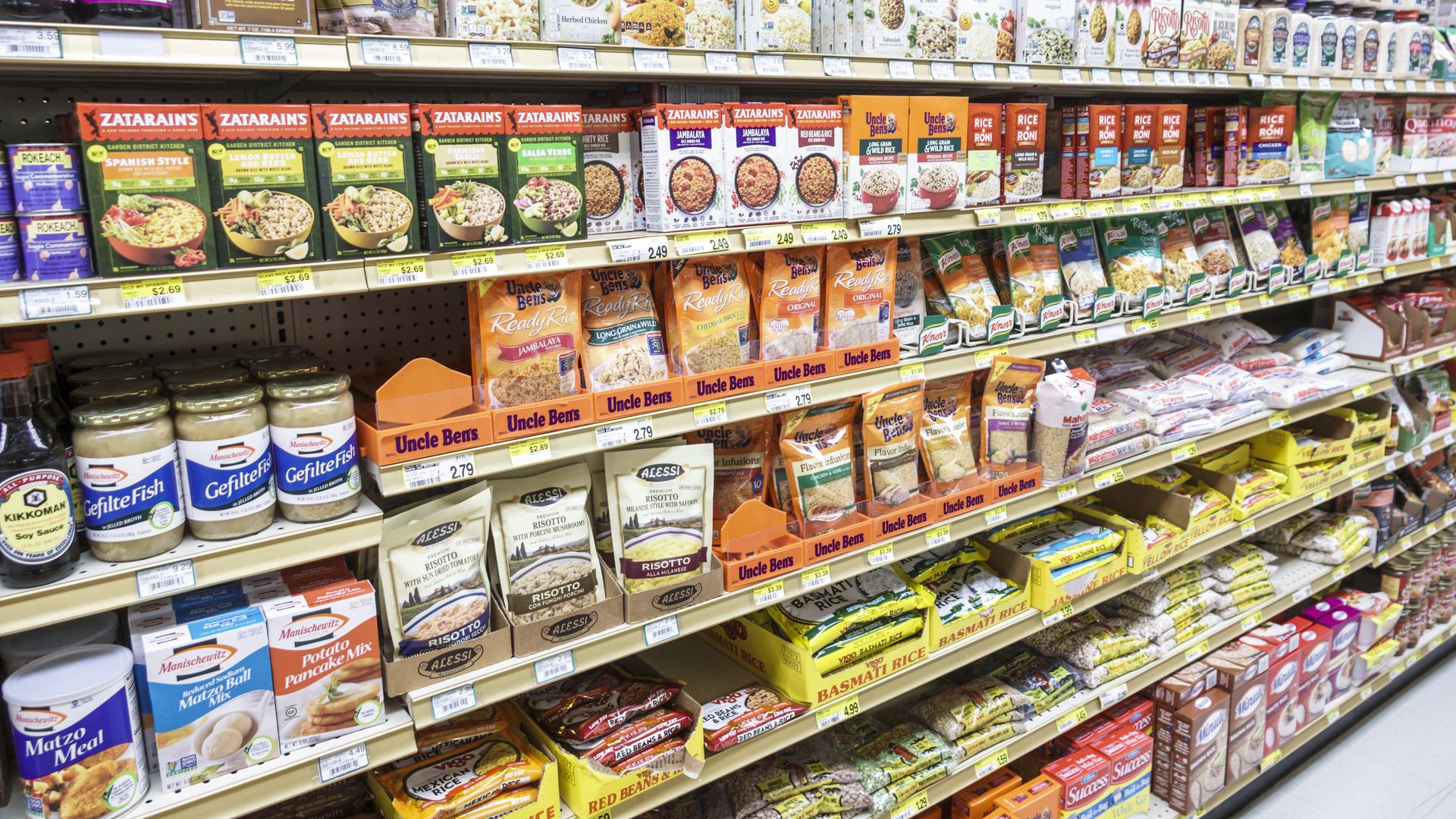
Photo: Jeffrey Greenberg/Education Images/Universal Images Group via Getty Images
Why do American grocery stores still have an ethnic aisle? (NYT)
Should non-Western foods still be sequestered in an era when "an estimated 40 percent of the population identifies as nonwhite," or does the "ethnic aisle" make it easier for shoppers to discover new delicacies?
California takes a first-of-its-kind step on building decarbonization (Smart Cities Dive)
California's Energy Commission voted to adopt measures that will discourage the use of gas heating in newly constructed buildings.
There's wine. Then there's natural wine. Then there's 'zero-zero' wine (San Francisco Chronicle)
Some people are taking the "natural" winemaking movement to a new level, making wine "in which they add nothing to the grapes as they ferment."
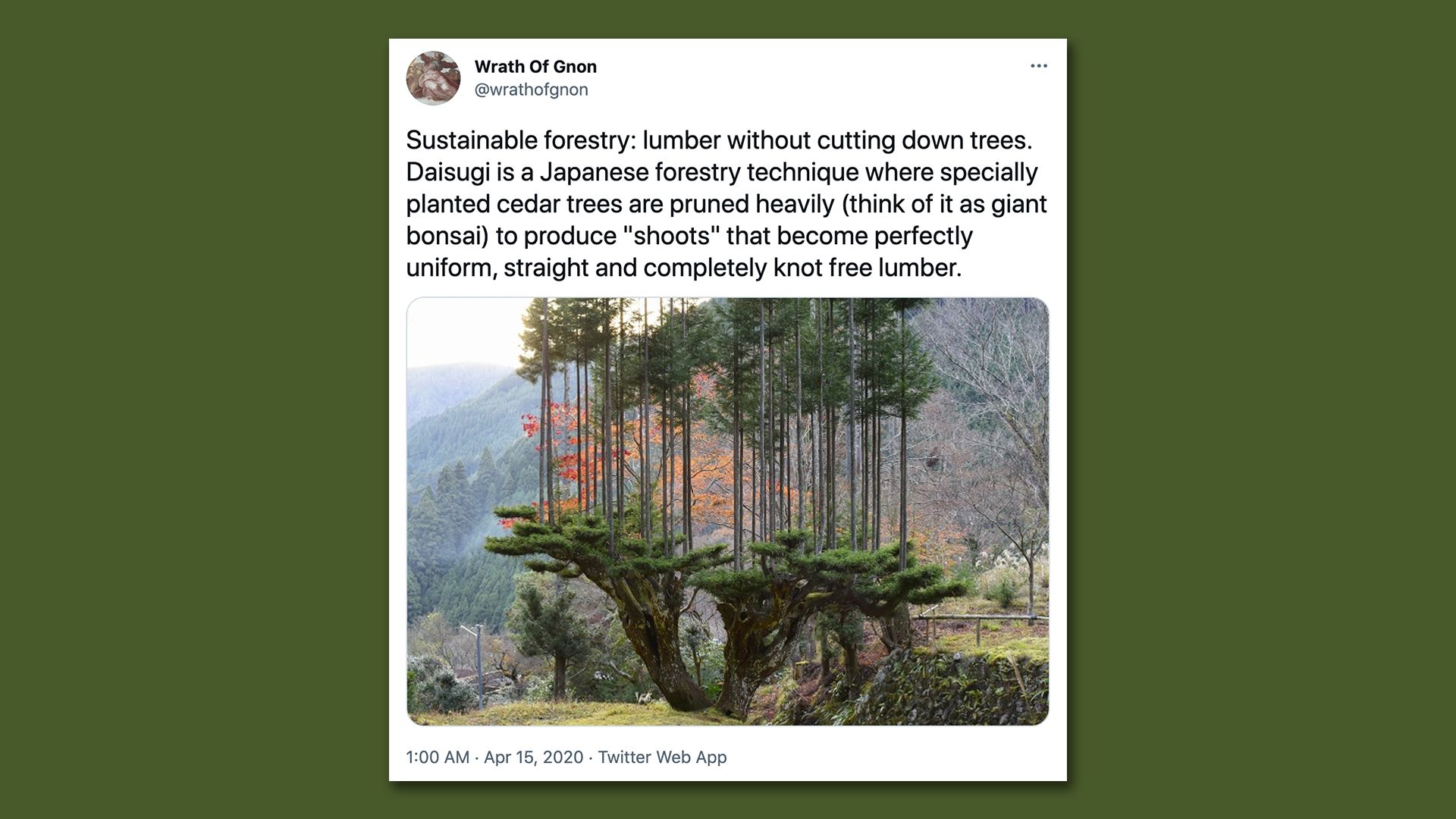
5. 1 tree thing: Daisugi
Via Twitter
This tweet spawned a lot of interest in daisugi, a Japanese arboreal practice dating back to the 14th or 15th century in which cedars are grown perfectly straight and can be harvested without having to cut down the entire tree, Jennifer writes.
The name "daisugi" translates to "platform cedar," according to Wikipedia.
According to this blog:
The technique was developed in Kyoto as a means of solving a seedling shortage and was used to create a sustainable harvest of timber from a single tree. Done right, the technique can prevent deforestation and result in perfectly round and straight timber known as taruki, which are used in the roofs of Japanese teahouses.
Reader photos:
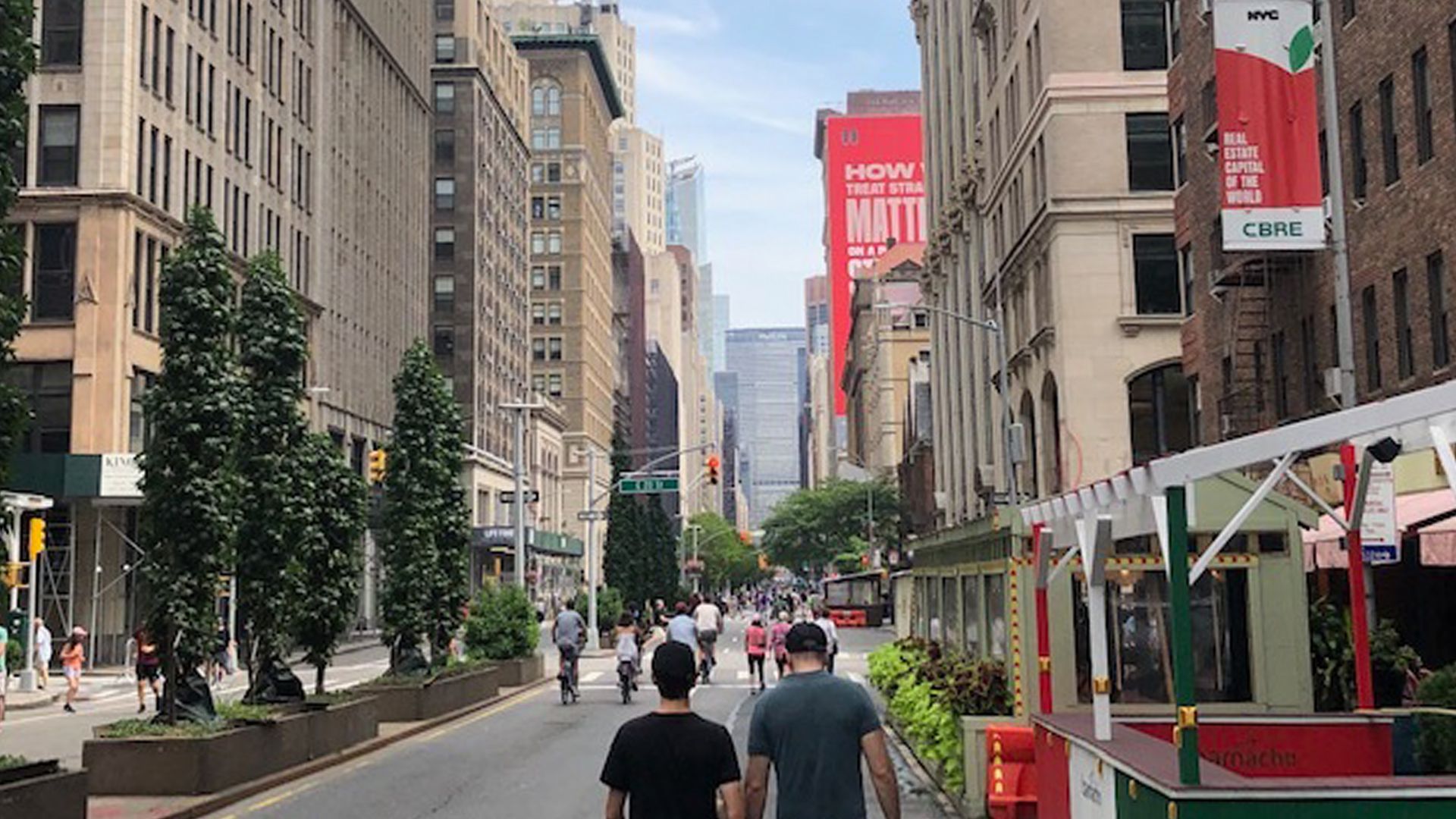
Car-free Park Avenue in Manhattan, an occasional treat under the city's "Summer Streets" program. Photo: Ezio Da Dalt
What's Next: Car-free urban streets.
Ezio Da Dalt writes: "Summer Streets NYC. Saturday, August 7."

What's Next: (More) reefer madness!
Axios executive editor Sarah Kehaulani Goo writes: "Hereβs my photo from the near future β a cannabis farm in Vermont where Iβm on vacation. Iβm sure we will see (and smell) more of these. It is very fragrant!"
Thanks for reading! Got something on your mind? Unburden yourself to us at [email protected], and please implore your friends to subscribe here.
Sign up for Axios What's Next

The next decade of big, sweeping changes will unfold in cities and communities where new technologies like 5G, AI and drones are transforming how we work, live and play together. Whatβs Next will guide you through the revolution.