Axios What's Next

December 15, 2021
All these months later, we still don't know when we're going back to the office, Erica Pandey writes.
- Send a photo of something cool and forward-looking that we can publish. Email: [email protected].
Today's Smart Brevity count: 1,135 words ... 4 minutes.
1 big thing: The lingering mystery of our return to work
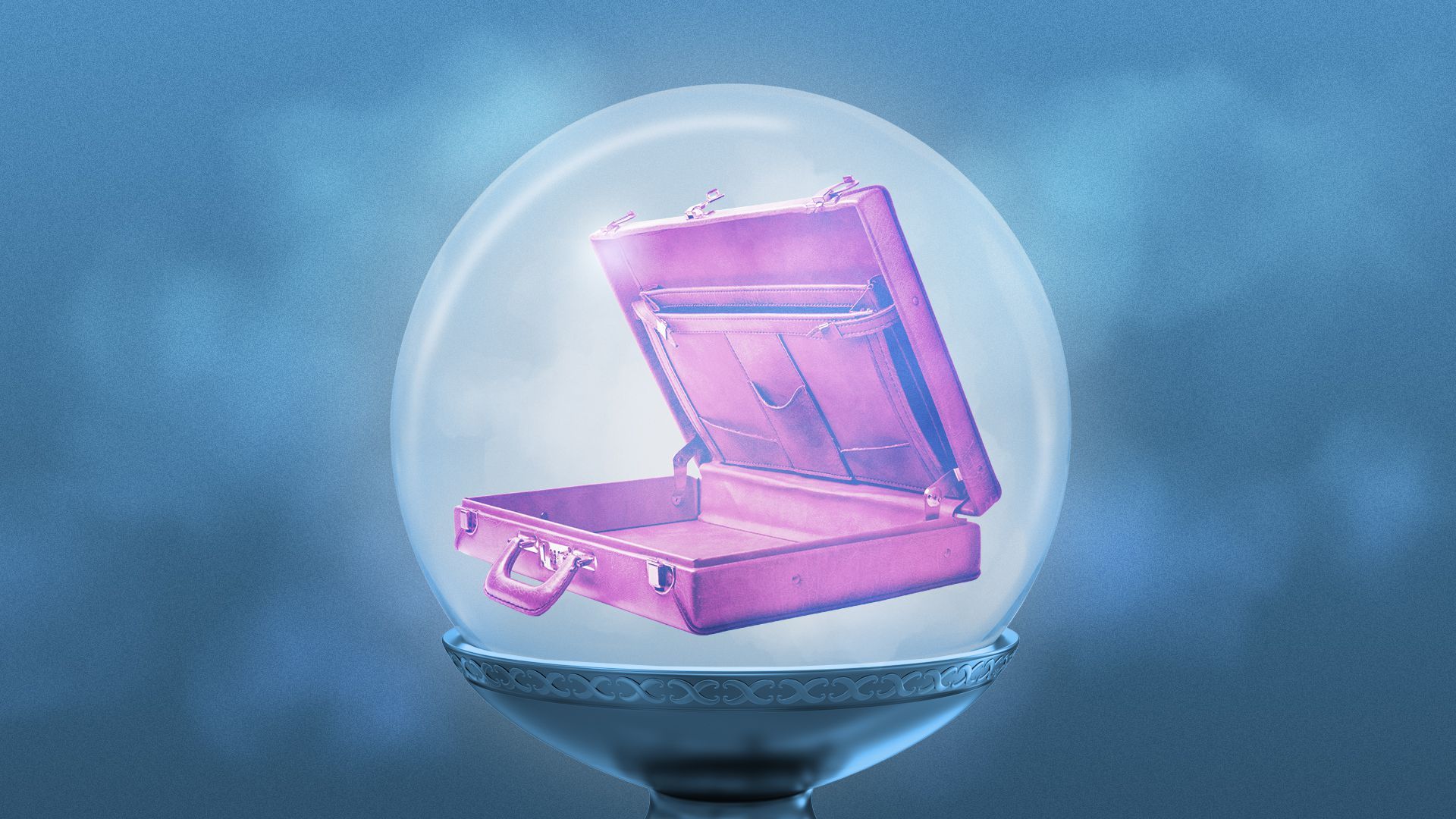
Illustration: Sarah Grillo/Axios
In the 22 months since U.S. companies sent their workers home, they've collected droves of poll data, paid workplace consultants billions of dollars, and drafted plan after plan.
- But they still don't know much more about post-pandemic work than they did in March 2020, Erica writes.
Driving the news: The latest factor to foil every return-to-work plan is the arrival of the Omicron COVID variant.
"Companies are in kind of a Catch-22," says Brad Bell, director of the Center for Advanced Human Resource Studies at Cornell. "On the one hand, employees are wanting transparency. They want a plan."
- "But every time we think we're coming out of this, and companies go to flip the switch on return-to-work, something comes up," he says. Then, firms end up having to walk back their words, further frustrating or confusing workers.
- In June, Morgan Stanley CEO James Gorman said at a conference that he'd be "very disappointed" if his workforce wasn't back in the office by Labor Day 2021. But this week, he told CNBC, "I was wrong on this.... Everybody’s still finding their way."
- Other firms that have pushed back their return-to-work dates in the last week include Ford, Lyft and DocuSign, the New York Times' Emma Goldberg writes. DocuSign's planned Jan. 10, 2022 return was its fourth attempt at setting a date to bring employees back.
Not only do companies not have a return-to-work date, they also don't exactly know what that return to work will look like.
- Senior employees and executives as well as young, early-career workers want to return to the office full time. But a vast majority of the middle wants a flexible, hybrid workweek.
"It’s way more complex and way more difficult to make that transition [to hybrid] than we thought," says Brian Kropp, head of Gartner's human resources practice. "It’s gonna take another two to three years at least. It is that big of a change."
- That's because marrying remote and in-person work is not a technology problem like we originally thought, Kropp says. "It’s a consistency and evenness-of-experience question."
- When some workers are home and some are in the office, firms have to tackle problems like remote workers falling out of sight and out of mind — and even losing out on project assignments or promotions to their in-person colleagues.
The bottom line: We were guessing at how COVID might change the working world 22 months ago, and we're still guessing today.
2. Losing our religion

The share of religiously unaffiliated Americans nearly doubled over the past 15 years to 29%, per a Pew Research Center survey cited in Mike Allen's Axios PM.
- Christians of all varieties make up 63% of the adult population — down from 75% a decade ago.
Between the lines: Most of the increase in what Pew calls "nones" comes from the decline of Protestantism.
- 40% of U.S. adults are Protestants, down from 52% in 2007.
The big picture: The religiously unaffiliated are no longer crowded in coastal cities, Santa Clara adjunct professor Elizabeth Drescher told AP.
- They're now spread across all regions, age ranges, ethnicities and socioeconomic backgrounds.
3. The Great American closet purge
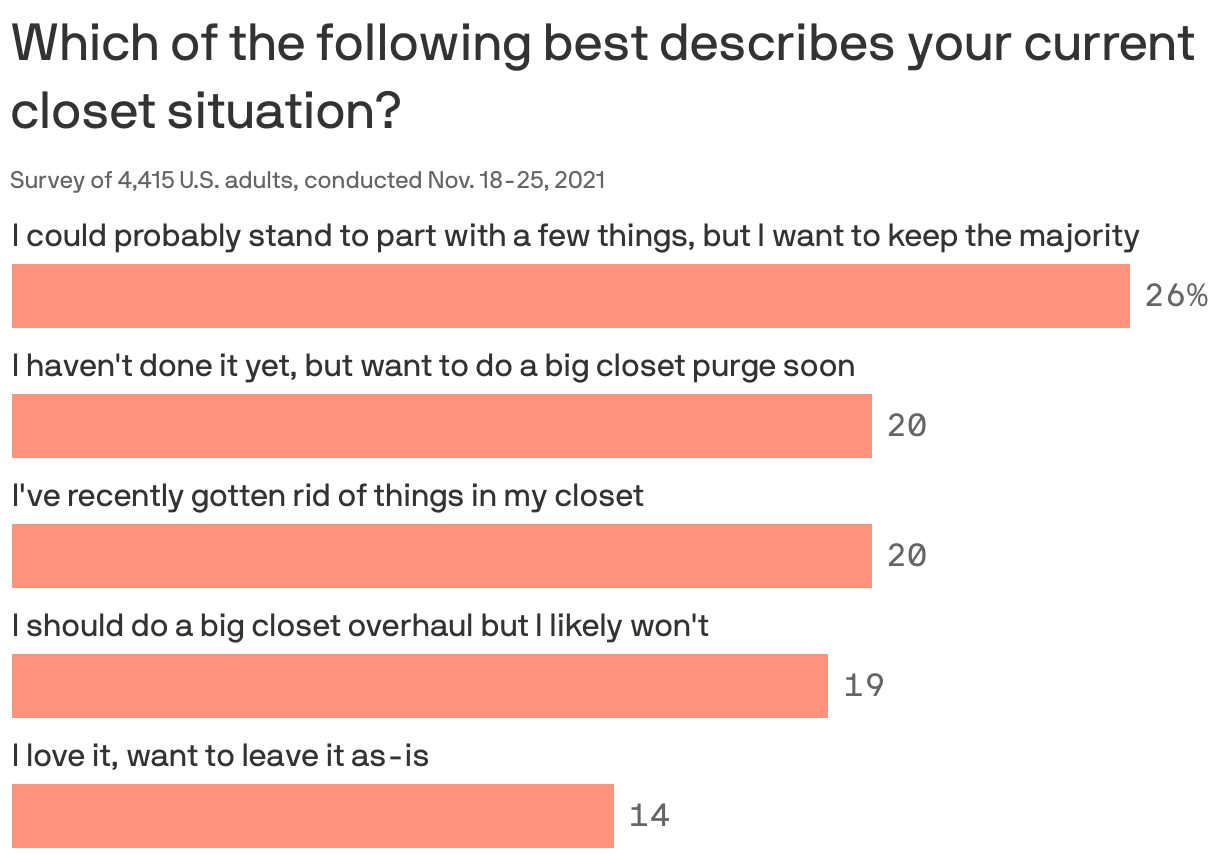
40% of Americans want to purge their closets or have done so already, according to a recent CivicScience survey.
The big picture: Clothing retailers and resale websites and apps stand to profit off of this sweeping trend, Erica writes.
What's happening: In the last two years, many have stocked up on comfy clothes or athleisure as they've spent more time at home. Now, they're plotting post-pandemic closet revamps.
- Many Americans have also lost or gained weight during the pandemic, and they're in the market for new clothes that fit.
- As a result, apparel and footwear are two of the strongest retail categories this holiday season.
This rise in closet overhauling also comes as Gen Z and millennial consumers drive a renaissance of thrift stores and secondhand shopping. So there's a big — and growing — market for the purged clothes.
Worth noting: If you're planning to donate your old clothes instead of selling them, do your research to make sure they don't just end up in a landfill and contribute to fast fashion's carbon footprint.
- Mashable suggests donating to Goodwill or the Salvation Army because these big organizations can handle volume, and they’re less likely to get overwhelmed and throw clothes out.
4. Getting to your flight on time
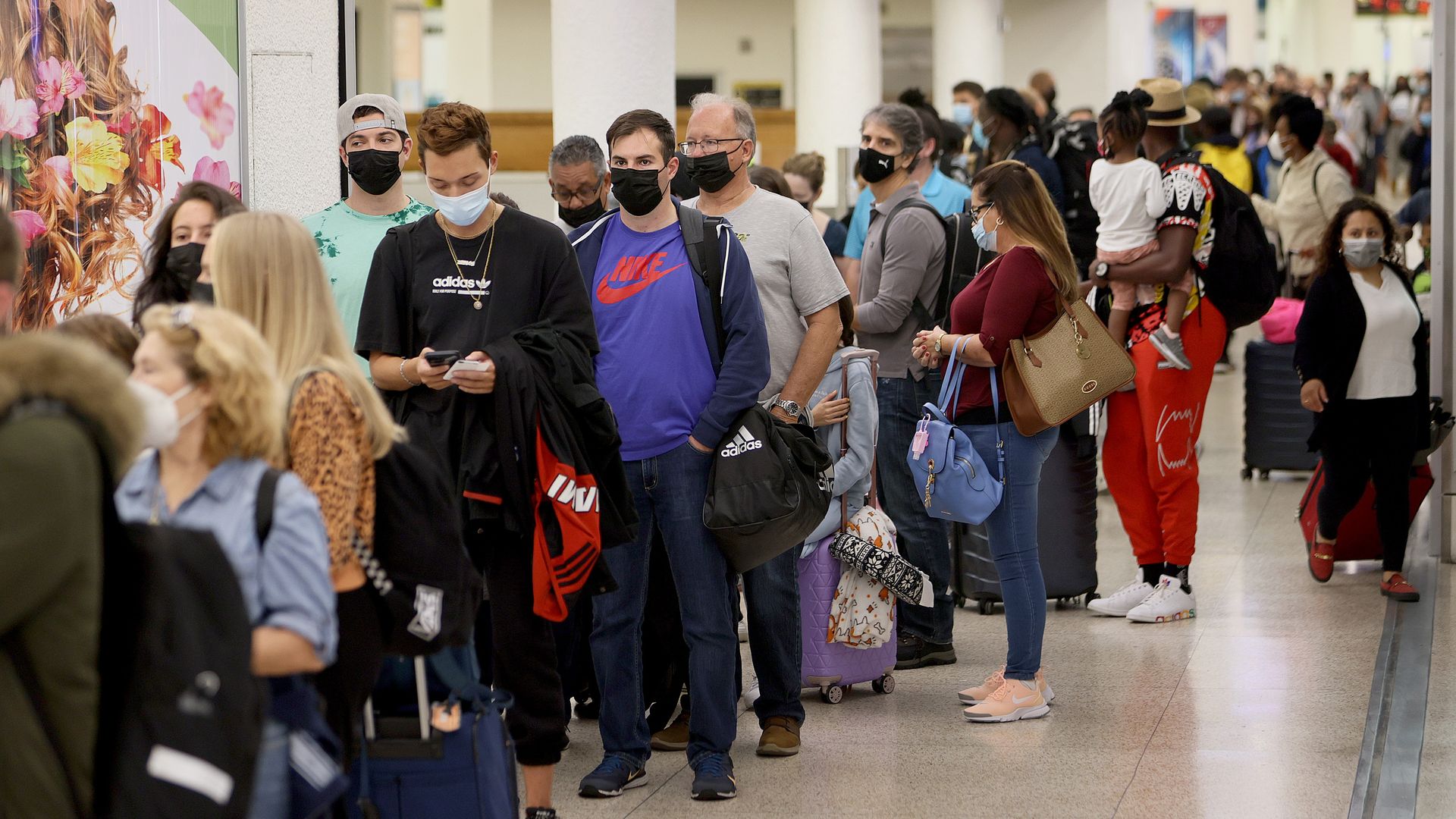
Holiday travel is expected to approach pre-pandemic levels. Photo: Joe Raedle/Getty Images
Clear, the ID security company that aims to speed passengers through airport security, will now book you an Uber to make sure you arrive at your gate on time, Joann Muller writes.
Why it matters: Holiday travel is expected to approach pre-pandemic levels this year, which could lead to extra stress for passengers, many of whom haven't traveled in two years.
Driving the news: Clear is partnering with Uber to integrate its ride-hailing platform directly into the Clear app’s "Home to Gate" feature.
- Home to Gate analyzes traffic data, security screening wait times, and walking distance in the terminal to advise when you should leave home to arrive at your gate on time.
- The integration with Uber means you can even reserve a ride ahead of time on Clear's app for no extra charge.
How it works: You don't have to be a Clear Plus member to use the Home to Gate feature, but access to Clear's expedited security lines requires membership.
- Open the Clear app and tap "Home to Gate."
- Share your location and flight details, and the app will tell you the best time to leave for your flight.
- Tap the "Get A Ride With Uber" button, and the Uber app will reserve your ride, with all your trip details.
5. Mud in your eye: Cleaning self-driving car sensors
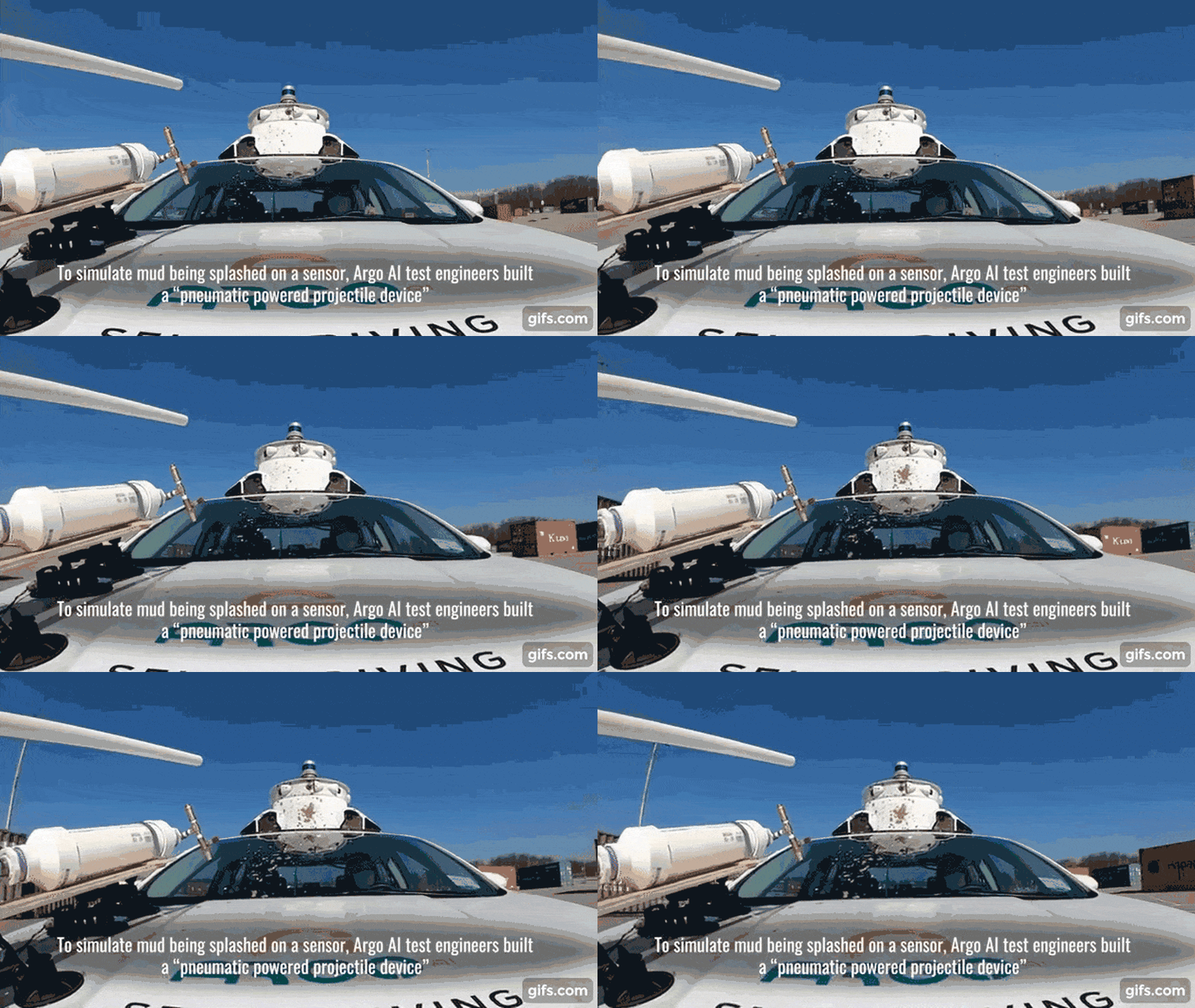
Argo AI's "mud cannon" flings dirt at the sensors of a self-driving car. Image: Argo AI
Autonomous vehicle developers are deliberately blinding their cars to perfect various sensor-cleaning strategies, Joann writes.
Why it matters: Like humans, self-driving cars must be able to actually see the world around them to make decisions. But rain, dirt, debris and even insects can obscure their vision, requiring systems that can automatically clean the sensors.
- Companies have been testing a variety of cleaning methods, from blowing small puffs of air on cameras and lidar sensors to squirting them with liquids and then wiping them with tiny squeegees.
What's happening: To help with the research, engineers at one company, Argo AI, even jerry-rigged a "mud cannon" to splatter its test cars with a pudding-like substance.
- The goal was to simulate mud splashing from a passing car — without damaging the sensors.
- During six weeks of trial and error, Argo AI constructed a hood-mounted gizmo from PVC pipe, sprinkler valves and a portable air compressor that could fling a carefully crafted mix of water and scratch-proof dust at the car's sensors.
- The end result is like a "simple potato gun, with a sprinkler valve."
What to watch: 3M is developing a replaceable, superhydrophobic film that would act like a waterproof screen protector for vehicle sensors. Â Â
Was this email forwarded to you? Get your daily dose of What's Next magic by signing up for our free newsletter here.
Sign up for Axios What's Next

The next decade of big, sweeping changes will unfold in cities and communities where new technologies like 5G, AI and drones are transforming how we work, live and play together. What’s Next will guide you through the revolution.


