Axios What's Next

March 14, 2024
A new tool from a leading humanoid robotics startup allows multiple droids to be summoned at once, Jennifer reports today.
Today's newsletter is 1,087 words ... 4 minutes.
1 big thing: Hit button, activate robots
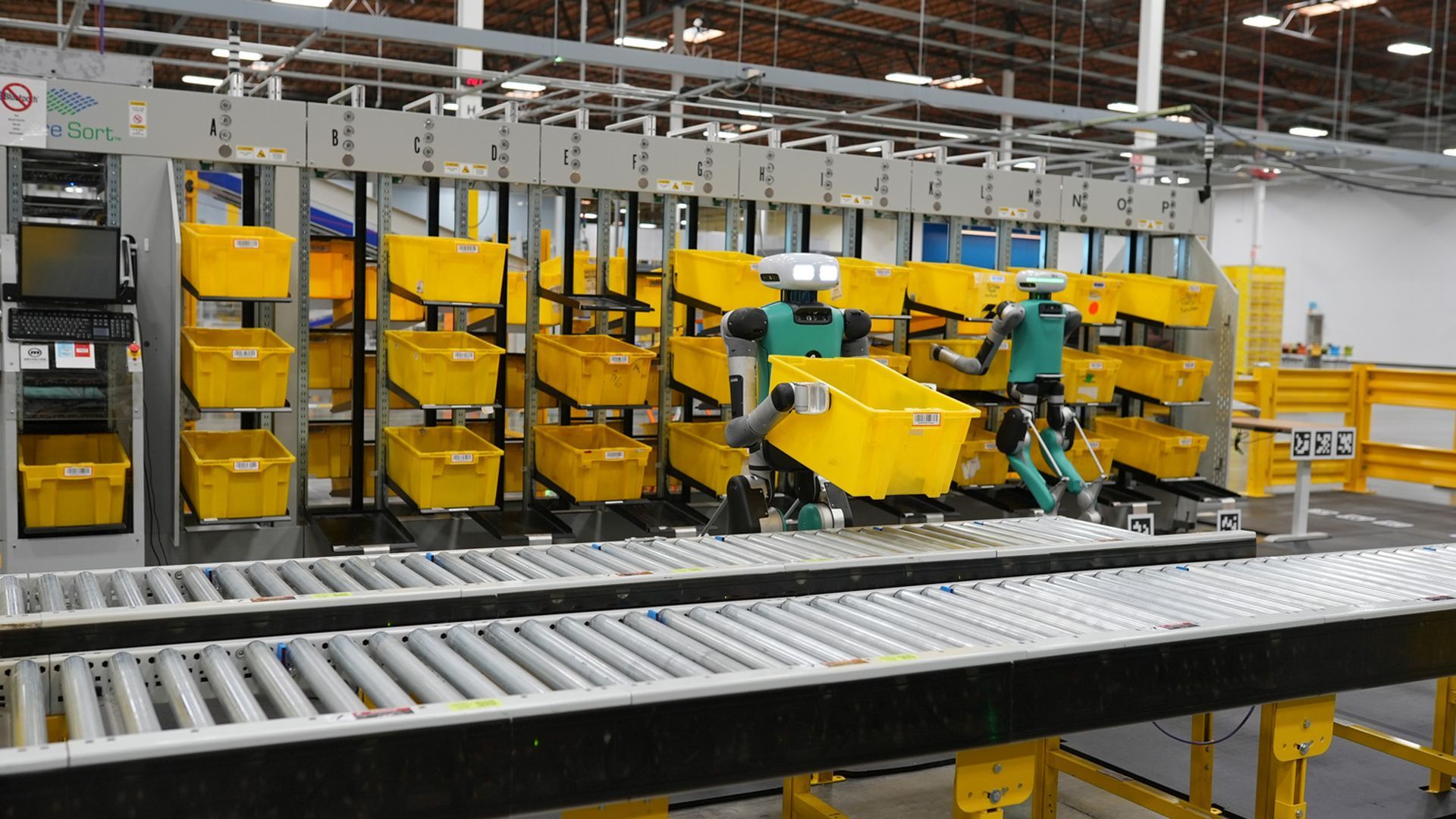
Agility's robots are on trial assignment at an Amazon warehouse south of Seattle. Photo courtesy of Agility Robotics
Envisioning a day when hundreds of humanoid robots can be summoned and deployed at the touch of a button, Agility Robotics has announced its first fleet management platform, Jennifer reports.
Why it matters: There's intense competition among humanoid robot manufacturers to get their products into the industrial marketplace, where companies like Amazon and BMW are eager for their help.
Driving the news: The new platform, Agility Arc, is a cloud-based tool that'll be able to command a robot army, say, to start moving bins to a conveyor belt at a particular time.
What they're saying: "The ability to control fleets of robots is something that everybody in the robotics business needs to do," Damion Shelton, president of Agility Robotics, tells Axios.
- "I think we're the first humanoid robot vendor to have any solution offering on that front."
- Agility "envisions ultimately very large deployments, into the hundreds," Shelton adds.
Where it stands: Walking, dexterous robots are gradually making the leap from the science lab to the workplace, requiring more sophisticated management systems.
- Agility's robot, named Digit, is being tested by Amazon and GXO Logistics, which recently deployed it at a Spanx warehouse in Georgia.
- A competing robot maker called Figure, which just garnered a massive investment from Jeff Bezos and OpenAI, is starting to staff a BMW production line.
- Agility is opening a manufacturing facility in Oregon called RoboFab, with plans to eventually produce 10,000 two-legged robots annually.
Catch up quick: In its earliest incarnations, Digit was controlled by "a single engineer with a laptop, telling the robot to do something," Shelton says.
- Last year the system was upgraded so that multiple robots could be controlled at the same time to work together on a single task.
"Now what we have is a whole integrated fleet management system that allows you to coordinate multiple robots out of a single user interface," Shelton says.
- "That's a big step towards the larger customer deployments, where you would have multiple robots operating within a customer environment and want to track the charge level, the success or failure rate of the robot, and statistics like how much load they've been carrying."
🤖 Zoom in: Shelton gave the example of a warehouse that has an inbound tractor-trailer arriving at 3 p.m. with inventory that needs to be processed.
- "So you need all the robots charged up and ready to go by 3 p.m," he says, "but you also have this body of work that needs to get done from 8 a.m. to 11 a.m."
- With Agility Arc, "you can dynamically load-balance the fleet," Shelton says — ensuring there's constantly enough robots to get the day's work done.
Zoom out: Advances in humanoid robots are coming thick and fast.
- Agility has been experimenting with integrating large language models and generative AI into Digit, so you can assign it tasks in natural language.
- See a video of Digit being told verbally to "pick the box that's the color of Darth Vader's lightsaber and put it on top of the tallest box in the front row."
Yes, but: The Occupational Safety and Health Administration and other federal agencies are still working out how to set safety rules governing the new metallic workers.
The bottom line: The humanoid robot revolution is upon us — expect these droids to start moving into industrial settings over the next few years, and then retail stores and our homes.
2. More books challenged
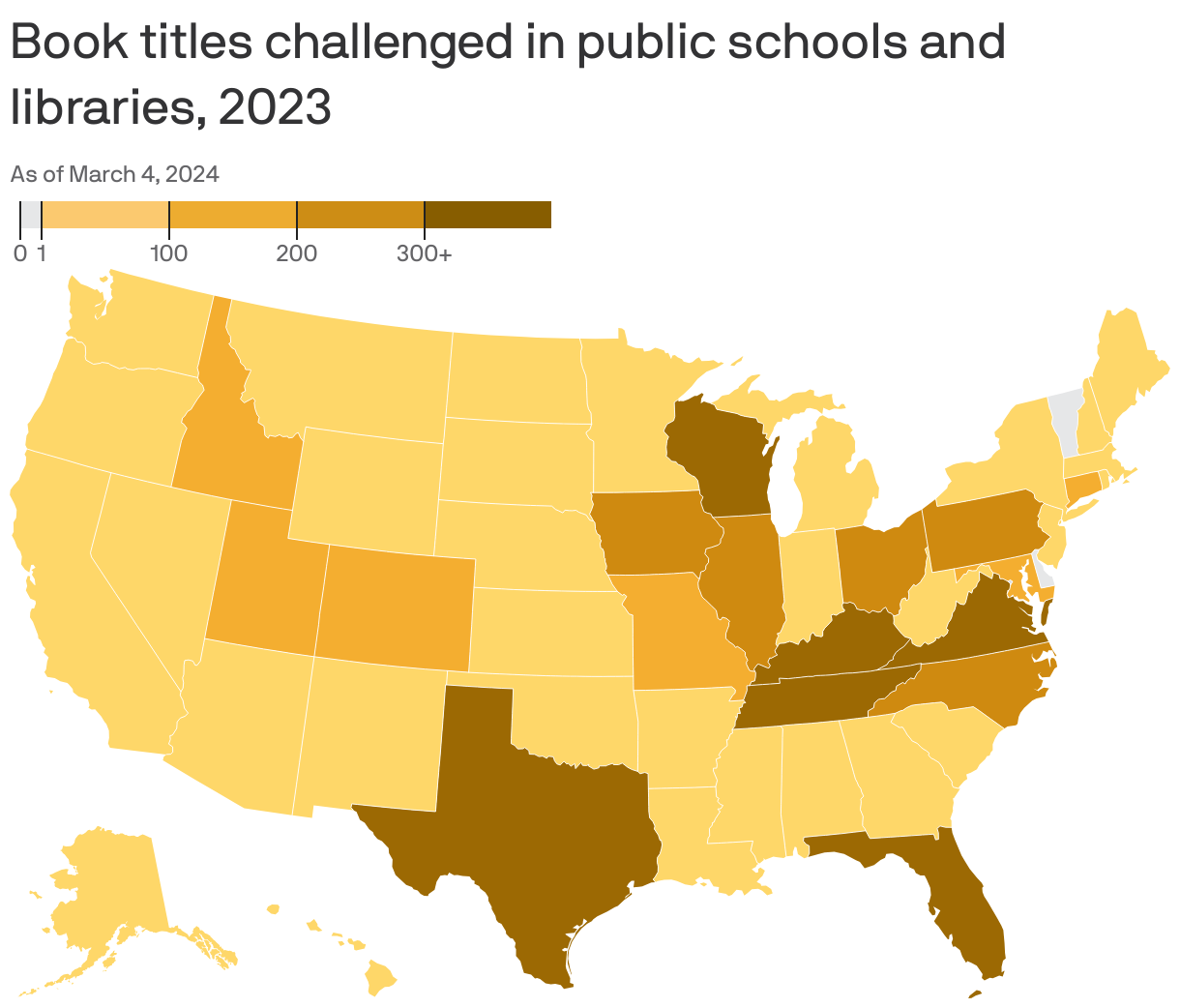
Open embedded content from datawrapper.dwcdn.netThe number of books targeted for censorship at U.S. schools and libraries rose 65% in 2023 over 2022, Jennifer writes from a new American Library Association (ALA) report.
Why it matters: It's the highest level the group has ever reported, coming as pro-censorship groups increasingly target multiple titles at once.
By the numbers: 4,240 different titles were targeted for censorship last year, compared with 2,571 in 2022 — which was then a record.
- Yes, but: The number of overall censorship demands dropped slightly, to 1,247 in 2023 from 1,269 in 2022.
The big picture: Librarians and educators view the move to stifle reading material for young people as such a grave threat that they're propagating the term "intellectual freedom challenges" as a descriptor.
- Censorship efforts tend to focus on books with multicultural or LGBTQ themes — 47% of targeted books "represented the voices and lived experiences of LGBTQIA+ and BIPOC individuals," per ALA's report.
Between the lines: Opponents of targeted books are going beyond school libraries and putting more pressure on public libraries.
- The number of titles targeted for censorship at public libraries rose by 92%, versus 11% at schools.
- And demands for "censorship of multiple titles, often dozens or hundreds at a time" drove the overall surge, per ALA.
Caveat: ALA considers its censorship tally "only a snapshot," noting that it doesn't include book challenges that weren't reported directly to the group or covered by the media.
3. Biden's roadmap for cleaner trucks
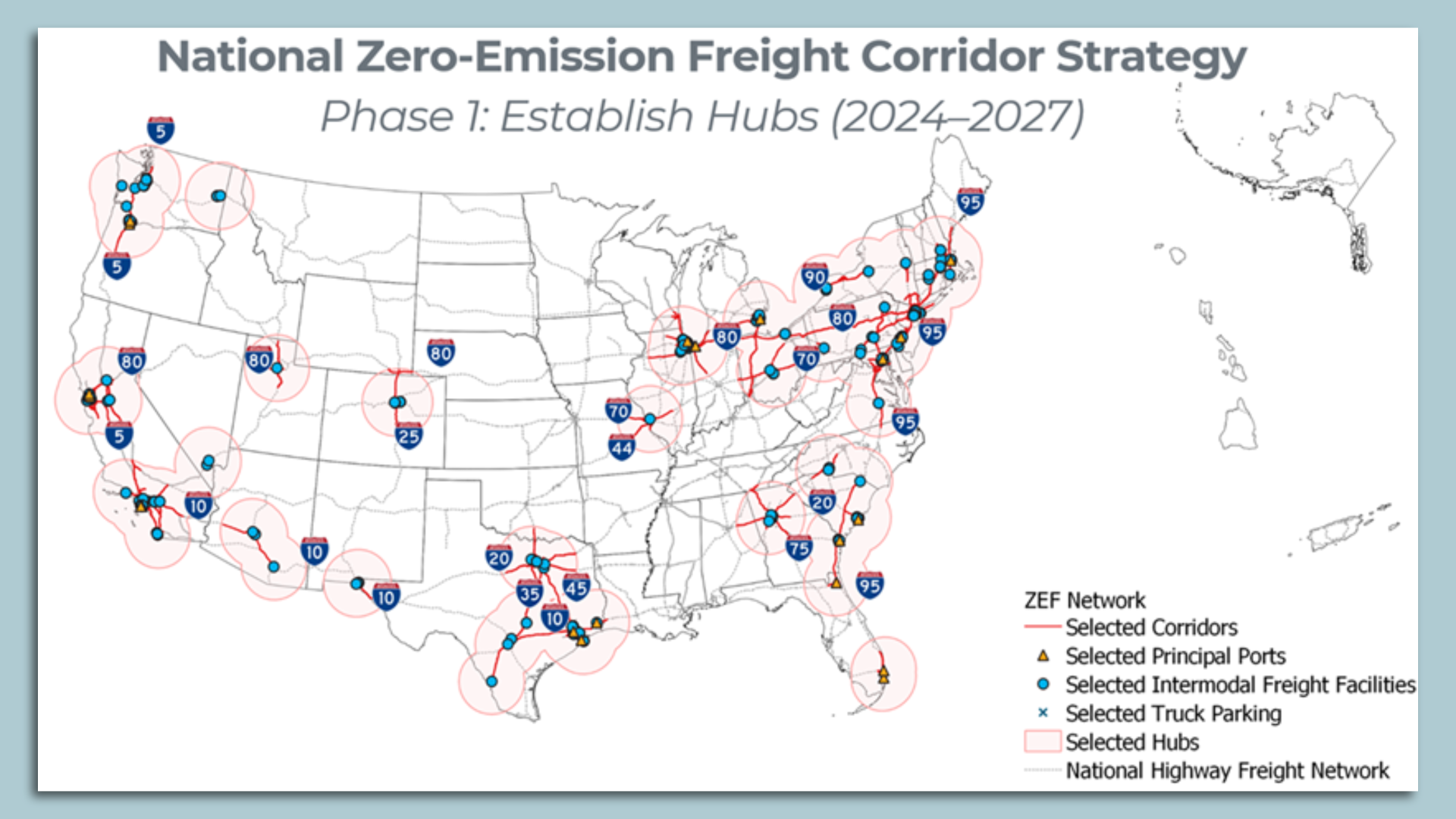
Image courtesy of the Joint Office of Energy and Transportation
The Biden administration has unveiled a detailed road map to help spur the rollout of charging and hydrogen refueling infrastructure for big trucks, Axios Generate's Ben Geman reports.
Why it matters: Diesel-powered trucks are a big source of carbon dioxide and dangerous air pollutants — yet the country lacks enough electric and hydrogen infrastructure to shift away from them.
The big picture: Enter the administration's new "National Zero-Emission Freight Corridor Strategy."
- It's designed to help guide public dollars and catalyze private investment, while also aiming to organize local, regional and industry planning and activity.
Between the lines: Biden officials also see it as a tool for breathing life into the administration's goal of zero-emissions models reaching 30% of medium- and heavy-duty truck sales by 2030, and 100% by 2040.
4. D.C.'s plan to keep Nats Park
Illustration: Annelise Capossela/Axios
Washington, D.C., officials have proposed a dedicated ballpark maintenance fund to guarantee Nationals Park's future, Axios D.C.'s Cuneyt Dil reports.
Why it matters: Nationals Park transformed the city's Navy Yard neighborhood — and no one wants a repeat of the Capital One Arena fiasco.
State of play: Nats Park opened in 2008, and bits and pieces are getting old.
- As landlord, the District is responsible for repairs.
- The city recently spent about $20 million for a new scoreboard and lighting in time for Opening Day on April 1.
Yes, but: The facility may need another $350 million in upgrades through the end of the team's lease in 2038, per one outside estimate.
The latest: The proposed fund would be made up of taxes generated in the stadium — so it would be a self-sustaining, stable source of money to replace, say, deteriorating elevators or seats.
Big thanks to What's Next copy editor Amy Stern.
Was this email forwarded to you? Get your daily dose of What's Next by signing up here for our free newsletter.
Sign up for Axios What's Next

The next decade of big, sweeping changes will unfold in cities and communities where new technologies like 5G, AI and drones are transforming how we work, live and play together. What’s Next will guide you through the revolution.