Axios What's Next

May 11, 2023
It's not your imagination: Allergy season is dragging on this year — with climate change to blame, as Alex reports.
Today's newsletter is 805 words ... 3 minutes.
1 big thing: Where allergy season is getting longer
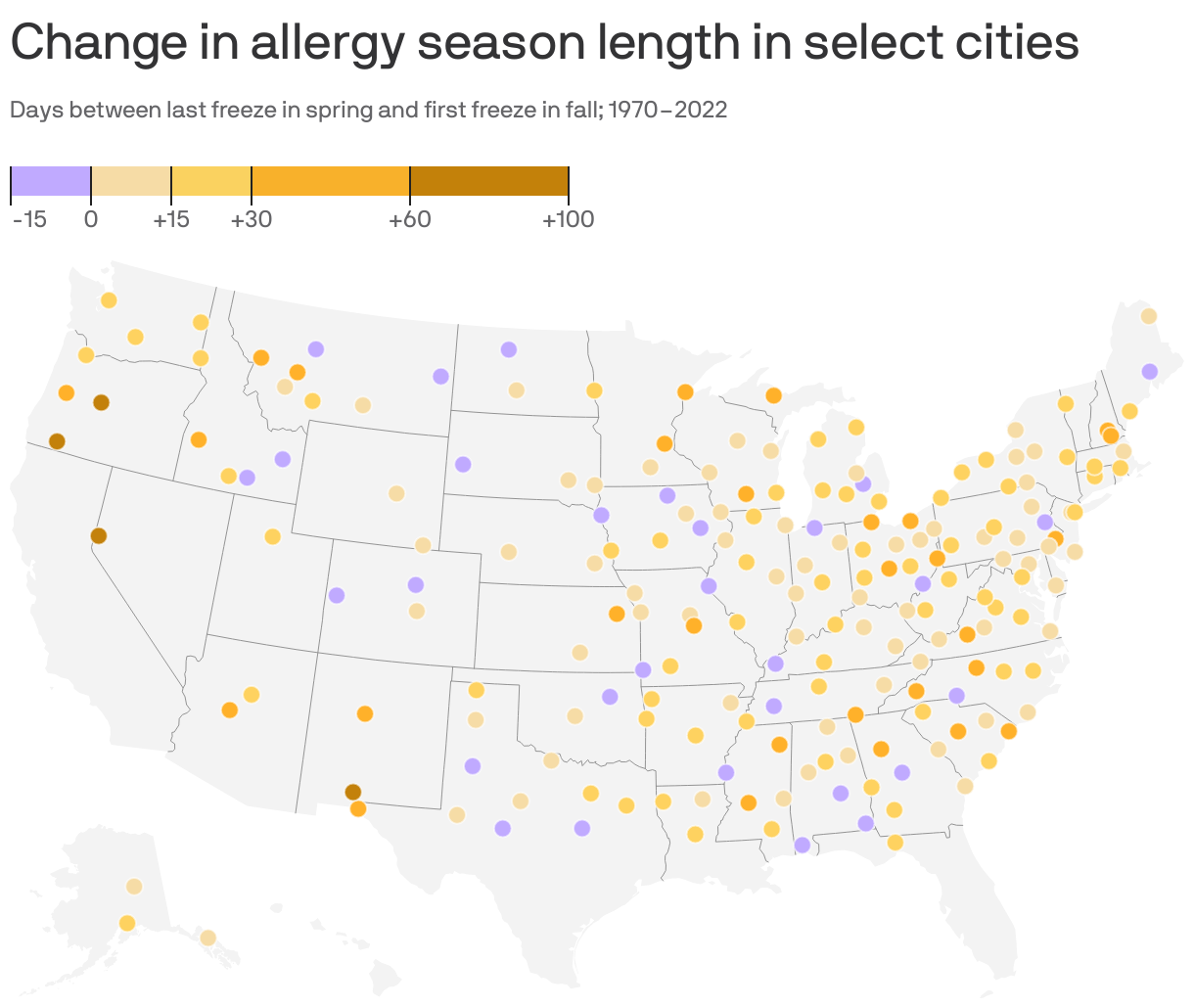
Allergy season lengthened by 15 days on average between 1970 and 2021 across about 200 U.S. cities, per an analysis from Climate Central, a nonprofit climate news organization, Alex Fitzpatrick and Alice Feng report.
- That's based on the number of days between the last freeze each spring and the first freeze each fall — essentially, the annual window during which seasonal allergy sufferers are most likely to rely on their antihistamine of choice to get by each day.
Why it matters: The longer allergy season is tied to climate change, per Climate Central — and it has big health ramifications for the roughly one-quarter of Americans who suffer from seasonal allergies (and for respiratory health more broadly).
- "Earlier spring and longer periods of freeze-free days mean that plants have more time to flower and release allergy-inducing pollen," Climate Central says.
- From 1990 to 2018, pollen counts increased by 21% nationwide, with the greatest increases in the Midwest and Texas, according to a 2021 study, Axios' Arielle Dreher reports.
Zoom in: Allergy season has been extending dramatically in several cities — including, most notably, Reno, Nevada, where it's now 99 days longer than it was in 1970.
- Zoom out: The "freeze free" season has lengthened by at least a month in more than 30 cities.
Yes, but: Allergy seasons shortened in a handful of cities between 1970-2021, including Denver (-15 days) and Charlotte (-9 days).
Of note: Cities in the Deep South and parts of California were left out of the analysis because they don't experience traditional freezing seasons the way other parts of the country do.
What's next: Ongoing climate change means further deviation from what was once considered the norm.
- "We do expect that areas that haven't previously had substantial pollen seasons will potentially start to experience pollen seasons," William Anderegg, director of the Wilkes Center for Climate Science & Policy at the University of Utah, told Arielle.
The bottom line: If you feel like seasonal allergies are suddenly a bigger part of your life, here's some solid data to back that up.
2. Wendy's testing AI chatbot drive-thru service

Illustration: Allie Carl/Axios
Get ready for AI at the drive-thru ordering screen, courtesy of Wendy's, Tyler Buchanan of Axios Columbus reports.
- The chain plans to automate its drive-thru ordering with an AI chatbot service it's been testing with help from Google, per a company news release.
How it works: Generative AI will process orders, and language model technology will "talk" to customers in real time to answer menu questions.
- The chatbot is programmed to handle customized orders and special requests.
Where it stands: Wendy's plans to launch the pilot next month at a company-operated restaurant in the Columbus, Ohio area.
- If all goes well, the chain will expand the technology to more restaurants.
🤔 Our thought bubble: So you're saying the chatbot won't judge when we order mounds of spicy chicken nuggets?
3. Boom times in the 'burbs
A suburban mall in Springfield, Va. Photo: Robert Knopes/Education Images/Universal Images Group via Getty Images
What's bad for the big city — the decline of the 5-day office commute — is good for the suburbs, which are experiencing a retail renaissance, the Wall Street Journal reports.
- A "growing number of retailers in city office districts are relocating their businesses to the suburbs, where visits to shopping centers are on the rise as fewer people commute to downtown workplaces," per the Journal.
- An example is fast casual restaurant Sweetgreen, which has been closing locations in Los Angeles, Boston and New York City but ramping up in suburbia, the Journal reports.
Where it stands: Most downtowns are still struggling to attract the foot traffic they once did before the pandemic, as Alex Fitzpatrick and Alice Feng have reported.
- But the beneficiaries are suburban landlords and shoppers, who are even returning to "high-end enclosed malls, which were hard hit by the pandemic," the WSJ said.
- "Foot traffic at Simon Property Group's malls is higher this year compared with 2022 while overall occupancy was 94.4% in the first quarter, just shy of pre-pandemic levels," the Journal said.
4. An environmentally sensitive lawnmower
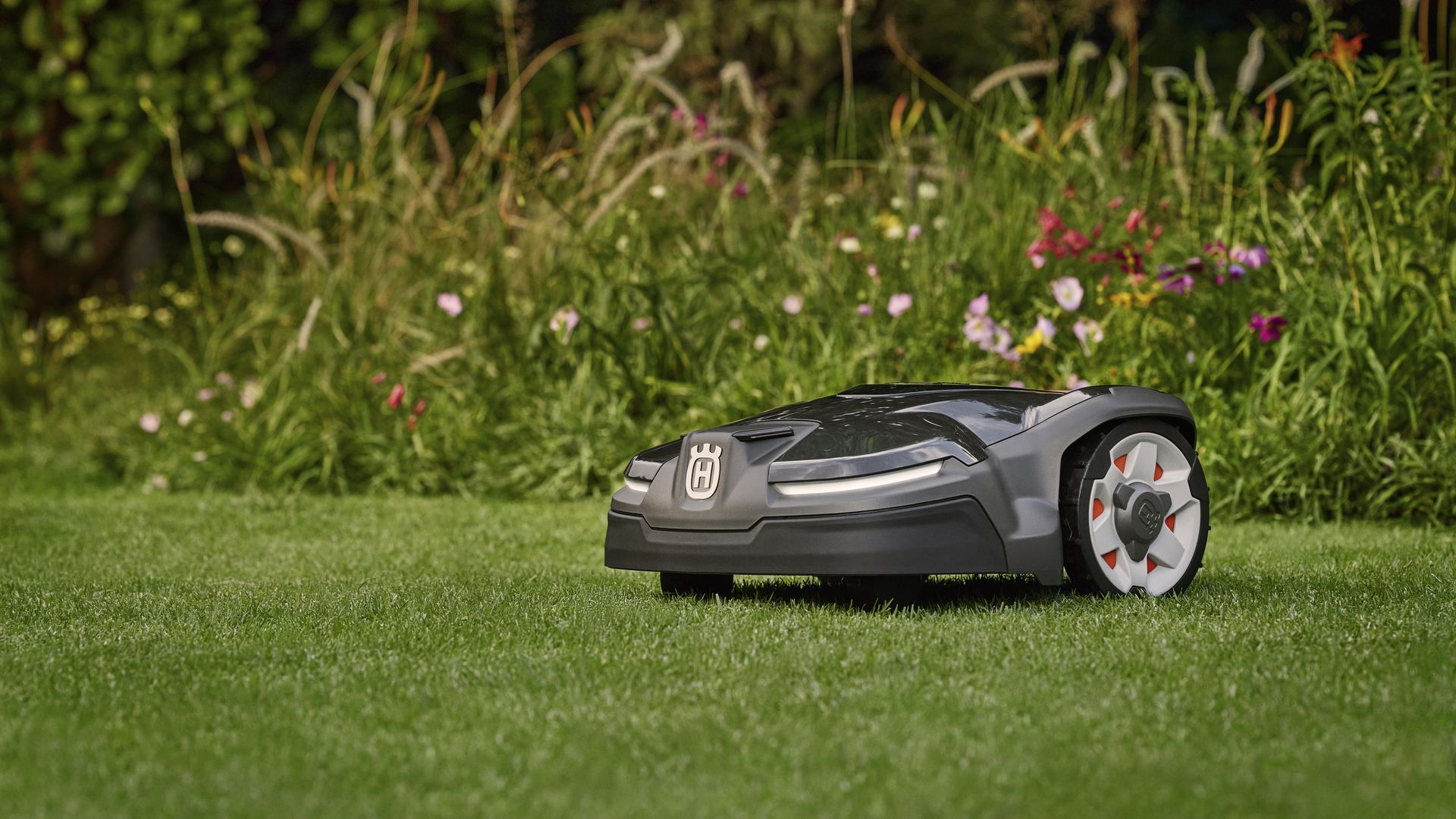
When set to "Rewilding Mode," this mower automatically leaves 10% of any lawn unclipped, the better to attract bees and other pollinators. Photo courtesy of Husqvarna
Swedish company Husqvarna says its robotic lawnmower now comes with a mode called "rewilding," which leaves 10% of a lawn unmown in order to attract bees, butterflies and other pollinators, Jennifer A. Kingson writes.
Why it matters: With spring here, Americans are debating whether to participate in programs like "No Mow May," which are meant to help the environment by keeping grass at a length that encourages biodiversity.
- But such programs are controversial because unkempt lawns are unsightly, and letting the grass grow too long can be counterproductive.
- Experts say that leaving a portion of your lawn unmown can achieve dual goals: keeping your turf attractive to both bees and neighbors.
How it works: Husqvarna says the "rewilding" feature, introduced this month, uses GPS sensors to create a virtual map of the lawn and automatically allocate 10% to a rewilding zone. (See a video here.)
"Thank you" to our stalwart What's Next copy editor, Amy Stern.
Was this email forwarded to you? Get your daily dose of What's Next by signing up here for our free newsletter.
Sign up for Axios What's Next

The next decade of big, sweeping changes will unfold in cities and communities where new technologies like 5G, AI and drones are transforming how we work, live and play together. What’s Next will guide you through the revolution.