Axios Vitals

October 09, 2020
Good morning. We made it to another Friday.
Today's word count is 1,574, or a 6-minute read.
1 big thing: A new October surprise
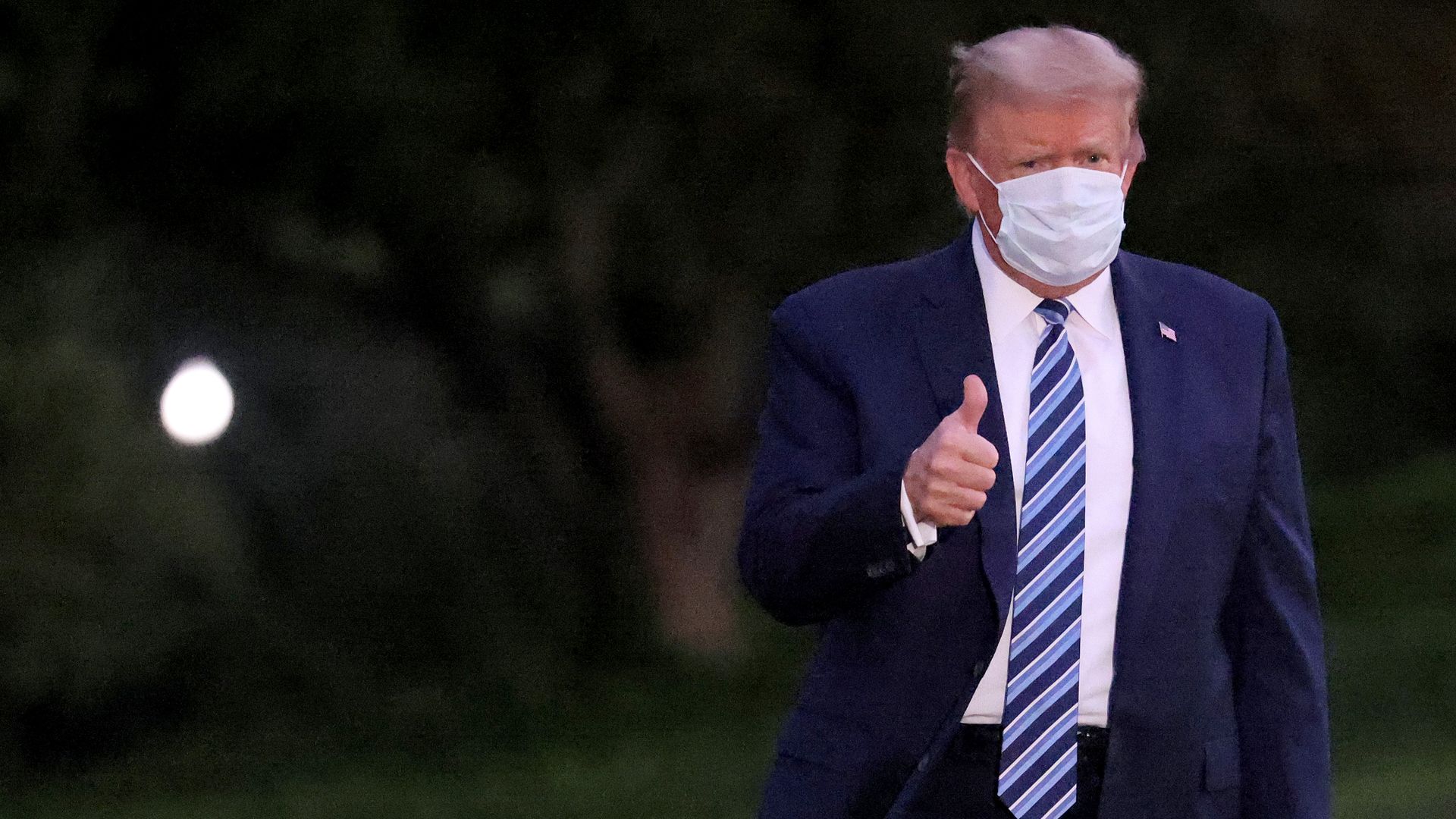
President Trump gestures upon return to the White House from Walter Reed National Military Medical Center. Photo: Win McNamee/Getty Images
President Trump has called an experimental coronavirus therapy he received "a gift from Heaven" and promised to make it widely available — igniting yet another round of concern about politics encroaching on science.
- "We have an emergency use authorization that I want to get signed immediately," Trump said in a video yesterday.
The big picture: "The problem is every therapy for coronavirus has become politicized — every single therapy, and that's the last thing you want in a pandemic, so this is just next in line," Walid Gellad, director of the Center for Pharmaceutical Policy and Prescribing at the University of Pittsburgh, told the Washington Post.
Details: Trump is talking about a cocktail of laboratory-made antibodies made by Regeneron that he received as part of a host of medications over the past week.
- Regeneron and Eli Lilly, which is developing a similar therapy, both applied for an emergency use authorization from the Food and Drug Administration this week.
- Regeneron has said that it would have about 300,000 doses of the drug available in the next few months, and Eli Lilly will have about 1 million doses ready by the end of the year, per the Post.
- That means that even if the drugs are quickly authorized, the number of patients who can receive them will be limited.
Between the lines: The drugs, while promising, are still undergoing clinical trials, and it's unclear whether the Regeneron therapy was responsible for Trump's apparent recovery.
What they're saying: "The science of antibody drugs could ... devolve into another political dispute.
- "But the FDA should and will weigh the benefits of the therapy against the risks and judge the application on the scientific merits, hopefully without political interference," former FDA commissioners Scott Gottlieb and Mark McClellan wrote in a WSJ op-ed yesterday.
2. Medical ethics in pandemic times
Illustration: Sarah Grillo/Axios
Politics aside, there's a much deeper ethical debate being had about using experimental treatments, Axios' Alison Snyder and Eileen Drage O'Reilly report.
The big picture: As the global pandemic continues, the tension between providing the best available care for patients and performing trials to determine whether that care is effective risks complicating the medical response.
- The big question: Is it unethical to withhold a possible treatment from someone who instead receives a placebo, or to continue to administer that treatment without having collected data on whether it works?
Driving the news: Trump received the experimental monoclonal antibody cocktail via expanded access or "compassionate use," which allows someone to access a treatment outside of a clinical trial before it is approved.
- Experts say his subsequent claims of the treatment being a cure risks reducing enrollment in clinical trials, flooding companies with requests for access to a limited number of doses and creating false hope for patients.
Between the lines: Offering patients experimental COVID-19 drugs via emergency use authorizations, expanded access programs and compassionate use can slow needed clinical trials.
- Researchers have struggled to enroll people in clinical trials in which they may receive a placebo if patients can access a drug directly.
- One example: "There's been some hiccups with the expanded access use for convalescent plasma, because it was something that precluded people from enrolling in a randomized control trial, so it took longer, and we still don't quite know how well convalescent plasma works," says Johns Hopkins' Amesh Adalja.
3. The latest in the U.S.


White House physician Sean Conley said in a memo released Thursday that he believes President Trump will be able to safely return to public engagements Saturday, or day 10 of the president’s coronavirus illness.
White House communications director Alyssa Farah declined to tell reporters when Trump last tested negative for COVID-19 on Thursday, saying that "the doctors would like to keep it private."
White House chief of staff Mark Meadows hosted his daughter's 70-person indoor wedding in Atlanta in May, despite major coronavirus lockdowns and local ordinances blocking large gatherings, the Atlanta Journal-Constitution first reported on Thursday.
House Speaker Nancy Pelosi said Thursday she would not agree to a standalone bill to assist the airline industry without a broader relief package that addresses public health, unemployment, and aid for state and local governments.
Within a day of tweeting that he was calling off bipartisan talks for a coronavirus stimulus deal, President Trump phoned House Minority Leader Kevin McCarthy and indicated he was worried by the stock market reaction and wanted a "big deal" with Speaker Nancy Pelosi, Axios' Alayna Treene and Jonathan Swan report.
4. The latest worldwide


Europe is now recording far more new coronavirus cases than ever before, Axios' Dave Lawler reports.
- One reason is testing. Deaths and hospitalizations remain far below the levels seen in the spring, though they continue to tick upward.
- Officials in Spain and France are scrambling to respond to their particularly worrying outbreaks. Madrid is now under quarantine, while Paris has closed bars for two weeks.
- Germany had fared better but is now facing a spike. Germany's public health agency said "parties and family gatherings, including weddings, birthdays and funerals, were the main sources of new infections," per WSJ.
The other side: Hope is rising that Latin America is now past the peak of a long, brutal climb.
- Hard-hit countries including Brazil, Mexico and Peru have all seen significant declines in new cases and deaths.
- It's unclear whether the encouraging trend will continue. WSJ warns that "Latin Americans, comforted by the recent declines, have filled hair salons, bars and gyms."
- "With only 8% of the world’s population, Latin America has now accounted for a third of global deaths from COVID-19."
India's case count is also trending downward, though it's too early to conclude the worst is over.
5. Why pandemic aid matters


A quarter of Americans say they know someone who has gone into work while feeling unwell, according to a survey provided exclusively to Axios by the Paid Leave for All campaign.
Why it matters: We will not be able to get the pandemic under control unless people can stay home when they're sick. Clearly, many Americans are not able to do that — especially people of color — without risking their job or their paycheck.
Details: In March, a quarter of private-sector workers in the U.S. didn't have a single day of paid sick leave, according to an analysis of recent Bureau of Labor Statistics data analyzed by the National Partnership for Women and Families.
- But paid sick leave varies drastically by income; 69% of the lowest-income workers had no paid sick days, compared to 6% of the highest-income workers.
- Part-time workers were much less likely to have paid sick leave than full-time workers.
The bottom line: The same groups that struggle to stay home from work — low-income Americans and people of color — are the same groups that have been hit hardest by the pandemic. That's not a coincidence.
6. Washington's big contact tracing problem

Photo Illustration: Eniola Odetunde/Axios. Photo: Chris Graythen/Getty Images
The D.C. Health Department is trying to jump-start contact tracing efforts around the White House's coronavirus outbreak. Tracing has been inadequate so far even as cases spread deeper into the city, Axios' Marisa Fernandez writes.
The big picture: The White House has decided not to move forward with recommended public health protocols of contact tracing and testing since President Trump tested positive for the virus.
The state of play: Tracing has been done for people who had direct contact with Trump, White House spokesman Judd Deere told the Washington Post.
- Still, the Centers for Disease Control and Prevention recommends tracking the hundreds of people who were at the event.
On Capitol Hill, there's also no formalized contact tracing program in place, even as lawmakers themselves test positive.
- Two infected staffers in Rep. Doug Lamborn's (R-Colo.) office were told to not disclose to roommates they may have been exposed, WSJ reports.
The bottom line: The White House's refusal to contact trace is "a missed opportunity to prevent additional spread," Emily Wroe, a co-leader of a contact-tracing team at Partners in Health, told Nature.
7. HCA to return $1.6 billion in bailout funds
HCA Healthcare is giving back $1.6 billion of federal bailout payments and paying back $4.4 billion in Medicare loans early. The money was intended to help hospitals weather the pandemic as patients delayed elective care, Axios' Bob Herman reports.
Why it matters: Over the summer, the hospital industry said the pandemic was resulting in "the greatest financial crisis we have ever faced in our history." But HCA expects to report higher revenue and adjusted profits in the third quarter.
By the numbers: The taxpayer bailout payments represented 55% of HCA's profit in the second quarter.
- Hospitals and other health care providers secured $175 billion in bailouts from Congress since the start of the pandemic.
What they're saying: HCA CEO Sam Hazen said in a press release that returning the funds and repaying the loans early was "appropriate and the socially responsible thing to do."
What we're watching: Finances at other large hospital systems similarly improved in the second quarter, compared with the first quarter.
- That trend likely could continue as more people rescheduled surgeries and saw their doctors, despite the persistence of coronavirus cases throughout the country.
8. Dog(s) of the Week!
Onix. Photo: Nancy Whiteman
Meet Onix, who is a VERY persistent pup. She has sent me not one, but TWO videos explaining why she should be dog of the week!
- "Onix is a 4-year-old mixed breed. She was living on the streets when we adopted her at 9 months from a local rescue," writes her mom, Nancy.
- "She knows she was rescued and shows us that with undying love and obedience every day. We had her DNA done and found: 40% unidentifiable and the remaining 60% equally divided into Pomeranian, Pekingese, Lhasa apso, Chihuahua and poodle."
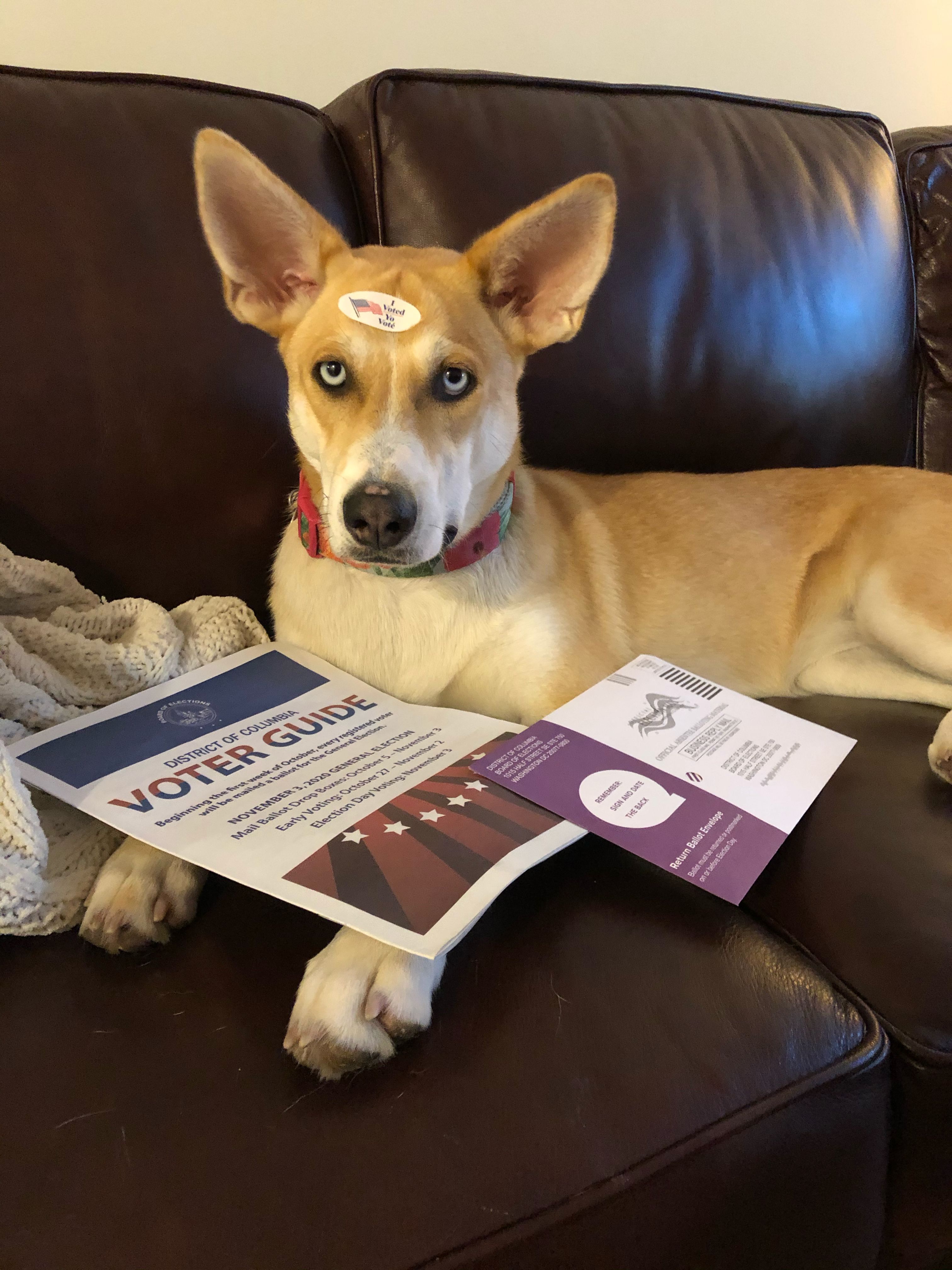
And here's the most civically engaged dog I've seen yet — Lilly! She is yet another pandemic pup.
- "Got her the first week of April, and now she is 8 months old. She is a husky mix, uses her big ears to hear all your secrets and likes to 'pup-kour' when mom is working from home and look fondly at herself in the mirror," her mom, Melissa, writes.
Why it matters: The longer the week, the more dogs we need.
What's next: Keep sending me your dogs!
Sign up for Axios Vitals

Healthcare policy and business analysis from Tina Reed, Maya Goldman, and Caitlin Owens.