Axios Vitals

March 01, 2023

Good morning, Vitals readers. Today's newsletter is 986 words or a 3½-minute read.
Situational awareness: FBI director Christopher Wray on Tuesday acknowledged the agency's assessment that the origins of the COVID-19 pandemic "most likely" resulted from a potential lab leak in Wuhan, China, Axios' Sareen Habeshian writes.
1 big thing: Post-Roe, prosecutors can seek unprotected reproductive health data

Illustration: Aïda Amer/Axios
The increasing criminalization of abortion in the U.S. is exposing major gaps in the legal protection of health information, as more health data ends up in the hands of patients rather than doctors, Axios' Ashley Gold and Oriana Gonzalez write.
Why it matters: Health privacy in the post-Roe digital age is fraught, as prosecutors seeking to enforce anti-abortion laws are free to go after reproductive health data in mobile apps, where it is unprotected by federal law.
- Companies buy and sell sensitive health data, which is one concern; the unregulated use of personal data to enforce abortion bans is another.
- As many as one-third of women use digital tools to track their periods, Axios' Erin Brodwin reports. That can be for reasons as simple as monitoring their cycles, planning to avoid a pregnancy or trying to conceive.
Driving the news: Virginia lawmakers recently tried to pass a law that would exempt digital menstrual health data from law enforcement access. The administration of Gov. Glenn Youngkin (R) helped defeat the bill, per the Washington Post.
- Meanwhile, lawmakers in states like California and Washington have introduced bills that look to protect people's electronic data, including information collected by period-tracking apps.
Be smart: The Health Insurance Portability and Accountability Act (HIPAA) protects sensitive health information when it's in the hands of health insurers and doctors. But it doesn't protect health data when it's logged in a phone app, discussed in a text with a friend or written about in an email.
- That leaves people unable to protect personal health information from law enforcement online, putting the onus on individuals to minimize their digital health footprint, using encryption or being cautious about what platforms they use.
Agencies like the Federal Trade Commission can, and do, go after companies for improperly disclosing sensitive data — such as the recent action the FTC took against GoodRx for sharing patients' health data with Meta and Google without the users' consent.
- However, the FTC is powerless against law enforcement seeking such data.
Related: Lawmakers warn Biden on feds aiding anti-abortion investigations
2. First RSV vaccine wins key endorsement
The race to make the nation's first vaccine against the respiratory syncytial virus, or RSV, could be nearing the finish line after an FDA advisory committee voted Tuesday to recommend Pfizer's vaccine candidate for adults older than 60.
- That same committee, the Vaccines, and Biological Products Advisory Committee (VRBPAC) will weigh in today on another RSV shot for older adults from GlaxoSmithKline.
Why it matters: If either or both are approved by the FDA, it would provide a defense against what is a highly contagious and potentially dangerous virus in vulnerable patients.
- It causes up to 80,000 hospitalizations among children younger than 5 years old and as many as 160,000 for adults 65 years and older, according to the CDC.
Between the lines: Pfizer said the vaccine can reduce the risk of illness from RSV by 86%.
- GSK said its vaccine can reduce the risk of illness by 83%.
Yes, but: Ahead of the meeting, the FDA flagged concerns about Guillain-Barré risks for both shots.
- Committee members weighed the risks for the Pfizer shot on Tuesday, as well as concerns about administering it with flu and COVID shots, before voting 7-4 to endorse the vaccine.
3. FDA will have "empowered" human foods chief
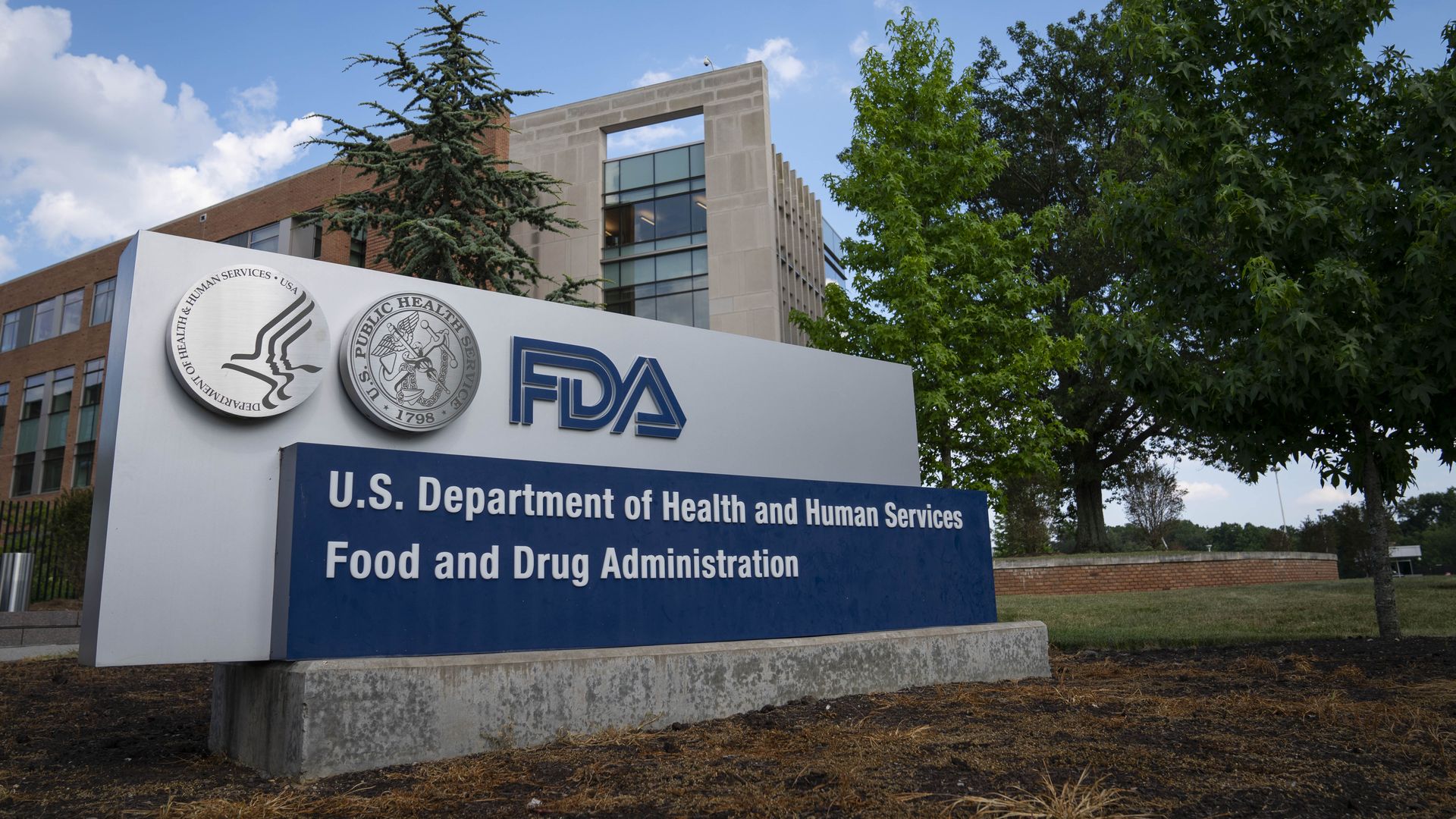
Photo: Sarah Silbiger/Getty Images
The FDA is launching a search for the newly created deputy commissioner for human foods, promising that person will have "a clear line of authority" over the proposed human foods program, the agency announced Tuesday.
Why it matters: It's the latest attempt to detail a plan to reorganize its oversight of food products after the agency faced significant scrutiny in recent years, culminating with last year's baby formula crisis.
- Details are still slim but the reorganization plans detailed Tuesday include a plan to create a unified Office of Integrated Food Safety Systems Partnerships.
- The FDA also announced it will move cosmetics regulation and color certification functions out of the Center for Food Safety and Applied Nutrition into the Office of the Chief Scientist.
- The FDA plans to finalize its proposal this fall.
What they're saying: "I cannot stress enough that my vision is focused on a new, agency-wide model where the activities and responsibilities of the regulatory programs and ORA are better synced to improve efficiency and effectiveness with clear decision rights so that everyone knows who has authority," Califf said in a statement.
Yes, but: While the reorganization might address some of the factors that led to recalls and shortages of baby formula in the U.S., that market remains heavily concentrated, commissioner Robert Califf told the Wall Street Journal.
4. Mental health care in the ER

Illustration: Sarah Grillo/Axios
Black Americans are nearly twice as likely as white Americans to go to hospital emergency departments for mental health care, the Centers for Disease Control and Prevention said in a new report based largely on pre-pandemic data, Axios' Sabrina Moreno writes.
Why it matters: Demand for behavioral health services is swamping the health care system, but those turning to an ER indicate which groups might be facing extra barriers to preventative care.
By the numbers: Among the 6,000 mental health-related ER visits between 2018 and 2020, Black Americans had the highest rates for any mental health disorder — including substance use, anxiety and mood — at 96.8 visits per 1,000 adults.
- Black and Hispanic adults between the ages of 18 and 44 were more likely to go to the ER for mental health issues than any other group.
- Black and Hispanic patients were also more likely to wait more than an hour to be seen than white patients, the study found.
5. Catch up quick
👉 The Justice Department wants a manufacturing plant in "Cancer Alley" to reduce emissions. (NBC News)
💊 How a drug company exploited a safety requirement to make money. (New York Times)
👀 My son's time is running out due to a rare disease. The FDA needs to add more clinical trial flexibility. (STAT)
🦇 A biotech startup focused on bat biology raises $100 million. (Axios)
Have a news tip? Just reply to this email.
Did someone forward this email? Subscribe here.
Thanks for reading, and thanks to senior health care editor Adriel Bettelheim and senior copy editor Bryan McBournie for the edits.