Axios Vitals

September 11, 2024


Good morning, Vitals readers. Today's newsletter is 999 words, about a 4-minute read.
Situational awareness: 92% of people in the United States had health insurance for at least some part of the year in 2023, virtually unchanged from the year before, the U.S. Census Bureau announced yesterday.
1 big thing: Maternal care deserts are growing

Half of U.S. counties lack a hospital that provides obstetric care, and more than a third don't have a single obstetric clinician, according to a new report that portrays workforce shortages and hospital closures as an everyday reality.
Why it matters: Access to care is getting worse at a time when America's maternal mortality rate is more than double that of other wealthy countries and the infant mortality rate recently rose for the first time in two decades.
The big picture: Obstetric care is suffering from larger demographic trends — including the overall decline in birth rates — along with ripple effects in red states from the demise of Roe v. Wade, per the report from March of Dimes.
- But its problems also overlap with systemic health care worries, including the rise of chronic health conditions, stubborn insurance access gaps, labor shortages, and deteriorating economic conditions for some hospitals.
- Counties that March of Dimes calls "maternity care deserts" — or counties with no hospitals or birth centers offering obstetric care and no obstetric clinicians — are disproportionately likely to be rural and associated with a higher risk of preterm births.
Between the lines: In 2021 and 2022, at least 107 obstetric units around the country closed, per the report.
- The main reasons were low birth volume, insufficient reimbursement rates, and staff shortages, according to the report.
- Medicaid, which generally pays significantly less than private insurance, covered 41% of births in 2022.
The report found that 35% of counties, which are home to more than 2.3 million women of reproductive age, don't have a single birthing facility or obstetric clinician.
- Midwives could ease some of the shortage, but 23 states have laws restricting how much care they can provide, the report noted.
2. Abortion ban looms large over debate

Abortion predictably loomed large over last night's presidential debate, with Vice President Kamala Harris asserting that former President Trump would sign a national abortion ban and Trump taking a leave-it-to-the-states posture.
The big picture: Trump continued to waffle on abortion, at one point appearing to contradict GOP vice presidential candidate JD Vance's recent claim that the former president would veto a national ban.
- Harris, meanwhile, attacked Trump's assertion that returning the issue to the states was what most people wanted and blamed him for nominating Supreme Court justices whose votes helped overturn Roe v. Wade.
- "I think the American people believe that certain freedoms, in particular the freedom to make decisions about one's own body, should not be made by the government," she said.
Trump again claimed credit for the Dobbs decision that overturned Roe v. Wade, saying, "Every legal scholar, every Democrat, every Republican, liberal, conservative, they all wanted" the issue of abortion "to be brought back to the states."
- When Harris said Trump would sign a national abortion ban into law if he wins, Trump replied, "It's a lie. I'm not signing a ban ... because we've gotten what everybody wanted."
Trump also repeated that he'd keep the Affordable Care Act in place unless his administration comes up with "something that's better and less expensive."
- Pressed by moderator Linsey Davis if he had a replacement plan, Trump replied, "I have concepts of a plan."
- Harris said she supported private health care options and building on the Affordable Care Act.
- She pledged to extend caps on drug costs for seniors beyond Medicare to the private market.
Sareen Habeshian contributed to this story.
3. Suit cites denial of gender-affirming care

A class-action lawsuit claims Aetna violated federal non-discrimination law by denying coverage of certain gender-affirming surgeries.
Why it matters: The lawsuit, filed Tuesday, cites civil rights protections in the Affordable Care Act that themselves are currently being challenged by conservative-led states.
Driving the news: The complaint states Aetna categorically denies coverage for facial reconstruction surgeries prescribed to treat gender dysphoria, even though it covers the same kind of surgeries for other medical conditions.
- Two of the lead plaintiffs in the lawsuit ended up paying more than $35,000 out of pocket while a third has not yet been able to afford the surgery.
- The lawsuit estimates that this issue affects more than 70,000 Aetna customers across the country.
Between the lines: These surgeries are usually reserved for adults and aren't among the procedures targeted by recent state bans on transgender care. But systemic barriers make them hard to access, said Gabriel Arkles, a lawyer for the plaintiffs and co-interim legal director at Advocates for Trans Equality.
The other side: "Aetna has a strong track record of supporting the LGBTQ+ community and is committed to meeting the health care needs of all our members," spokesperson Alex Kepnes told Axios.
- Aetna plans cover other types of gender-affirming surgeries, including breast and genital surgeries, when deemed medically necessary.
4. Apple leans in on medical devices

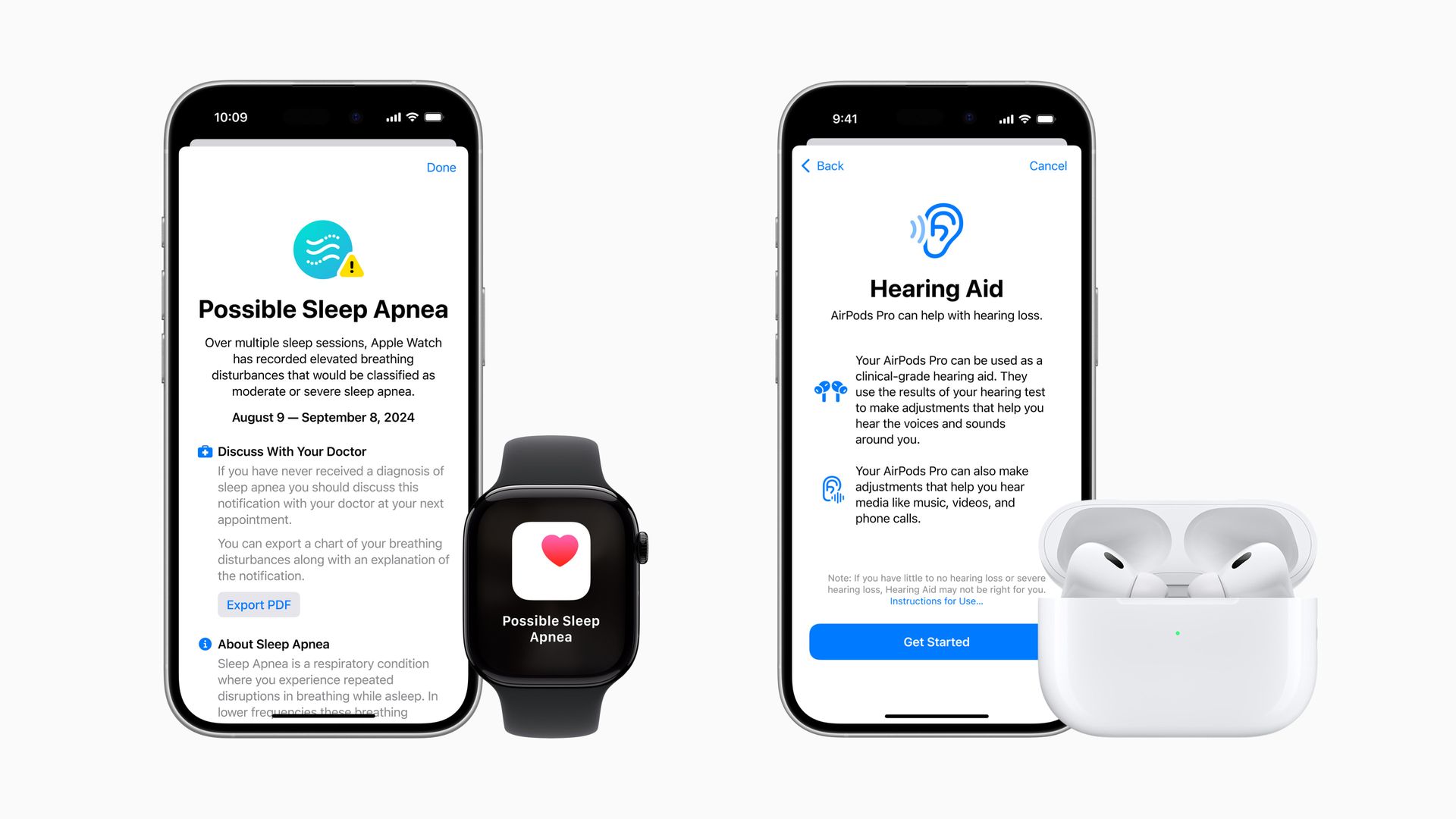
Apple is looking to build its case that its products can make one not just more productive, but also healthier.
Why it matters: With the launch of features to detect sleep apnea and treat hearing loss, Apple is enabling its popular, widely available devices to detect conditions that are widespread but often undetected.
Driving the news: Apple announced on Monday that its latest watch software will use data from the watch's accelerometer to automatically detect if its wearer appears to be suffering from moderate to severe sleep apnea.
- Meanwhile, a software update for the latest AirPods Pro 2 earbuds, will allow users to perform a hearing test and use the earbuds as over-the-counter medical-grade hearing aids for those with mild-to-moderate hearing loss.
What's next: Both are expected to get regulatory approvals and launch this fall.
5. Catch up quick
👉 Multiple federal suicide prevention strategies haven't stopped deaths from rising most years over the past two decades. (KFF Health News)
🏥 Doctors are giving Black women unneeded C-sections to fill operating rooms, a study suggests. (New York Times)
🧪 Early puberty may be linked to a common chemical used in personal care products. (NBC News)
⚡A key Senate holdout is now willing to drop the filibuster in order to pass abortion rights legislation if Democrats can keep control of the chamber. (Axios)
Thanks for reading Axios Vitals, and to senior health care editor Adriel Bettelheim, managing editor Alison Snyder and copy editor Patricia Guadalupe. Please ask your friends and colleagues to sign up.