Axios from Tel Aviv
April 12, 2023

Welcome back to Axios from Tel Aviv.
- This week's edition (1,991 words, 7½ minutes) starts with growing tensions between Jordan and Israel over the Jerusalem escalation.
- It also dives into what U.S. officials are telling Israel about the Pentagon intelligence leak. And it checks in on how the Saudi-Iran normalization process is going and what it might mean for Yemen.
1 big thing: Tensions boil between Israel and Jordan in Jerusalem
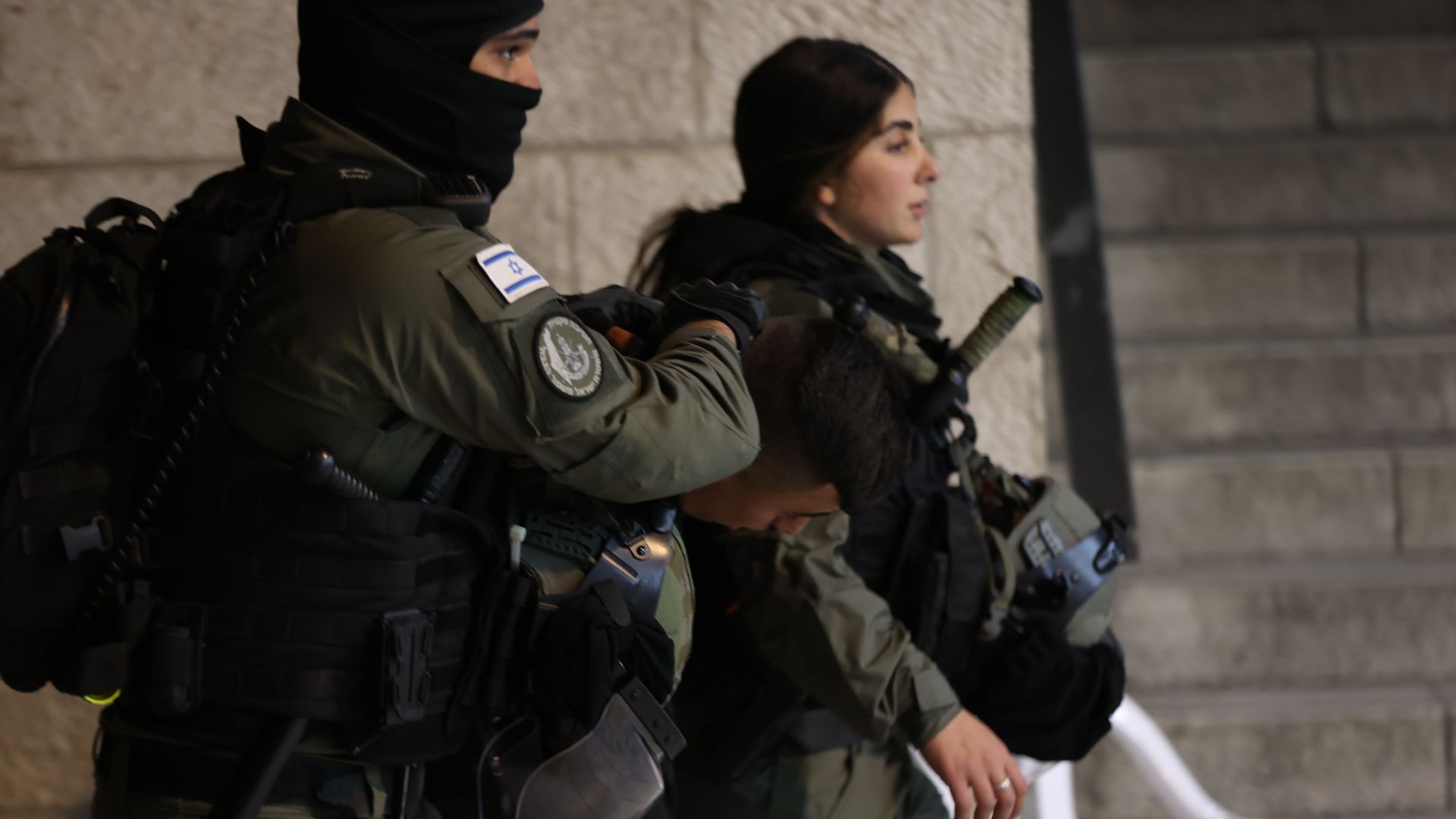
Israeli police detained some Palestinians after raiding the Al-Aqsa Mosque complex in East Jerusalem on April 5. Photo: Mostafa Alkharouf/Anadolu Agency via Getty Images
Escalating tensions and violence at Jerusalem's Al-Aqsa Mosque compound over the last few weeks have exacerbated the already strained relations between Jordan and Israel, two U.S. and two Israeli officials said.
Why it matters: Jordan’s King Abdullah II is the custodian of the Muslim holy sites in Jerusalem. Because of Jordan's huge Palestinian population, any tensions in Jerusalem, and specifically at the Al-Aqsa Mosque, immediately become a domestic political issue.
- The Al-Aqsa Mosque compound, also known as Haram al-Sharif, is the third holiest site for Muslims. It is also the holiest site for Jews who call it the Temple Mount. This reality has long made it one of the most sensitive and explosive areas in the Middle East.
Driving the news: Israel, Jordan, the U.S. and other key players in the region ramped up their efforts to de-escalate tensions ahead of the holy month of Ramadan, which also coincided with Passover.
- The first two weeks of Ramadan were largely calm, but the situation escalated last week when Israeli police raided the compound to remove Palestinians who had barricaded themselves inside the Al-Aqsa Mosque.
- Jordan harshly condemned the raid and blamed Israel for the escalation. Since then, the Jordanian Foreign Ministry has issued at least 11 statements and tweets condemning and criticizing Israel's policy regarding the holy site.
The big picture: Tensions continued to escalate as the Jordanian and Israeli governments exchanged statements blaming each other for being responsible for the escalation.
- Jordanian Foreign Minister Ayman Safadi on Thursday accused Israel of unprovoked aggression against peaceful Palestinian worshippers. "Israel is pushing us into the abyss of violence and undermines the peace treaty with Jordan," he told CNN.
- The Israeli Foreign Ministry fired back, claiming the Jordanian Waqf, which administers the mosque, didn’t take steps to stop violence by Palestinian worshipers.
Israeli officials specifically pointed to Safadi's recent comments as stoking tensions.
- They told me that meetings between Safadi and several Israeli officials before Ramadan went well. But they accused him of taking an extreme line when tensions began to escalate.
- “Safadi acted as if he was Jordan’s Ben-Gvir," one Israeli official said, referring to the far-right Israeli national security minister who has previously stoked tensions, including in Jerusalem.
- Senior U.S. officials said Safadi was livid and saw the Israeli police raid on the mosque as a provocation by the Israeli government.
Behind the scenes: The Israeli government asked the U.S. and the United Arab Emirates to ask the Jordanian government and Safadi, in particular, to calm down the rhetoric and work to de-escalate the situation, Israeli and U.S. officials said.
- Jordanian and U.S. officials said Safadi asked the Biden administration and the Emiratis to say the same to the Israelis.
- The Jordanians at a certain point refused to receive the messages they were given by the U.S. and the UAE, claiming Israel was lying about what was happening at the mosque and stressing they are only willing to hear from Israel directly that it is committing to stop its violations of the status quo at the compound.
- The Biden administration and the Israeli government were concerned that the tensions with Jordan would create a flare-up on Sunday, but both Jewish and Muslim prayers ended calmly with the Israeli police not raiding the mosque and Palestinian worshipers not using violence.
- “The Israelis told the U.S. afterward that things didn’t explode because the Biden administration pressed Jordan and the Waqf, and the Jordanians told the U.S. things didn’t explode because the Biden administration pressed Israel," a source with direct knowledge of the situation said.
State of play: Israeli officials say that in recent days Safadi has refused to talk to Israeli government representatives and that tensions with the Jordanians are still high.
2. Scoop: U.S. urged Israelis not to overreact to Pentagon leak
Photo: Andrew Harrer/Bloomberg via Getty Images
The Biden administration tried to reassure Israeli officials in recent days that Washington is committed to its security relationship with Israel, two Israeli officials said. Tensions flared after leaked details from purported secret Pentagon documents appeared to suggest that the U.S. had spied on Israel and its other allies.
Why it matters: The leak, which also included sensitive details from U.S.-Israeli consultations, could have major implications for the vast intelligence sharing between Israel and the U.S., especially if Israeli secrets are at risk of being shared due to any kind of security breach.
- U.S. officials have acknowledged that at least some of the documents appear to be authentic intelligence assessments put together by the Pentagon, but officials have also cautioned that some of the information in documents also appears to “have been doctored.” The Justice Department has opened an investigation into the leak.
- The White House declined to comment for this story. The State Department and the Pentagon didn’t respond to Axios' requests for comment.
Driving the news: One of the leaked top-secret documents contained a short paragraph about Israel and alleged involvement by Mossad officials in the protests against the government’s judicial overhaul.
- The document stated that the assessment was based on signals intelligence, suggesting that U.S. intelligence agencies were allegedly spying on their Israeli counterparts.
- Axios was unable to independently verify the authenticity of the document. The Israeli Prime Minister's Office released a statement on behalf of Mossad denying any involvement by the agency in the protests.
Another top-secret document that was leaked and seen by Axios contained a U.S. intelligence analysis of Israeli policy regarding military aid to Ukraine and stressed that U.S. pressure could drive Israel to deliver more military assistance to Kyiv.
- The document, which was first reported by the New York Times, contained sensitive details from U.S.-Israeli consultations on the airstrike campaign against Iran in Syria and Israel's concerns about Russian-Iranian military cooperation.
- Axios was not able to verify the document independently.
Behind the scenes: U.S. officials have reached out via several channels to assure their Israeli counterparts that it's investigating the leak, the two Israeli officials told Axios. One of the Israeli officials said that Pentagon officials urged their counterparts in the Israeli Defense Ministry to not overreact.
- State Department officials also spoke in recent days with their Israeli counterparts to reassure them and said the Biden administration is investigating the leak, the second Israeli official said.
What’s next: Eyal Zamir, the director general of the Israeli Defense Ministry, will visit Washington on Thursday and is expected to discuss the issue with his Pentagon counterparts, Israeli officials said.
3. Hope for Yemen truce as Iran-Saudi normalization progresses
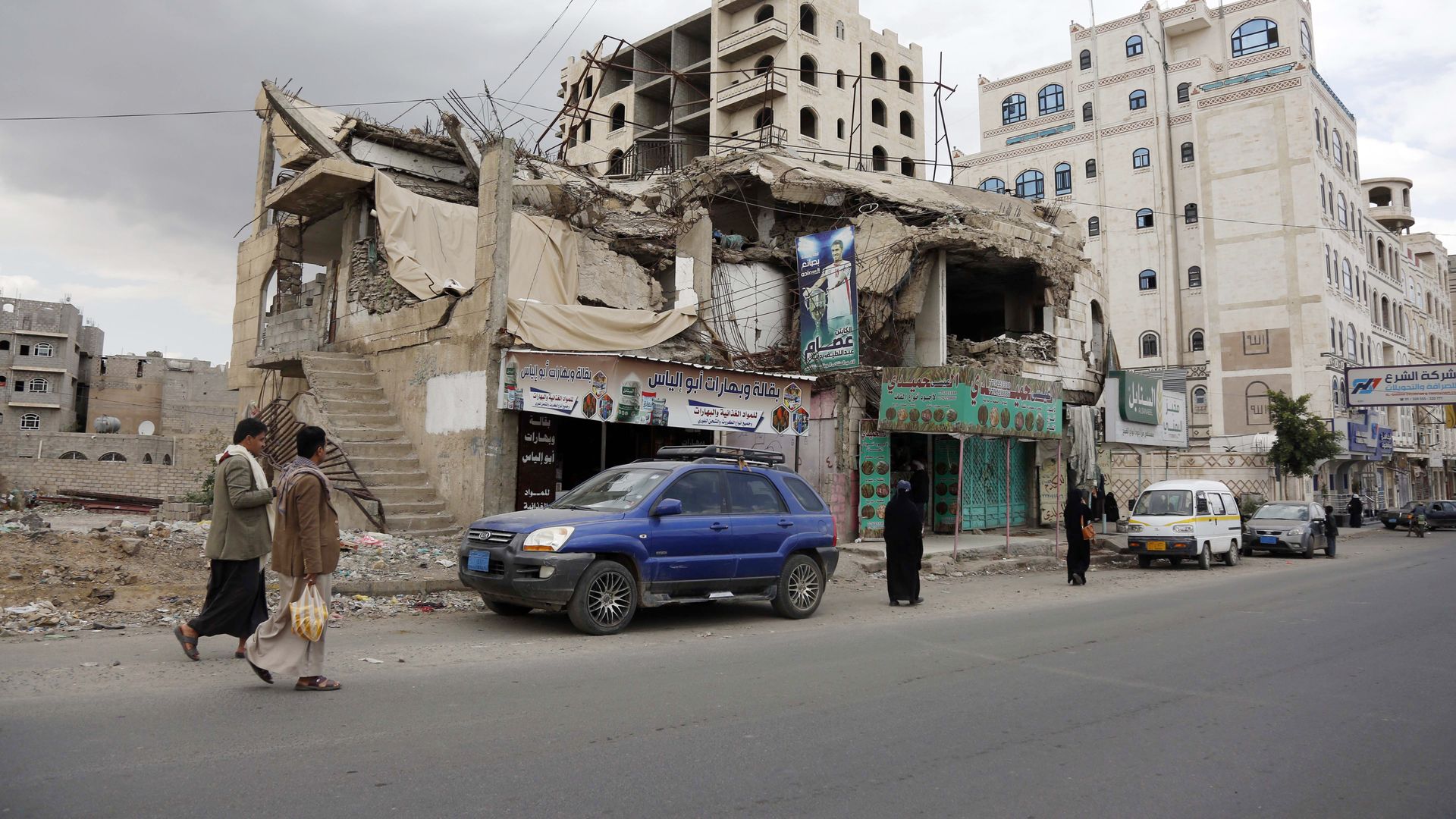
People walk in Sana'a, Yemen, near a building destroyed in past aerial strikes on March 28. Photo: Mohammed Hamoud/Getty Images
There's growing optimism that the Iranian-backed Houthi rebels and the Saudi-backed Yemeni government are inching closer to a truce and establishing a road map to end the yearslong war.
The big picture: The progress in the peace talks in Yemen comes as part of a broader wave of normalization after Iran and Saudi Arabia agreed to reestablish full diplomatic relations easier this year.
Driving the news: Tim Lenderking, the U.S. special envoy for Yemen, traveled to the Gulf yesterday to join the efforts being made by the UN and other parties to reach an agreement to extend the cease-fire and expand the peace process in the war-torn country, the State Department said.
- The UN, the U.S. and the Omani government have been working for a year on the peace talks between the warring parties and their backers in Yemen.
- Earlier this week, a delegation of Omani and Saudi diplomats visited Sana'a and met with senior Houthi officials. The visit was seen as another sign of progress toward a possible deal.
- Saudi-owned newspaper Asharq al-Awsat, citing Yemeni sources, reported that the emerging deal includes extending the cease-fire by at least six months, further opening air and sea ports, and resuming the exports of oil.
- The Yemeni government and the Houthis also announced their intention to implement a prisoner swap deal through the International Red Cross on Thursday.
What they're saying: “After over a year of intensive U.S. and UN diplomatic efforts and support from regional partners like Saudi Arabia and Oman, Yemen is witnessing an unprecedented opportunity for peace," the State Department said.
4. Saudi Arabia and Iran hope to open embassies before the hajj
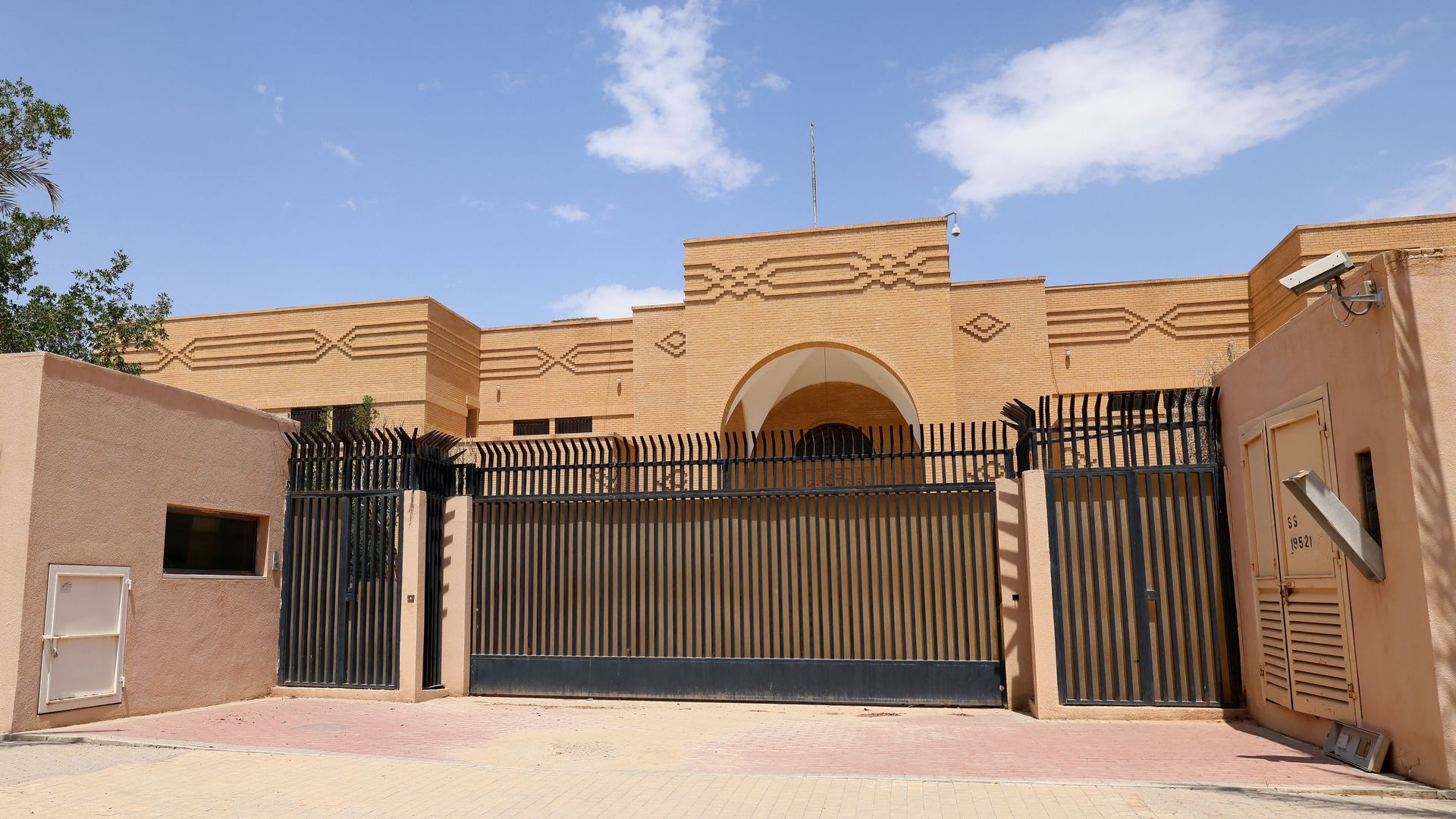
The closed Iranian Embassy in the diplomatic quarter of the Saudi capital Riyadh. Photo: Fayez Nureldine/AFP
Saudi Arabia and Iran started working this week on reopening their embassies in Tehran and Riyadh.
Why it matters: The step is a key element in the normalization process between the countries.
Driving the news: The Saudi and Iranian foreign ministers met last Thursday in Beijing — the first such meeting in seven years.
- Two days after the meeting, a Saudi delegation arrived in Iran for technical talks about reopening the kingdom’s embassy, according to the Saudi Foreign Ministry.
- The Saudi diplomats visited the embassy in Tehran and the consulate in the city of Mashhad.
- Meanwhile, a delegation of Iranian diplomats arrived in Riyadh today for similar talks about reopening the Iranian Embassy.
- Saudi Arabia and Iran on Monday announced the resumption of direct commercial flights between the countries.
State of play: Alireza Enayati, the head of the Iranian Foreign Ministry’s Gulf department, told the Iranian press that the aim is to reopen the embassy in Riyadh and the consulate in Jeddah before the beginning of the hajj pilgrimage in June.
- According to the Iranian press, Enayati, who was a member of the Iranian negotiation team with Saudi Arabia over the last two years, is a candidate for being appointed his country’s ambassador to Riyadh.
Worth noting: Syrian Foreign Minister Faisal Mekdad arrived in Riyadh today. It's the first visit by a Syrian foreign minister in more than a decade.
- The visit is another sign of the broader normalization wave taking place in the region and could eventually lead to Syria rejoining the Arab League.
5. Rockets fired from Lebanon highlight growing Hamas-Hezbollah ties
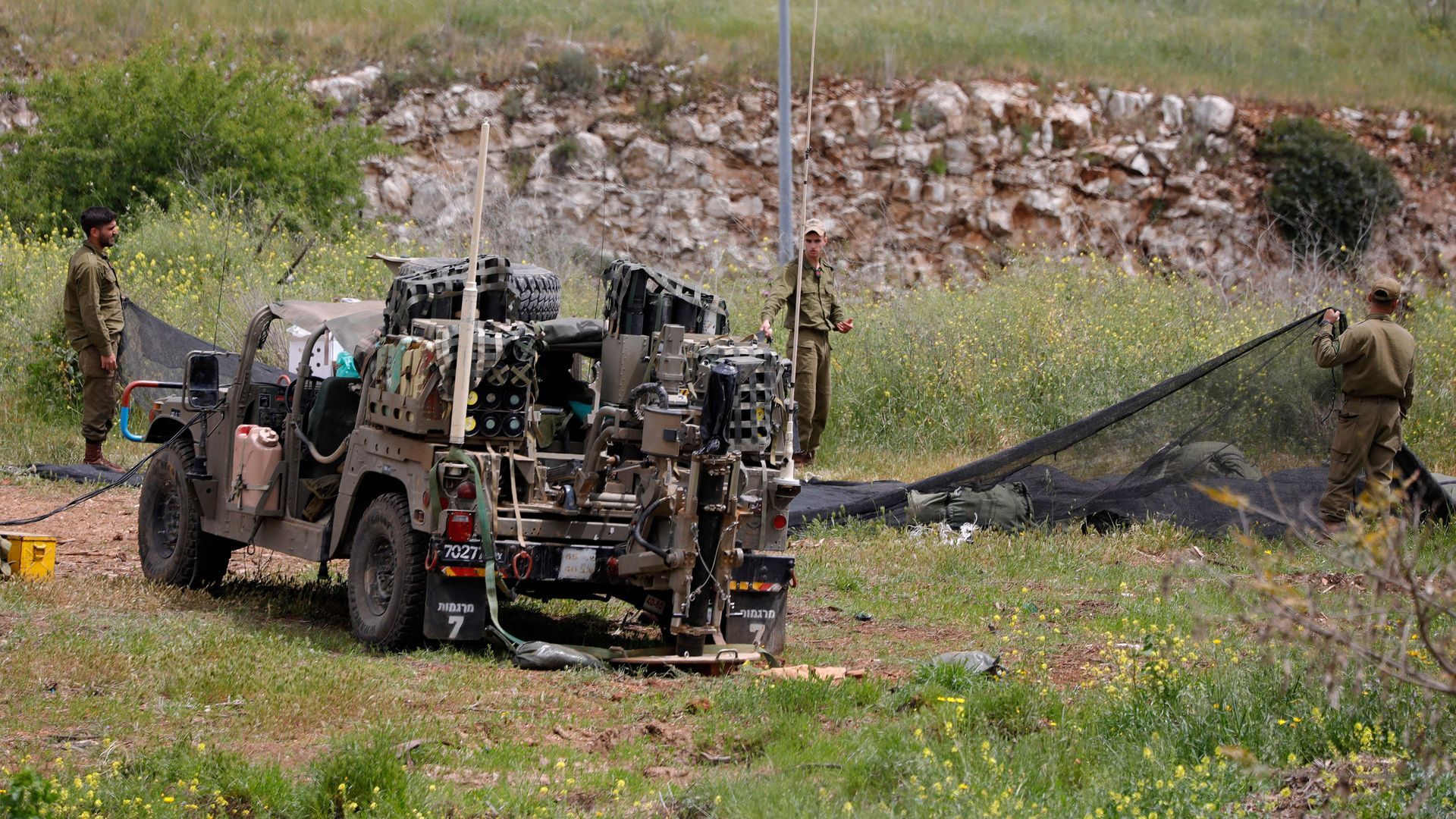
Israeli soldiers deploy in an open area near the border with Lebanon. Photo: Jalaa Marey/AFP via Getty Images
Last week’s intense exchange of rocket fire over Lebanon’s southern border with Israel left Lebanon in fear of being dragged into another war, which would be catastrophic as the country faces an unprecedented economic crisis, Hanna Davis reports for Axios from Beirut.
The big picture: The rocket attack — the worst escalation since the 2006 war — also demonstrated the increasing coordination between Lebanon’s Iran-backed Hezbollah and Palestinian armed group Hamas, experts say.
Driving the news: Israel blames Hamas for the attacks, but Hezbollah likely authorized the group to launch the rockets, Hilal Khashan, a professor of political science at the American University of Beirut, told Axios.
- Hamas has not formally claimed to have launched the rockets, but the group has praised them. For its part, Hezbollah denied being involved. In response to Israel’s attacks, Hezbollah Deputy Secretary-General Naim Qassem last week said that “the entire axis of resistance remains vigilant."
- Hamas has in recent years increasingly sought to deepen its connections with the Iran-backed Hezbollah, which as one of Lebanon's most powerful political parties has ample ability to maneuver the country’s domestic and international affairs.
- Now isolated from most of the Arab world, Hamas has “reluctantly” turned to Iran for support, said Khashan.
State of play: Hezbollah’s likely involvement in the rocket fire particularly “enraged” Lebanon’s Christians, amplifying their mistrust toward the Shiite political party and reinforcing their determination to prevent the election of a pro-Hezbollah president, Khashan said.
- But Hezbollah’s allies have also condemned the recent violence in the south. The Hezbollah-allied Shiite political party, Amal, said they were not satisfied with the “playing of the security and stability of the south” and did not support the launching of rockets.
- Meanwhile, Lebanon has filed a complaint to the UN in response to Israel’s retaliatory attacks on Hamas targets, which it stated were a “flagrant violation” of the country’s sovereignty.
- Hamas leader Ismail Haniyeh on Sunday concluded his visit to Lebanon, where he met with Hezbollah leader Hassan Nasrallah and discussed “the readiness of the axis of resistance” against Israel.
The bottom line: Israel and Hezbollah want to avoid igniting a war that could explode into a regional confrontation.
- Israel deliberately avoided a wider conflict with Hezbollah by focusing its retaliation on Hamas targets.
- Hezbollah’s authorization for Hamas to launch the rockets was a mere “show of solidarity” with the Palestinian cause, Khashan said, the Lebanese militia also aiming to avoid an all-out conflict.
- “Hezbollah doesn’t want to confront Israel because they know the consequences,” Khashan warned.
Today's newsletter was copy edited by Sheryl Miller.