Axios Sneak Peek
July 16, 2023

Josh Kraushaar here. Thanks for joining Sunday Sneak Peek, our weekly look ahead at the forces shaping American politics.
- Smart Brevity™ count: 1,470 words ... 5.5 minutes.
1 big thing: House majority runs through the courts
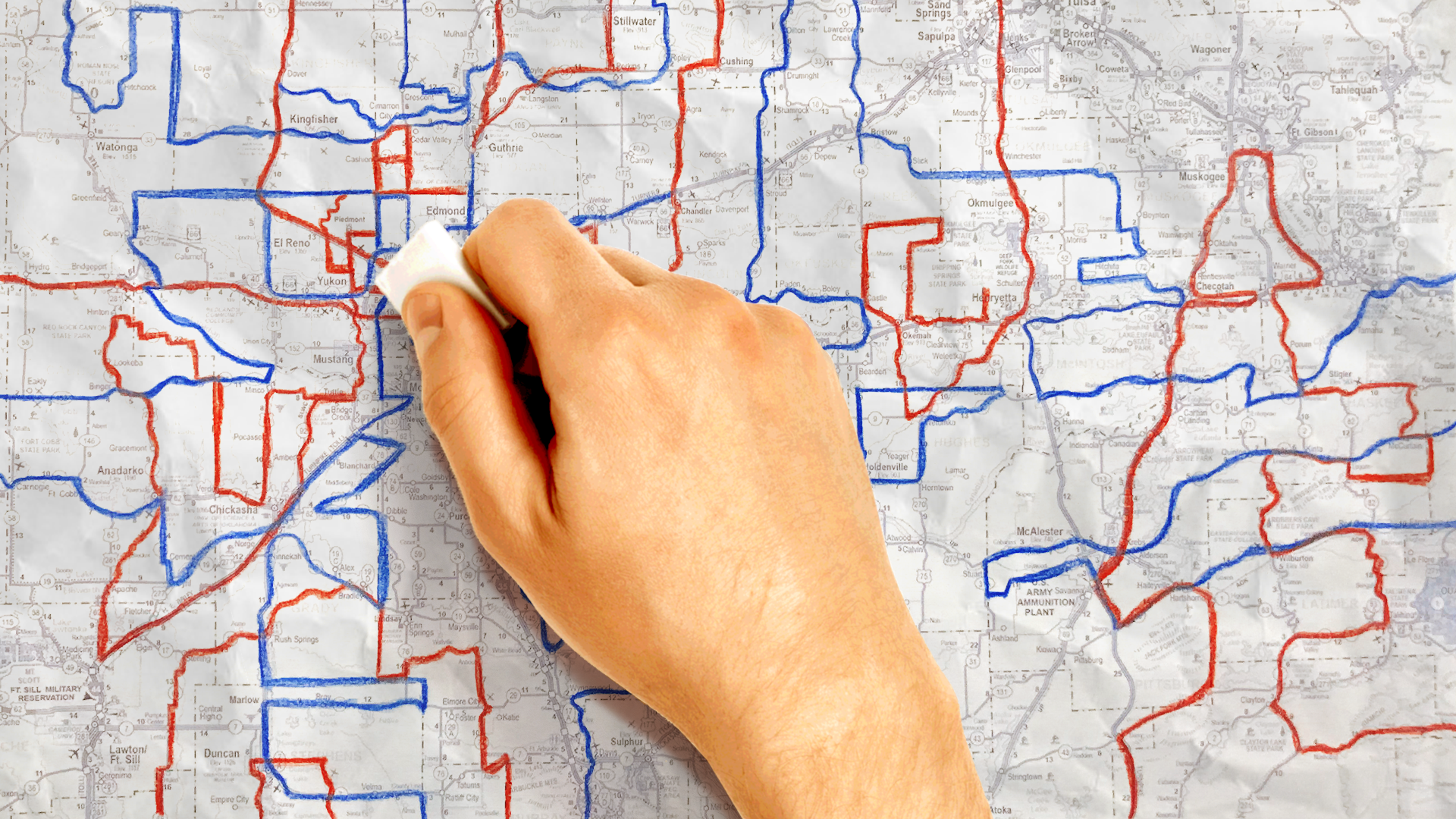
Illustration: Rebecca Zisser/Axios
The outcome of unusual off-cycle redistricting efforts in at least five states — Alabama, Louisiana, New York, North Carolina and Ohio — will play an outsized role in determining which party holds the House majority next year.
Why it matters: Typically, the battle for House control takes place on the campaign trail. In 2024, decisions in state courtrooms will also help determine which party wins control of the lower chamber.
Zoom in: Congressional maps are drawn every 10 years following the census and are intended to last a decade.
- But with courts becoming more politicized and partisans seeking every advantage they can get, there's been a flurry of activity seeking to overturn the maps that were implemented for last year's elections.
- In addition, the U.S. Supreme Court ruled last month in Allen v. Milligan that Alabama needs to redraw its congressional districts to ensure fairer racial representation. The court's decision is also expected to overturn Louisiana's map and could reverberate in several other Southern states.
Driving the news: A New York appellate court’s decision Thursday to order a redraw of the state’s congressional map — a decision that will be appealed — threatens to complicate House Speaker Kevin McCarthy's (R-Calif.) tenuous grip on his leadership role.
- Republicans can’t afford to lose more than four House seats in next year’s election. If Democrats can claw back several additional pickups in the Empire State, with an assist from a new map, it could determine the majority.
- New York's Court of Appeals, the state's highest court, will ultimately decide whether a new map will be drawn. The court overturned a gerrymandered map drawn by state Democratic lawmakers last year, but the composition of the court is now more favorable to liberals.
- Republicans in 2022 won six congressional districts in New York State that President Biden carried, and even small tweaks to the map could make competitive districts unwinnable for Republicans.
Go deeper: A favorable ruling for Democrats in New York would offset an anticipated Republican gerrymander of the North Carolina map, after the North Carolina Supreme Court overturned its recent ruling concluding that partisan gerrymandering is illegal.
- Republicans are well-positioned to net at least three House seats under a partisan redraw of the battleground state's congressional map. North Carolina's House delegation is currently split evenly between Republicans and Democrats, 7-7.
- North Carolina GOP legislators have said they plan to redraw the map later this year.
Between the lines: The big wild card in the redistricting wars is in Ohio, where the state Supreme Court will soon be determining the future of the state's newly drawn map.
- Ohio's current map was declared illegal by the state Supreme Court in 2022 but was used last year because there wasn't enough time to draw an alternative.
- Democrats performed well under the new map, winning all three of the state's contested battleground districts. But Republicans still hold 10 of the 15 House seats in the GOP-leaning state.
- Ohio Republicans may prefer to keep the political status quo to avoid a more aggressively gerrymandered map from being overturned.
The bottom line: Gerrymandering has always been part of the political process.
- But the fact that both parties are aggressively trying to gain every possible advantage to dominate in states they control ensures there will be fewer competitive races for control of the House.
2. 📺 Spot of the week: Club starts anti-Trump blitz
Screenshot: Win It Back PAC ad
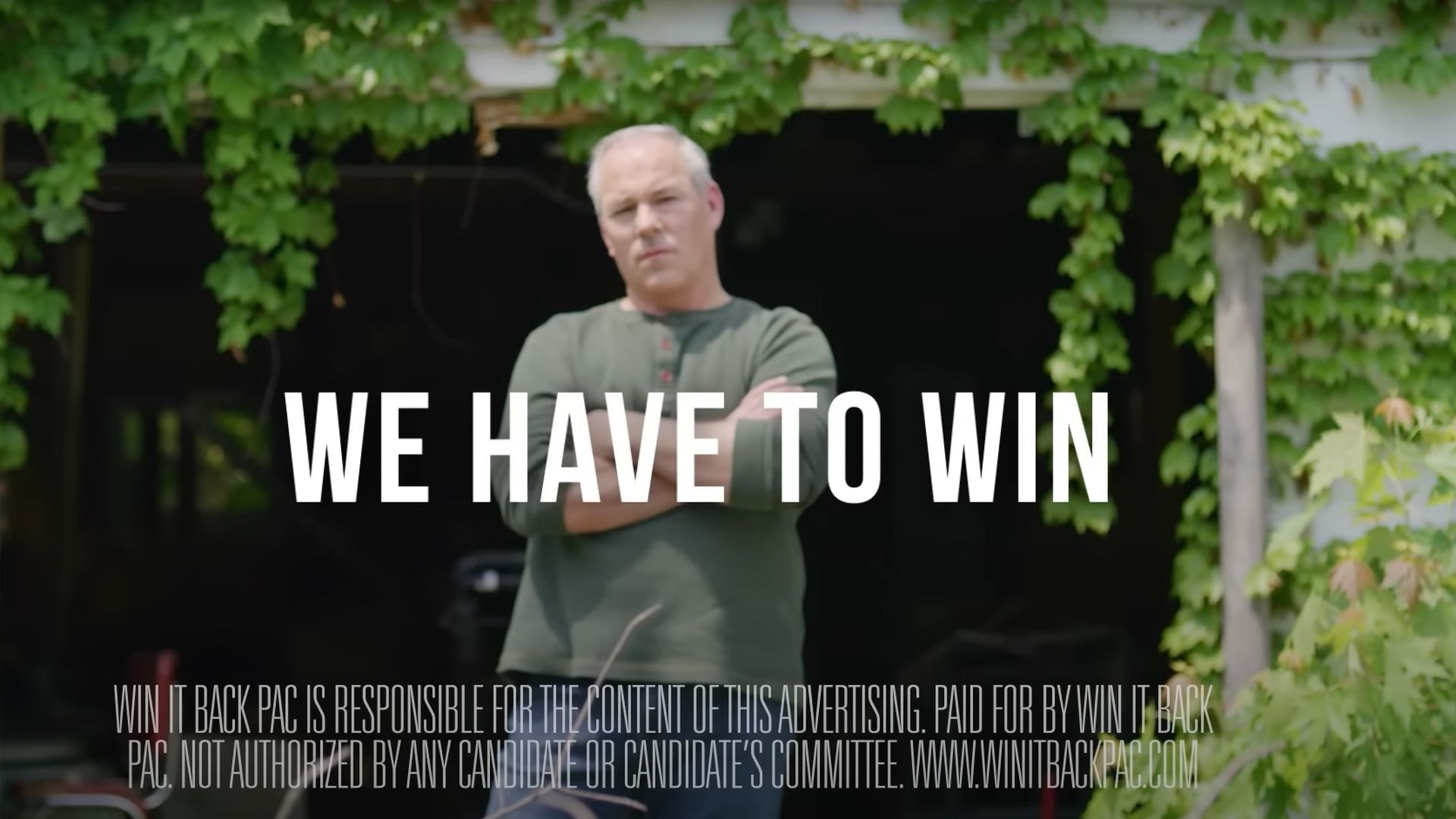
A group affiliated with the anti-tax Club for Growth this week launched a sustained ad blitz against former President Trump, featuring a supporter concerned the GOP front-runner is unelectable in 2024.
Why it matters: The ad is a textbook example of how tricky it is to convince Trump-friendly Republicans to consider voting for an alternative in next year's primary.
- The ad tries to play up the chaos surrounding Trump's presidency along with concerns about his electability against Biden.
- The ads by the Win It Back PAC cost about $3.6 million and are airing on television in the critical early states of Iowa and South Carolina.
Go deeper: "We definitely need someone that can freakin' win," a man sitting at his home says in the spot. "I think you'd probably lose that bet if you voted for Trump."
- The man references the "non-stop drama" surrounding Trump and the rifts it has created within his own family. "He's got so many distractions, the constant fighting, something every day. I'm not sure if he can focus on moving the country forward."
Between the lines: The conservative Club for Growth, a onetime Trump ally, has emerged as one of the best-funded outside groups looking to stymie his political comeback.
- The group hasn't endorsed a favored candidate but has been focused on preventing Trump from winning the nomination.
3. 📉 Poll of the week: GOP's trust deficit

Illustration: Sarah Grillo/Axios
There's a huge partisan split over voter confidence in the legitimacy of next year's elections, according to a new AP/NORC Center for Public Affairs Research survey.
- Very few Republicans (22%) have high confidence that votes in the upcoming presidential election will be counted accurately. By contrast, 71% of Democrats are confident in the election process.
Why it matters: Trump's vocal denunciation against the electoral process has now been embraced by the Republican grassroots.
- If Trump is the GOP nominee again in 2024, he'll have even more support from within his party for contesting election results.
Between the lines: It's not just Republicans that have grown skeptical toward the integrity of the election process. Only 24% of independents said they had a "great deal" of confidence that votes will be counted fairly.
- Polling shows independent voters are often paying the least attention to politics and have lost the most trust in traditional institutions.
Zoom in: There's a gaping educational divide that drives perception over the fairness of elections. The poll found 60% of college-educated voters had a "great deal" of confidence in the election system, but only 35% of voters without a college degree said the same.
Go deeper: The biggest partisan divide over election rules is whether voters should have the ability to vote early by mail, without having any excuse. Only 24% of Republicans support no-excuse early voting, while 71% of Democrats favor the practice.
- GOP voters' resistance to voting early has become a systemic vulnerability for the party. Democrats aggressively try to bank as many votes as possible before Election Day to ensure high turnout among their base.
- Requiring a photo ID to vote — a provision Democrats have aggressively fought — is widely popular among voters in both parties. A whopping 87% of Republicans and 60% of Democrats support voter ID requirements.
4. 📖 Reads of the week: Uphill climb

Illustration: Brendan Lynch/Axios
1. "Hill Harper, 'Good Doctor' Actor, Enters Senate Race in Michigan" (New York Times)
Why it matters: Rep. Elissa Slotkin (D-Mich.), seen as the odds-on favorite to succeed Sen. Debbie Stabenow (D-Mich.), is now facing a celebrity opponent running to her left in the Democratic primary.
- Slotkin has been one of the most battle-tested Democratic lawmakers in Congress, winning three straight elections in a swing district in which Trump is popular. She also is one of the Democrats' top fundraisers, already raising an impressive $5.8 million for her Senate bid.
- But Black candidates have fared well with Democratic voters in recent elections: Mandela Barnes (Wisconsin), Cheri Beasley (North Carolina) and Val Demings (Florida) all pushed aside primary opposition in battleground-state primaries in 2022. (All three lost to Republicans in competitive general elections.)
2. "Abortion and Ukraine votes plunge defense bill into peril" (Axios)
Why it matters: Votes on amendments to restrict Ukraine aid proposed by right-wing Republicans Matt Gaetz and Marjorie Taylor Greene soundly failed but also exposed the rift within the GOP caucus over Ukraine.
- 70 House Republicans voted to prohibit all Ukraine security aid, while 89 voted in favor of cutting $300 million in Ukraine funding. It's a minority faction of isolationists, but one whose influence has grown in the last few years.
3. "GOP Senate campaign chair Steve Daines plans to focus on getting 'quality' candidates for 2024 primaries" (CBS News)
Why it matters: National Republican Senatorial Committee chair Steve Daines told CBS News' Major Garrett that he’s had "honest" and "productive" conversations with Rep. Matt Rosendale (R-Mont.) about the Montana Senate race.
- It's a sign that the GOP leader is having success in clearing the GOP field for business and military veteran Tim Sheehy, his favored candidate for the race against Sen. Jon Tester (D-Mont.)
- If Rosendale stays out, it will mark a significant behind-the-scenes victory for Daines, who has focused on preventing weak candidates from emerging in key Senate races.
- Daines helped secure endorsements for Sheehy among Trump-friendly senators in an attempt to dissuade Rosendale from running.
📬 Thanks for starting your week with us. This newsletter was copy edited by Kathie Bozanich.
Sign up for Axios Sneak Peek

Take a look at both ends of Penn Ave — and our best scoops