Axios Sneak Peek

May 28, 2023

Josh Kraushaar here. Thanks for joining Sunday Sneak Peek, our weekly look ahead at the forces shaping American politics.
- Smart Brevity™ count: 1,512 words ... 5.5 minutes.
1 big thing: Sunday spin zone
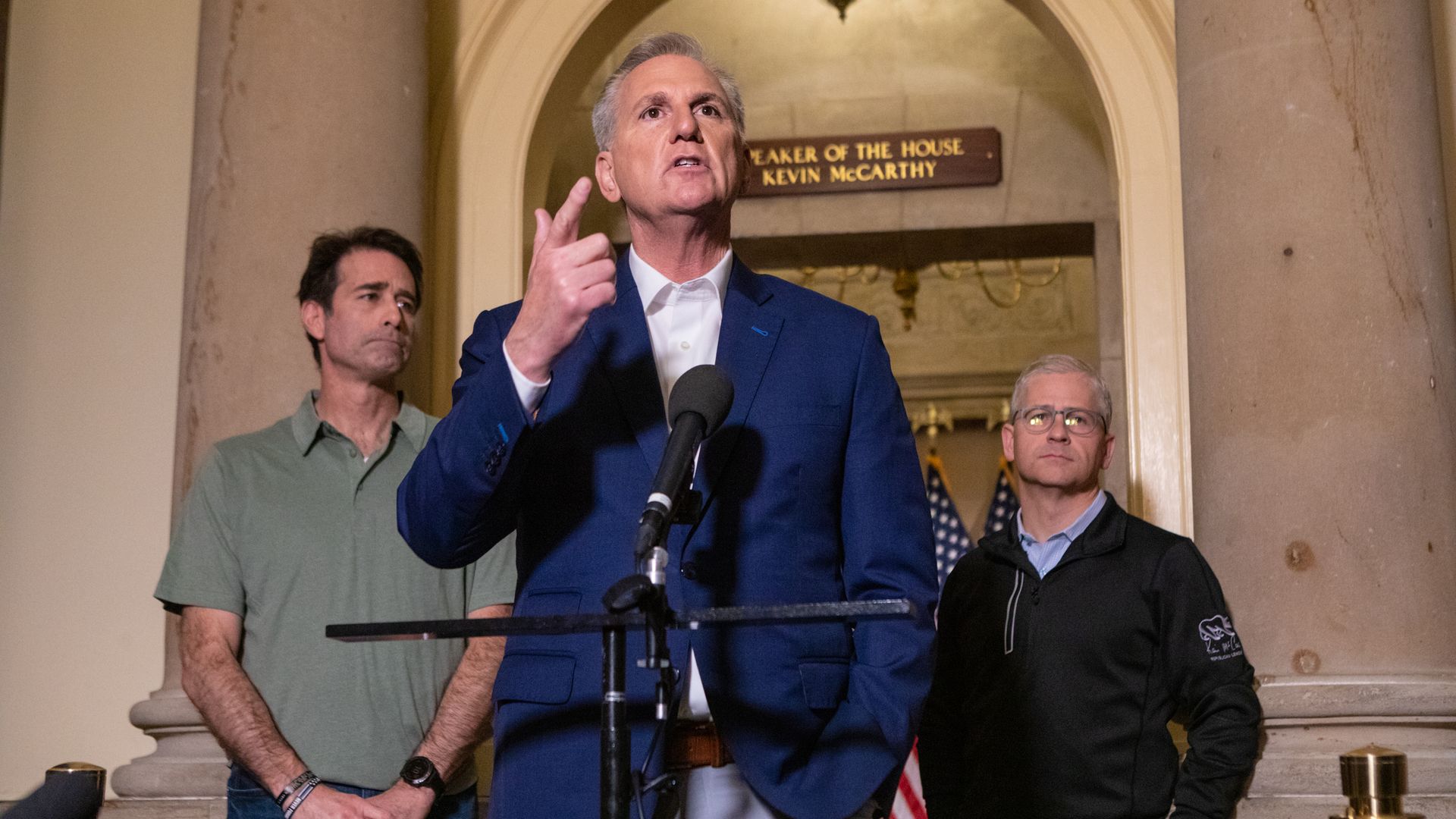
McCarthy with two of his deputies, Reps. Garret Graves, left, and Patrick McHenry. Photo: Anna Rose Layden/Getty Images
The White House and House GOP are each performing careful balancing acts as they race to sell their debt ceiling deal to lawmakers as a decisive victory — without alienating the other side, Axios' Andrew Solender reports.
Why it matters: The bill will almost certainly require substantial support from members in both parties to pass and avert a potentially catastrophic default on U.S. debt by June 5.
- The deal announced last night marked a huge breakthrough after months of brinkmanship — but party leaders still have to sell the bill to skeptical members and the public.
- "Everyone's trying to thread the needle to get to 218," said one House Democrat. "Either side bragging too much about their wins scares people and costs votes."
Driving the news: After telling his members on a Saturday night conference call that he made zero concessions to Democrats, House Speaker Kevin McCarthy (R-Calif.) doubled down in a "Fox News Sunday" interview.
- "Right now, the Democrats are very upset," McCarthy said. House Democratic leader "Hakeem [Jeffries] told me, there's nothing in the bill for them. There’s not one thing in the bill for Democrats."
- That was news to Jeffries, who said in a CBS News "Face the Nation" interview: "I have no idea what he's talking about, particularly because I have not been able to review the actual legislative text."
By the time he briefed the press at the Capitol later today, McCarthy was singing a very different tune.
- "It is not everything everybody wanted, but I think it is a very positive bill," he told reporters.
- Asked whether he could get Democratic votes for a bill he cast as a total GOP victory, McCarthy said: "We raised the debt ceiling, we negotiated in good faith with the president. ... There's a lot in here for both sides."
Zoom in: The two parties might as well be in other worlds when it comes to characterizing details of the deal.
- The GOP's one-pager on the bill, for example, says it caps 2024 non-defense spending at 2022 levels, but White House briefing materials say the deal keeps spending "roughly flat" with 2023 levels.
- Even where there's agreement, the spin can be vertigo-inducing: The GOP boasts that the deal "restart[s] student loan repayments," but the White House contextualizes that it simply "codifies an end to the pause — which the administration had planned to end on September 1."
The other side: Democrats have taken a more behind-the-scenes approach than McCarthy. The White House called congressional allies individually and sent briefing materials on Saturday night, but is waiting until 5 pm ET today to hold a virtual briefing.
- Rep. Jared Moskowitz (D-Fla.) characterized the fact that the bill raises the debt ceiling into 2025 as a "huge win" for Biden, but conceded McCarthy has "worked the public relations of this, in my opinion, to great effect."
- "Both sides are obviously going to sell it as a win for them," said Moskowitz. "That's how this works."
2. 💣 Senate GOP's land mine removal
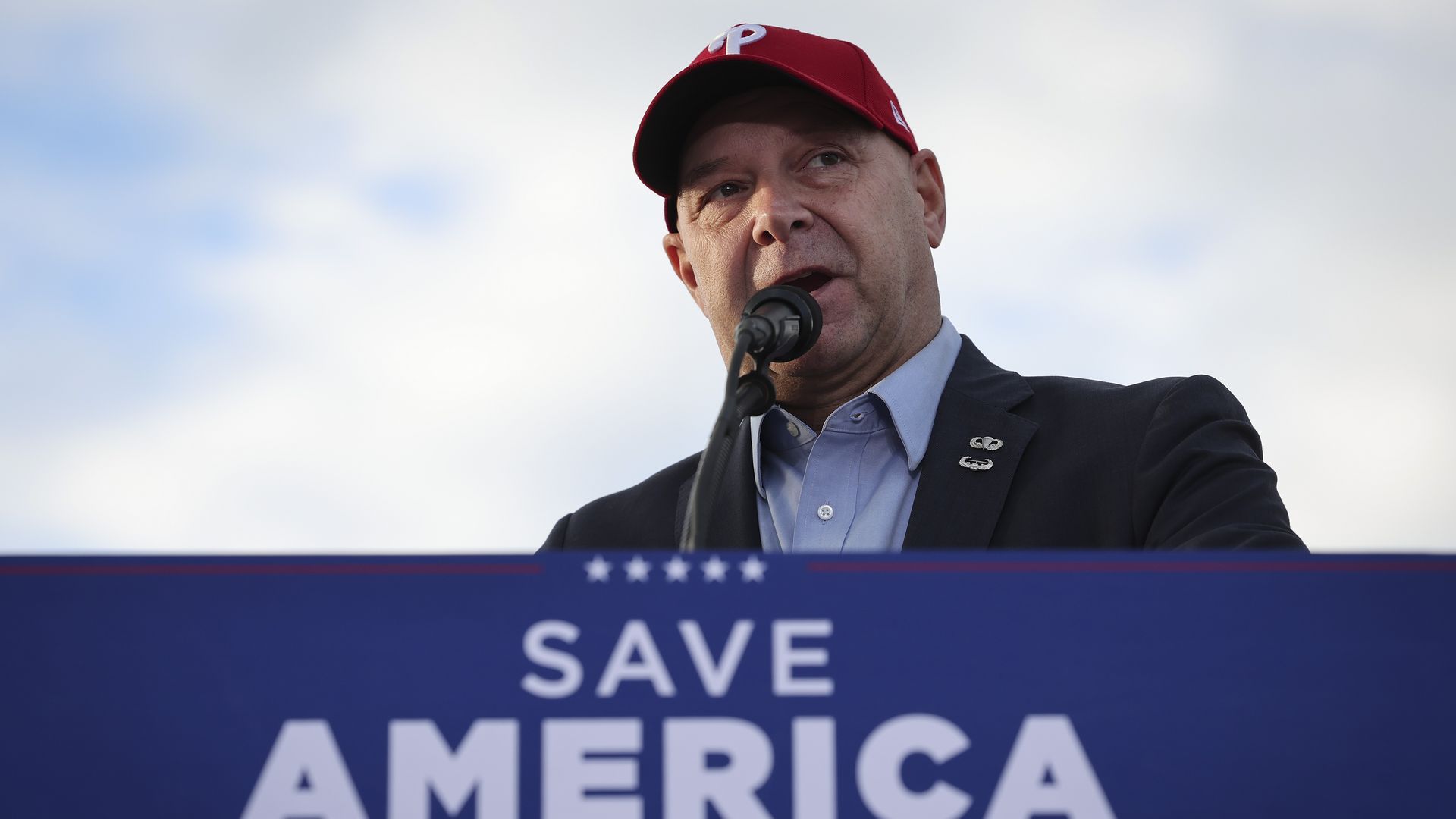
Doug Mastriano at a rally with Trump last November. Photo: Win McNamee/Getty Images
Senate Republicans received a jolt of good news this week after right-wing Pennsylvania state Sen. Doug Mastriano, who badly lost the state governor's race in 2022, decided not to run for Senate against Sen. Bob Casey (D-Pa.).
Why it matters: Mastriano's passing on the Senate run will vault Pennsylvania's Senate race up the ranks of top GOP pickup opportunities. Mastriano's gubernatorial campaign, which he lost by 15 points, was a drag on every Pennsylvania Republican running last year.
- Dave McCormick, a former hedge fund CEO and military veteran, is now likely to run for the seat, with an announcement likely later in the summer.
- If McCormick runs, it would be the GOP's first purple-state recruiting success — which has been a significant challenge, given former President Trump's staying power in national politics.
Between the lines: Sen. Steve Daines (R-Mont.) has played a much more active role in recruiting and dissuading candidates than Sen. Rick Scott (R-Fla.), his predecessor as chair of the National Republican Senatorial Committee.
By the numbers: If McCormick is the GOP nominee, he'd start out as an underdog against Casey.
- A Susquehanna Polling and Research survey released this month found Casey leading McCormick by 12 points (53%-41%).
- A March Franklin and Marshall poll found Casey's lead over McCormick at 7 points (42-35%), with only middling favorability ratings.
The big picture: The GOP's improving fortunes in Pennsylvania is another example of how behind-the-scenes recruitment (and in this case, relying on allies to persuade a weak candidate not to run) is paying off for the party during Daines' leadership of the NRSC.
- Daines persuaded popular West Virginia Gov. Jim Justice to run for Senate against Sen. Joe Manchin (D-W.Va.), though Justice faces a contested primary against Rep. Alex Mooney (R-W.Va.). Manchin hasn't yet committed to running for a third term.
- Daines personally encouraged businessman and military veteran Tim Sheehy to run against Sen. Jon Tester (D-Mont.). As a former Navy SEAL and Purple Heart recipient, Sheehy has a tailor-made political profile (on paper). He is also capable of self-funding the contest.
3. 🌽 Poll of the week: Iowa's field of broken dreams

Illustration: Sarah Grillo/Axios
A new Emerson College poll finds Trump holds a commanding advantage among Republicans in Iowa, home to the pivotal first-in-the-nation GOP caucuses.
- Trump leads Florida Gov. Ron DeSantis by a whopping 42 points (62%-20%) in Iowa, according to the survey. Former South Carolina Gov. Nikki Haley and former Vice President Mike Pence lag far behind at 5%.
Why it matters: For all the attention paid to national polls, it's the early-state contests that matter most. But there's no sign that Trump is any more vulnerable in these early contests, where his opponents have spent much time campaigning but have struggled to build momentum.
Driving the news: DeSantis is making his first in-person campaign appearance as a presidential candidate in Des Moines, Iowa, on May 30. The next day, he is scheduled to make four additional appearances across the state.
Reality check: One Iowa-based Republican strategist said the Emerson numbers were somewhat more favorable than the private polling he's seen. But even in more favorable internal polls for DeSantis, Trump still holds a healthy double-digit lead.
By the numbers: Trump's core of support within the GOP are voters without a college degree, 70% of whom back the former president. In Iowa, blue-collar voters make up a clear majority of the GOP electorate.
- Trump and DeSantis lead Biden comfortably in the GOP-friendly state. But Trump holds a slightly bigger advantage in a general election, leading Biden by 11 while DeSantis leads Biden by 7.
4. 📺 Spot of the week: Scott's patriotic push
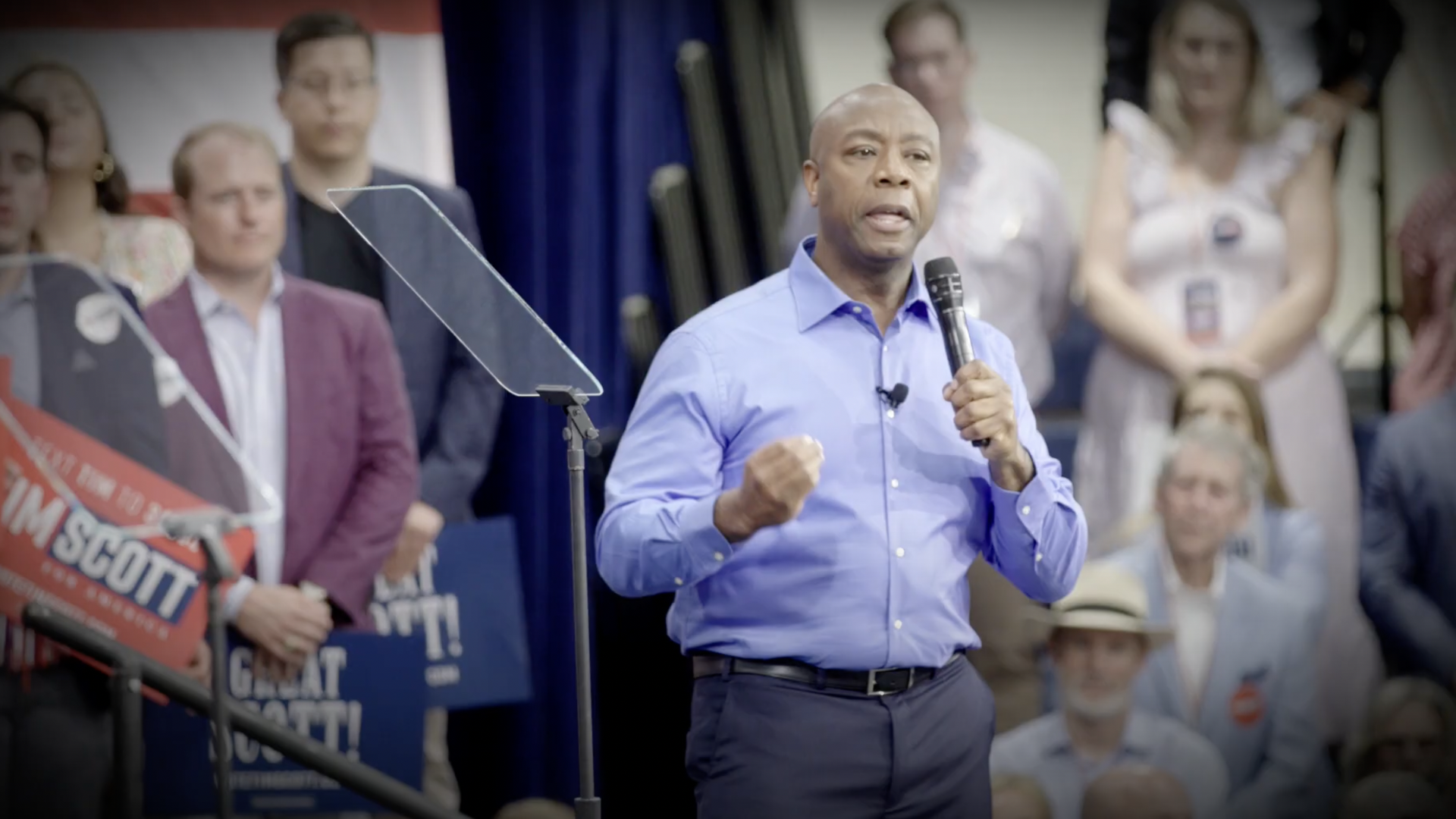
Screenshot: Tim Scott for America
Sen. Tim Scott (R-S.C.), fresh off his presidential kickoff, aired his second campaign ad tying his own inspirational story from poverty to Congress as proof of American exceptionalism.
Driving the news: The ad began airing Friday in Iowa. Scott's campaign is expected to focus aggressively on the first-in-the nation caucus state, given that his faith-based message is seen as a logical fit for the state's sizable evangelical Christian voting bloc.
Details: The new ad entirely features snippets from his well-received kickoff speech. "I will be the president who destroys the liberal lie that America is an evil country. That's why I'm the candidate the far left fears the most," Scott sayys.
- "I disrupt their narrative. I threaten their control. The truth of my life, disproves their lies."
The bottom line: Of all the challengers to Trump, Scott has the most upside potential.
- This week's CNN/SSRS poll asked GOP voters to pick three candidates they weren't supporting but wanted to learn more about. Scott led the list with 29% of voters naming him, narrowly ahead of DeSantis (28%) and Haley (24%).
5. 📖 Reads of the week: The unofficial kickoff to 2024

Illustration: Brendan Lynch/Axios
1. "Are the anti-Trump GOP forces starting to implode?" (Politico)
Why it matters: Trump continues to hold onto a commanding lead in the latest polls, while the Trump-skeptical opposition continues to splinter.
- DeSantis, the challenger most capable (on paper) of building a coalition between the MAGA and traditional GOP forces, botched his campaign launch with a glitch-filled announcement on Twitter Spaces.
- Haley's move sharply criticizing DeSantis this week, while pulling her punches against Trump, is another illustration of how the non-Trump forces are poised to divide up those voters looking for a new face of the GOP for 2024.
2. "Democrats vying to replace Feinstein embrace party’s shift to the left" (Washington Post)
Why it matters: The fact that Rep. Adam Schiff (D-Calif.) is racing to prove his progressive bona fides is a sign of how far to the left California's Democratic electorate has drifted.
- Schiff, with his anti-Trump credentials, deep campaign war chest and support from former Speaker Nancy Pelosi, is the front-runner on paper.
- But a new Los Angeles Times poll shows a close contest among Schiff, Rep. Katie Porter and Rep. Barbara Lee — with Porter holding an early, narrow edge over her Democratic rivals.
📅 We'll be off tomorrow for Memorial Day but back in your inboxes on Tuesday. This newsletter was copy edited by Kathie Bozanich.
Sign up for Axios Sneak Peek

Take a look at both ends of Penn Ave — and our best scoops