Axios Sneak Peek

June 05, 2022

Welcome back to Sneak. Smart Brevity™ count: 956 words ... 3.5 minutes.
1 big thing — Scoop: Jan. 6 committee's private divide

Illustration: Maura Losch/Axios
The House's Jan. 6 committee has split behind the scenes over what actions to take after this month's public hearings, Axios' Jonathan Swan and Hans Nichols have learned:
- Some members want big changes on voting rights — and even to abolish the Electoral College — while others are resisting proposals to overhaul the U.S. election system.
Why it matters: Televised hearings begin Thursday night at 8pm ET. Committee members are in lockstep about capturing Americans' attention by unfurling a mountain of evidence connecting former President Trump and those close to him with the attack on the Capitol.
- But the committee's legacy depends in large part on what reforms it pursues after those hearings — and that's where the united front breaks down.
The big picture: Disagreements arise whenever proposals are raised such as abolishing the Electoral College, vastly expanding voting rights or tightening the Insurrection Act to make it harder for a president to deploy the military domestically for use on civilians.
Behind the scenes: Nobody on the House select committee is more committed than Rep. Liz Cheney (R-Wyo.) to pursuing Trump for inciting the attack on the Capitol. But she flatly opposes some of the more sweeping election law reforms backed by several committee Democrats.
- The broadest differences are between Cheney and Rep. Jamie Raskin (D-Md.), according to three sources familiar with the committee's private discussions. The two have a warm personal relationship but fundamentally disagree on what needs to be done to reform America's election laws.
- Raskin, a former constitutional law scholar, is by far the committee's most outspoken member during its private discussions about voting rights.
- "Liz is much more conservative, as far as what kinds of changes she wants to see done," said a source with direct knowledge of their conversations.
Between the lines: Committee members know it's going to be extremely hard to get unanimous agreement on the legislative recommendations in their final report. So they've deferred those decisions to focus on preparing for the public hearings.
- "We do recognize that there are significant differences [in legislative recommendations] that we're going to have to work through because everybody has to sign the final report," a source with direct knowledge said.
- But the longer the Jan. 6 committee postpones making legislative recommendations, the less likely those recommendations are to pass — especially if Rep. Kevin McCarthy (R-Calif.) becomes House speaker next year.
2. Part II: Abolishing the Electoral College
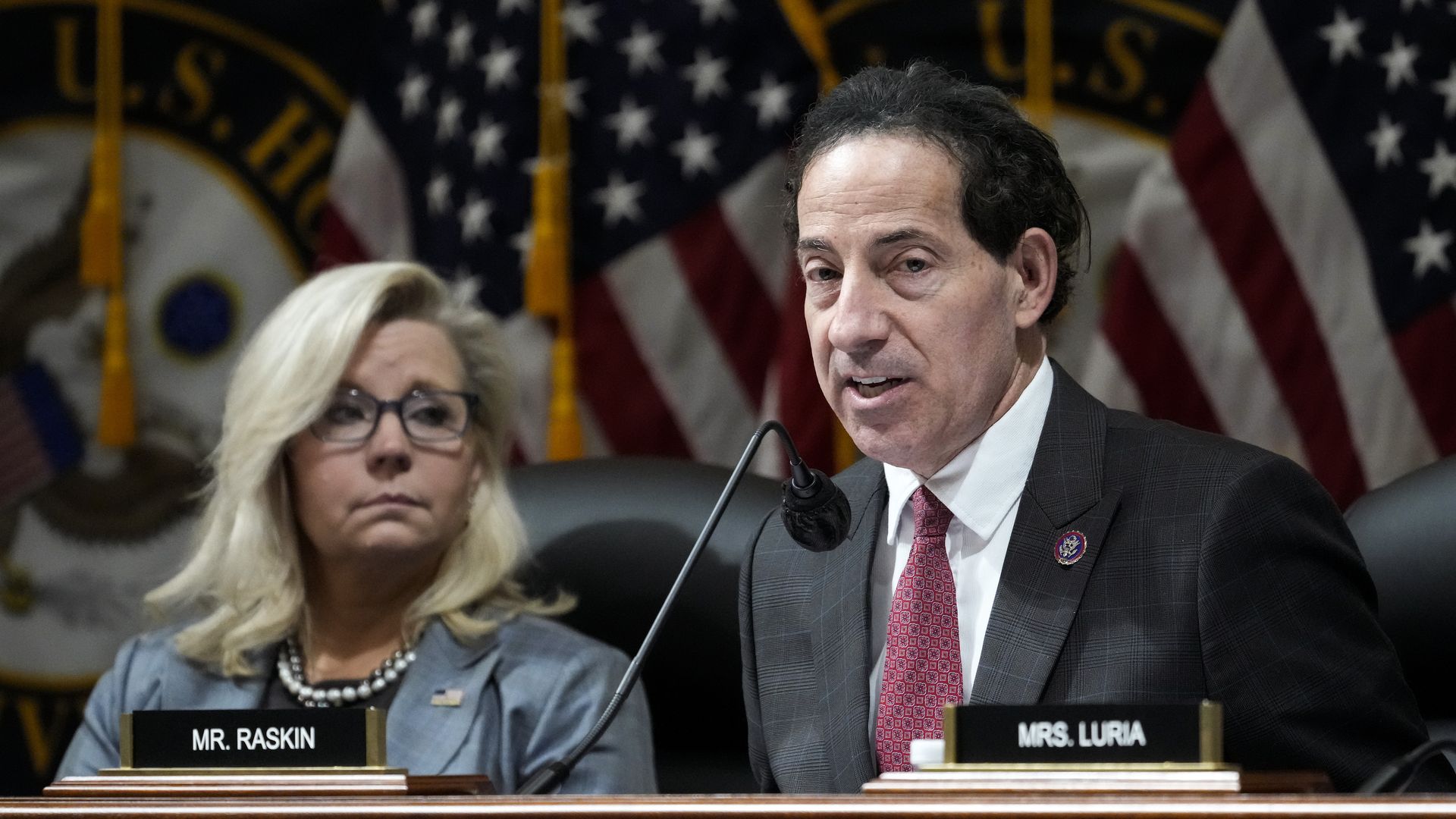
Reps. Liz Cheney (R-Wyo.) and Jamie Raskin (D-Md.) Photo: Drew Angerer/Getty Images
In multiple conversations among committee members, Raskin has argued that the Electoral College should be abolished — that if presidents were elected by a popular vote, this would protect future presidential elections against the subversion that Trump and his allies tried to pull off in 2020.
- Trump and some of his lawyers, including Rudy Giuliani, pressured Republican lawmakers in closely contested states to send alternate slates of electors to Washington.
Cheney thinks the committee will burn its credibility if it pushes for radical changes like abolishing the Electoral College, according to a source with direct knowledge.
- She has also joked to her colleagues on the committee that there's no way the single at-large representative for the tiny state of Wyoming would support abolishing the Electoral College, according to another source with direct knowledge of the internal committee deliberations.
Raskin has also pushed for the committee to endorse "federal legislation to oppose voter suppression tactics and gerrymandering," according to a source familiar with his comments to his committee colleagues.
- He has been an outspoken supporter of the Democratic Party's major voting rights bills — the For the People Act and the John Lewis Voting Rights Act.
- Other Democrats on the committee agree with Raskin on much of the substance of this legislation. All committee Democrats, for example, voted for the For the People Act in the House.
- But in internal committee conversations, Raskin's colleagues haven't been as vocal as he has in advocating for the most sweeping reforms.
Cheney is open to discussing reforms to the Electoral Count Act — the law that Trump tried to exploit to pressure former Vice President Mike Pence to illegally overturn the election — but has no interest in the Democratic Party's sweeping voting rights bills.
- Cheney has also discussed enhancing criminal penalties for "supreme dereliction of duty" and other types of activities Trump engaged in, such as pressuring state officials, according to a source with direct knowledge.
3. Sunday quotable: Pete's "definition of insanity"
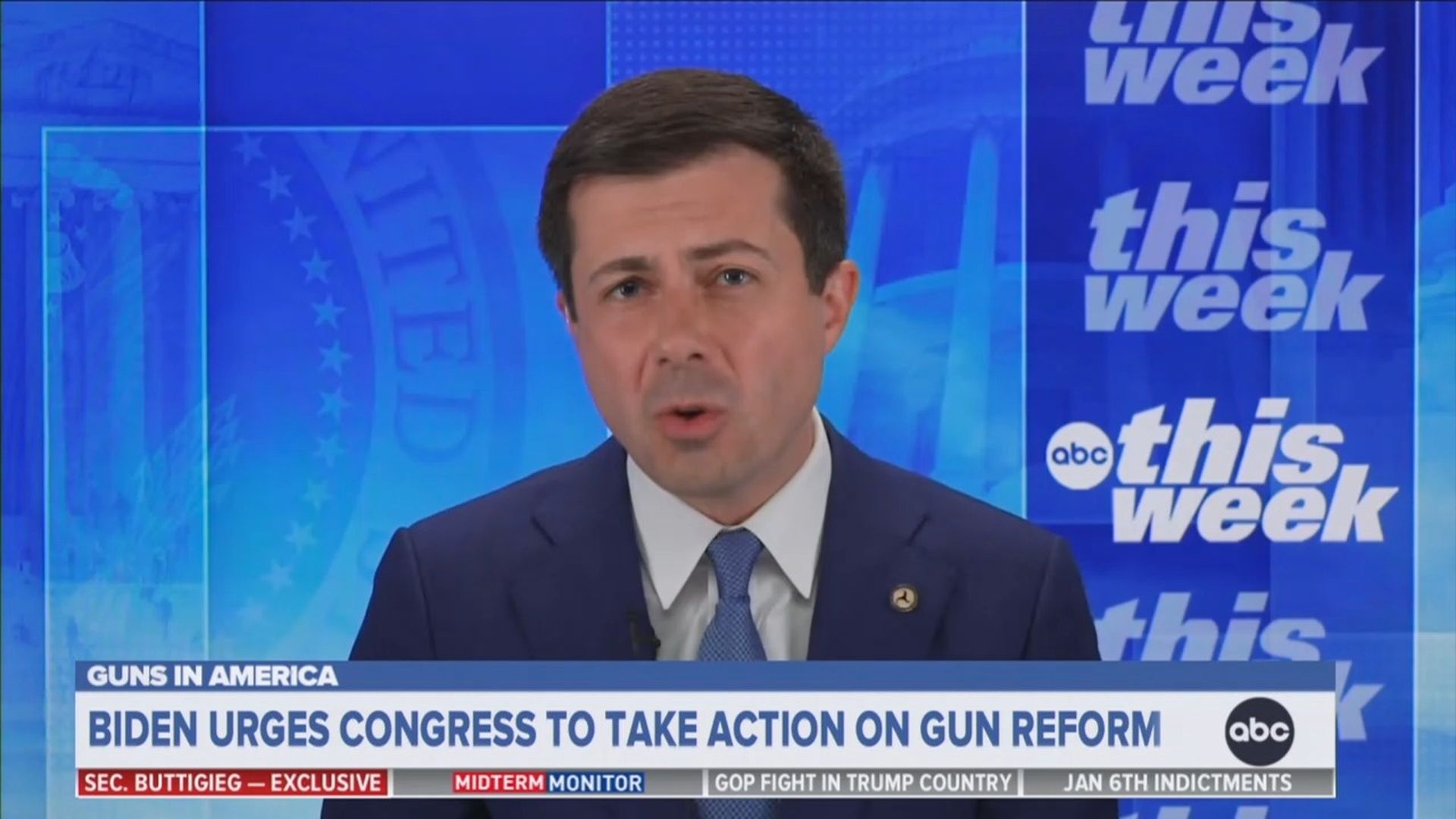
Screenshot: ABC's "This Week"
Transportation Secretary Pete Buttigieg scoffed at some Republicans' focus on hardening doorways and other school-safety measures as a response to the Uvalde, Texas, shooting, telling ABC's "This Week":
"The idea that us being the only developed country where this happens routinely, especially in terms of the mass shootings, is somehow a result of the design of the doorways on our school buildings is the definition of insanity, if not the definition of denial."
👀 Crunch time: Sen. Chris Murphy (D-Conn.), who is leading the Senate's bipartisan gun talks, told CNN's "State of the Union" the group needs to "make decisions on whether or not we have a sustainable package in the next five days."
4. ⛽ Gas prices hit record high — again

On the heels of Treasury Secretary Janet Yellen's admission that she was "wrong" about inflation, Commerce Secretary Gina Raimondo told CNN's "State of Union" that President Biden "gets up every day and goes to bed every night thinking about what can we do to get a lid on inflation."
5. 🇬🇧 Parting shot: Hologram Queen

Photo: Niklas Halle'n/AFP via Getty Images
Archival footage of Queen Elizabeth II during her 1953 coronation was projected onto the 260-year-old Gold State Coach, the centerpiece of a massive London street pageant on the final day of her Platinum Jubilee.
📬 Thanks for starting your week with us! You can send us tips or feedback by hitting reply to this newsletter or emailing us at [email protected].